
№ 004329 SEPTEMBER 2026PLACESAN JOSE, CALIFORNIA
The Winchester Mystery House
Thirty-Six Years of Building, No Reason Ever Written Down
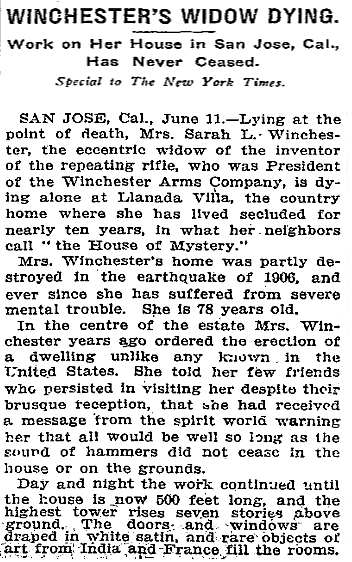
Unsolved since 1922For thirty-six years, carpenters built onto Sarah Winchester's San Jose farmhouse with no master plan — staircases that dead-end at ceilings, doors that open onto two-story drops. She never explained why. The most-repeated reason was in print while she was alive, in a wire story that got her age wrong.
What We Know
Sarah Winchester arrived outside San Jose in the mid-1880s, a widow in her mid-forties with no surviving child and roughly half the Winchester rifle fortune. She bought an unfinished eight-room farmhouse and its land, and told the carpenters to keep working. By her own account, with breaks, they did, until she died thirty-six years later.
What she left behind runs to more than 160 rooms, forty-plus staircases, and thousands of doors and windows, built without a single complete set of architectural plans; she is said to have sketched additions herself as she went, and to have had finished rooms torn out and redone when they didn’t please her. Two results are still there for any visitor to see: a staircase that climbs seven full turns and stops flush against a ceiling, and a second-floor door that opens onto an eight-foot drop to a flower bed, with no balcony behind it.
She wrote often to relatives, but almost nothing about why. In June 1898 she told her sister-in-law Jennie Bennett only that she was “constantly having to make an upheaval for some reason.” In a letter quoted in a 2016 history of the gun trade, she wrote that she had “become rather worn and tired out” and dismissed the workmen for the winter, a detail at odds with the popular claim that the hammers never once stopped.
The 1906 San Francisco earthquake wrecked a seven-story tower and the front of the house. Rather than rebuild, Winchester had the ruined floors sealed off. That’s the documented origin of at least some of the doors and stairways that now lead nowhere. She spent most of her remaining years at a house in Atherton instead.
In June 1911, a wire service reported her dying in the San Jose mansion, of “mental trouble,” and quoted unnamed friends saying she believed a message from the spirit world had warned her the hammers must never stop. She was not dying, and she was not living there. She died in 1922, at eighty-three, back in that same San Jose house — she’d been brought there in her final days to be near her doctor. Not the seventy-eight the wire story had given her, eleven years early, when she wasn’t even living there.
The Roadblock
Nobody kept the kind of record that would settle this. There is no diary. The one large cache of her own writing that survives, decades of correspondence with her attorney, is exactly what an estate’s paperwork should be: deeds, bank statements, tax receipts. Not one document in it states a reason for the house. She built from sketches, not blueprints, so there was never a master plan to check the finished rooms against, no way to separate an idea she’d had from a mistake she was fixing.
The physical evidence resists that separation too. Nothing in the house itself distinguishes which additions came from a whim and which came from repairing what the 1906 earthquake broke; a century later, both look like an unfinished building. And nobody who could answer for her is available to ask. No interview with her in her own words has surfaced, and the people who actually worked in the house left accounts that disagree with each other about her state of mind.
What survives instead is more than a hundred years of other people’s guesses about her, in print, starting while she was still alive. Reporters made the first ones. A business that sold tickets made the rest.
Best Guesses
An amateur architect’s endless revisions
Winchester had no formal training and, by every account, no complete plan; a carpenter who worked for her, James Perkins, described an ordinary crew taking instructions a day at a time. An untrained, unsupervised person with an enormous fortune and thirty-six years to spend it in will produce something that looks compulsive from the outside and is really just habit, endlessly indulged — though it doesn’t explain why a woman with no documented interest in building before 1886 never once decided the house was finished and simply lived in it. Her own letters back this up: an “upheaval for some reason,” rooms redone until they suited her, work paused some winters.
Grief and arthritis kept her building
By the time construction began, Winchester had buried her only child and, within a few years, her husband, and she was already developing the joint pain of rheumatoid arthritis that would worsen for the rest of her life. Her doctor recommended a warmer climate; the low, shallow-stepped staircases she built accommodate exactly the kind of mobility that disease takes away. Grief and chronic pain answered with constant activity are ordinary, well-attested things. But no letter ties her illness or her losses directly to the decision to keep building rather than simply live in a finished house. Almost any behavior in a widow who was both grieving and unwell can be read this way, which is also the theory’s weakness.
Earthquake repair, mistaken for chaos
The trouble with this one is arithmetic first: the 1906 earthquake struck roughly two decades into a project already running, so at best it covers only the second half. For that half, though, it has the strongest paper trail of any theory here. The quake wrecked a seven-story tower and the front rooms, and afterward Winchester had the ruined floors sealed rather than rebuilt — a specific, dated cause for some of the house’s dead ends, not a guess about her state of mind. Seen from outside, with no plans to consult, that kind of repair and reconfiguration looks identical to aimless new construction.
Appeasing the rifle’s ghosts
This is the version nearly everyone has heard: a medium warned her that the spirits of everyone ever killed by a Winchester rifle would come for her unless the hammers never stopped. What’s missing is Sarah Winchester’s own voice — no letter or verified interview has her stating this belief, and the medium most often named in the story cannot be traced earlier than a book published in 1967. But it isn’t a purely modern invention: a wire service printed the spirit-message claim in 1911, while she was still alive, and by 1929 an ad for the house itself was selling tickets on a “builder guided by the spirits.”
The Verdict
A letter. A diary entry. A remark to a friend who wrote it down. That’s what would end this — Sarah Winchester saying, in her own words, why she kept the carpenters working — and nobody has ever found it. Her attorney’s files run to hundreds of pages and settle none of it. Her only surviving statements about the house concern hallways and workmen, never motive.
Short of that, the honest ranking runs by evidence, not by popularity. The mundane readings each rest on something she actually wrote or a fact that’s actually documented — an untrained builder who never stopped revising, a sick and grieving widow, a genuine earthquake repair. The version most people know rests on a wire story that got her age wrong and a medium nobody can place before 1967.
The hammers stopped once, for a winter, by her own account. Then, as far as anyone has ever documented, they didn’t again until September 1922.
Where do you stand?
That’s one. There’s another every morning at 6 a.m. local time.
Share where you stand
What Didn't Hold Up
Details that circulate with this case but failed verification against independent sources. Cut from the story above — listed so you know they weren't missed.
“Winchester consulted a Boston medium named Adam Coons, who told her the spirits of everyone killed by a Winchester rifle would haunt her unless the building never stopped.”
Traced to Susy Smith's 1967 book Prominent American Ghosts, 45 years after Winchester's death. No period record of a Boston medium by that name has surfaced. What's confirmed: the unattributed spirit-message claim appeared in print in 1911, naming no medium.
“She held nightly séances in a dedicated 'Séance Room,' reachable only by a secret passage, wearing a special 'witch's cap.'”
Former staff described the room as ordinary — sometimes used as sleeping quarters — and no contemporary account documents a séance there. No verified record of any séance at the house has surfaced.
“Construction ran twenty-four hours a day, seven days a week, without a single day's pause, for thirty-eight years.”
Contradicted by her own letter dismissing the workmen for a winter's rest. The building was near-continuous across decades, but not unbroken — at least one seasonal stoppage is documented.
“Harry Houdini named the house 'the Winchester Mystery House' during his Halloween 1924 visit.”
The name was already appearing in local papers by May 1924, months before that visit. Houdini helped popularize it for the tourist operation afterward — but he didn't coin it.
The Rabbit Hole
- Adrienne Hill's investigation for Skeptical Inquirerwhere the séance-medium story actually comes from, traced back to a 1967 paperback.
- KQED's centennial retrospectivebuilt around interviews with Winchester's biographer, on what a century of retelling changed.
- Captive of the Labyrinth, borrowable in fullthe only full-length biography, built from Winchester's own surviving letters.
- The Samuel Leib Papers, digitized in fulltwenty-plus folders of her actual attorney correspondence — the paper trail that exists, as opposed to the one that gets repeated.