
№ 000320 AUGUST 2026ARTIFACTBEINECKE RARE BOOK & MANUSCRIPT LIBRARY, YALE UNIVERSITY
The Voynich Manuscript
The Book No One Can Read
Unsolved since 1912There is a 240-page book in a Yale vault, carbon-dated to the 1400s, written in an alphabet that matches no known language. America's best military codebreaker spent four decades on it and got nowhere. So has everyone since.
What We Know
Voynich is not an author. It’s a bookseller. Wilfrid Voynich bought the manuscript in 1912 from a Jesuit college in Italy and spent the rest of his life trying to identify who had written it and what it said. He never found out either.
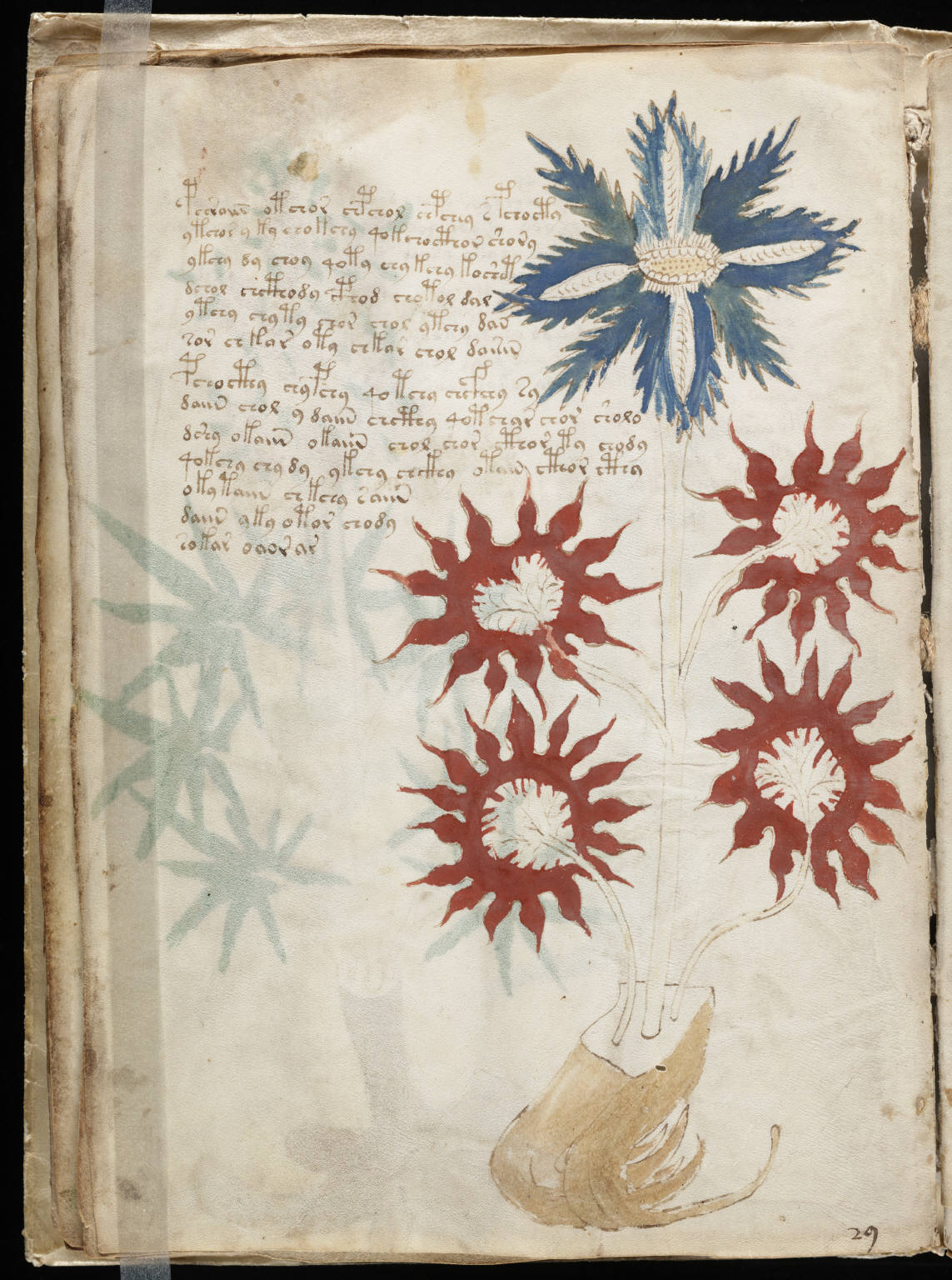
The book itself is small, about the size of a hardcover novel, 240 vellum pages covered edge to edge in flowing, confident handwriting in an alphabet that resembles no known script. Nearly every page carries an illustration: unidentifiable plants, women bathing in interconnected pools of green liquid, star charts with no obvious match to the real sky, small drawings that look like recipes. In 2009, radiocarbon dating of the vellum pinned its creation to between 1404 and 1438 with high confidence, and separate analysis of the ink and pigments matched materials in use during that same window. The parchment, in other words, is not a modern forgery. Someone in the fifteenth century sat down and filled 240 pages with this, on purpose, at real expense.
The manuscript has been examined by some of the most capable code-breakers in history. In the 1940s, an informal after-hours club of U.S. Army cryptanalysts, including William Friedman, the man who had already broken Japan’s Purple cipher and would go on to become the National Security Agency’s first chief cryptologist, took a serious run at it. They worked it for years, alongside British cryptanalyst John Tiltman, treating it the way they’d treat any enemy cipher: hunting for repeated patterns, testing substitution systems, looking for the seam where the code would give. Friedman’s own conclusion, after decades of study, was that the text was most likely a constructed language rather than a cipher over any real one. He never proved it, and he said so plainly before he died.
Every few years since, someone announces they’ve cracked it. Yale’s own library still gets emails making the claim on a near-weekly basis. None of the announcements, going back to the 1920s, have survived contact with scholars who actually specialize in the manuscript.
The Roadblock
Cryptanalysis needs something to lean on: repeated word patterns, letter frequencies that resemble a known language, structural quirks a cipher would preserve. The Voynich text does have real statistical structure, word-length distributions and repetition patterns that look far more like language than random noise. That’s exactly what makes it maddening. It’s structured enough to convince each generation of codebreakers it’s solvable, and resistant enough that none of them have solved it. Every successful historical decipherment, Egyptian hieroglyphs, Linear B, has had a bridge: a bilingual text, a known related language, some point of contact with something already understood. The Voynich manuscript has never had one.
Best Guesses
Constructed or synthetic language
Friedman’s own theory, and still a serious contender: the text isn’t hiding a message, it IS the message, in a language invented from scratch, self-consistent and rule-governed but corresponding to nothing else on Earth. It would explain the statistical realism without needing a decipherable key. It leaves open why anyone would spend the resources fifteenth-century vellum and pigment required on a language built to be understood by nobody.
Enciphered natural language
The most conventional guess: ordinary medieval text, in Latin, German, or a regional vernacular, transformed by a cipher system complex enough that six centuries of cryptanalysts haven’t cracked it. Every specific proposed cipher has eventually failed to produce coherent text when applied consistently across the whole manuscript.
Elaborate hoax
Meaningless text generated to look convincing, produced to sell a mysterious book to a wealthy, credulous buyer. The theory struggles against the manuscript’s genuine statistical complexity; producing text this internally consistent by hand, across 240 pages, without a real underlying system, would itself have been an enormous undertaking.
Lost or invented shorthand
A real, functional writing system tied to a specific scribal or medical tradition that simply didn’t survive anywhere else, the way isolated dialects and private notations sometimes vanish without leaving a second copy. This is the hardest theory to test: it predicts there’s nothing left to find that would confirm it.
The Verdict
Six centuries of readers have failed at this, and the failures share a shape. Each one arrives from the outside — a new tool, a new theory, brought to bear on the same 240 unchanged pages. Computing power has been thrown at it at scale. So has the best cryptanalytic talent of the twentieth century. The pages are indifferent to both.
What has never been available is a second point of contact: an inventory listing the book, a letter describing it, the same hand surfacing in another manuscript. Finds like that don’t reward effort aimed at the object. They tend to come from someone in a reading room noticing something adjacent, while looking for something else entirely.
Where do you stand?
That’s one. There’s another every morning at 6 a.m. local time.
Share where you stand
The Rabbit Hole
- Beinecke Library's full digitized manuscriptevery page, in high resolution, free to browse
- voynich.nu: the radiocarbon dating writeupthe actual dating methodology, not the popular summary
- Cryptologia: Friedman's transcription workinside the NSA-era attempt