
№ 008510 NOVEMBER 2026DEATHVALLEY OF THE KINGS, EGYPT
The Death of Tutankhamun
One Mummy, Four Scans, No Agreement
Unsolved since 1968In 1968, an X-ray of a 3,300-year-old skull found a loose fragment of bone, and a British anatomist announced the boy pharaoh had been murdered. A 2005 CT scan found no blow at all. Later tests blamed malaria, then a chariot crash, then a seizure. Egyptology still can't agree.
What We Know
R.G. Harrison, an anatomist at the University of Liverpool, examined an X-ray of Tutankhamun’s skull in 1968 and found a wedge of bone loose inside it, broken away at the back of the head. He concluded that someone had struck Tutankhamun from behind and killed him, and within a year the claim was on British television. The boy pharaoh, dead at eighteen or nineteen after barely a decade on the throne, became a murder victim in the popular imagination nearly 3,300 years after the fact.
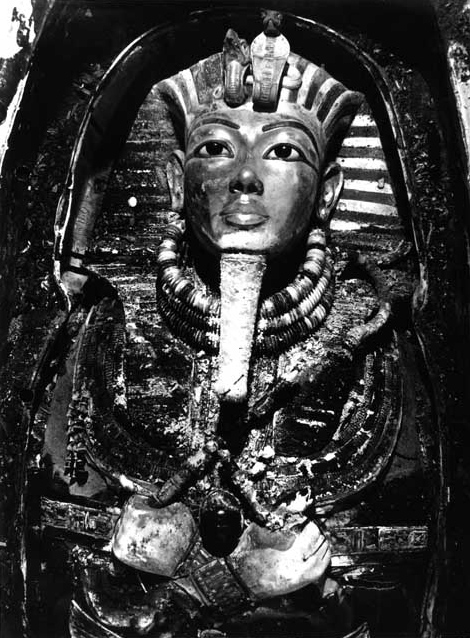
Tutankhamun himself left little behind to argue with. A minor 18th Dynasty king, chiefly remembered for undoing his father’s religious upheaval, he would likely be a footnote if Howard Carter hadn’t found his tomb nearly untouched in 1922, the only major royal burial of the era grave robbers never fully emptied. Carter’s team didn’t reach the body itself until 1925, when they lifted away the gold mask covering Tutankhamun’s face and found the linen wrappings beneath it fused black with hardened embalming resin. That survival is why a body remains to test any theory against.
Each new instrument reopened the question Harrison’s X-ray had raised. A 2005 CT scan, run specifically to check his murder claim, found no healed blow anywhere on the skull, only a badly broken left thighbone with no sign it had ever started to mend. Zahi Hawass, who led that scan, told reporters the results would close the case for good.
They didn’t. Five years later, Hawass’s own team tested the mummy’s tissue for DNA and announced malaria, layered on top of a bone disease already killing off part of his left foot. In 2013, a different team read the same skeleton and announced a chariot crash instead. A third group has proposed a seizure disorder running in his family, the kind that could fell a young man mid-stride. A fourth argues no single trigger will ever be provable, or was even necessary. Four teams, four instruments, four verdicts. The case Hawass called closed in 2005 is still, formally, open.
The Roadblock
Every scan turns up more evidence. None of it resolves what the last scan found, because two teams can look at identical bone and read it in opposite directions. The 2005 team looked at Tutankhamun’s missing ribs and sternum and called the edges clean and surgical, the work of embalmers or of Carter’s own crew levering the mummy out of a coffin it had fused to across three thousand years. The 2013 team looked at the same missing bone and called it trauma. Nobody disputes what’s missing. They dispute what removed it.
The diagnoses underneath the theories aren’t settled either. The 2010 genetic study built its malaria-and-bone-disease case partly on a clubbed left foot, a finding a same-year letter in the same medical journal disputed outright, reading the study’s own published images as showing a normal foot. That dispute never got resolved; it just got buried under louder headlines. Every theory here depends on evidence some other credentialed researcher has already gone on record doubting.
There is no eyewitness, no contemporary medical record, nothing written by anyone who watched him die. Only bone, and ever-better ways of arguing about what happened to it.
Best Guesses
Malaria on a collapsing leg bone
In 2010, a team led by Zahi Hawass tested tissue from Tutankhamun’s mummy for ancient DNA and found fragments of Plasmodium falciparum, the parasite behind the deadliest form of malaria, alongside CT evidence that a bone in his left foot had already begun dying from a disrupted blood supply. Their case: a body already limping and weakened met one malaria infection too many. Two physicians rebutted it in the same journal months later: severe malaria overwhelmingly kills small children in endemic regions, not semi-immune teenagers who’d likely survived it before, and a separate letter in the same issue read the study’s own scan images as showing nothing wrong with the foot at all. Even so, it remains the only theory here confirmed by an actual pathogen test, not an inference from bone shape or art.
A chariot crushed his chest
For a 2013 television documentary, forensic engineers at Cranfield University ran Tutankhamun’s CT data through car-crash reconstruction software built for modern road accidents, and matched the pattern to a kneeling man struck from behind. It has never been published as a peer-reviewed study; team lead Chris Naunton said at the time that review across so many disciplines wouldn’t be easy, and a co-author of the 2010 genetic study called the whole scenario physically impossible, since Tutankhamun’s clubbed foot meant he couldn’t have stood in a moving chariot at all. Still, it’s the only one of the four that tries to explain the body’s asymmetry directly: a crushed chest, ribs missing in a way the team read as violent rather than surgical, injuries down one side and none on the other.
A seizure caused a fatal fall
Hutan Ashrafian, a surgeon at Imperial College London, noticed something odd running through several generations of Tutankhamun’s family in their own tomb art: unusually feminized figures and elongated skulls, a pattern he read as an inherited form of temporal lobe epilepsy rather than an artistic convention. His proposal: a seizure dropped Tutankhamun mid-stride, breaking the same thigh bone the 2005 CT scan found fractured with no sign of healing. No chariot, no attacker, no argument about who removed what from his chest. Other researchers published a direct challenge to the art-historical reading his case depends on, in the same journal, within months. Reading a neurological diagnosis off 3,300-year-old portraiture, stylized by convention long before he was born, is a thin foundation, though it does explain the one injury nobody disputes actually happened.
Inbred frailty, not one strike
Set the other three theories aside and a fourth position remains: Tutankhamun’s parents were most likely full siblings, per the 2010 study’s own genetic findings, and generations of that kind of intermarriage produced a body carrying several congenital problems at once, a foot bone that couldn’t heal itself chief among them. On this reading, asking which single thing killed him may be the wrong question. No one trigger needs to be found; the body itself was already the cause, slowly, for years. Its weakness is also its strength. It can’t be disproven, because it needs no specific evidence to hold up, only the absence of a cleaner answer. So far, that absence is the one thing every other theory here keeps supplying.
The Verdict
What would actually settle this is a single full-body reexamination that treats the case as one problem instead of four separate papers: one team, one round of scanning, explicitly tasked with resolving the clubfoot question, the rib evidence, and the malaria diagnosis together, with every disputed finding re-run and published alongside its critics’ objections rather than around them. That hasn’t happened. Egypt’s royal mummies are examined rarely and carefully, for good reason, and nothing suggests another full study is coming soon.
Short of that, the fastest way to move this forward may not be new data at all. It may be better statistical tools for reading degraded ancient DNA, the exact method other geneticists have spent the years since 2010 publicly doubting. Rerun that malaria sample with today’s techniques and one leg of this argument might finally hold or fall.
Nobody has re-scanned him since 2010.
Where do you stand?
That’s one. There’s another every morning at 6 a.m. local time.
Share where you stand
What Didn't Hold Up
Details that circulate with this case but failed verification against independent sources. Cut from the story above — listed so you know they weren't missed.
“Ay, Tutankhamun's elderly successor, murdered him and married his widow Ankhesenamun to seize the throne — popularized by Bob Brier's 1998 book The Murder of Tutankhamen.”
Built on Harrison's 1968 skull reading, contradicted by the 2005 CT scan, which found no blow to the head at all. The Ay–Ankhesenamun marriage itself is also less certain than the story implies: a ring and some gold foil showing them together are the only evidence, and her name never appears in his tomb.
The Rabbit Hole
- The 2005 CT scan results, in Hawass's own wordsthe official press release, including the line declaring the case closed — five years before it reopened
- The 2010 JAMA study that started the malaria/DNA debatethe paper itself, plus links to the same issue's critical letters
- Did King Tut Die in a Chariot Accident? (PBS NOVA)the 2013 reconstruction, and the horse-kick, hippo-attack, and looted-tomb alternatives its own coverage lined up against it
- Ashrafian's epilepsy paper on the eighteenth dynastythe least-famous of the four theories, and arguably the hardest to dismiss outright
- "Mystery of King Tut's Death Solved? Maybe Not" (National Geographic, 2013)contemporaneous skepticism of the chariot claim, with the other injury explanations researchers floated