
№ 000118 AUGUST 2026SIGNALDELAWARE, OHIO, USA
The Wow! Signal
The Signal That Outlived Its Sender
Unsolved since 1977On a summer night in 1977, a radio telescope in Ohio heard something it was built to hear and never heard again. The astronomer reviewing the printout circled the reading and wrote one word in the margin. We have been listening for an encore for almost fifty years.
What We Know
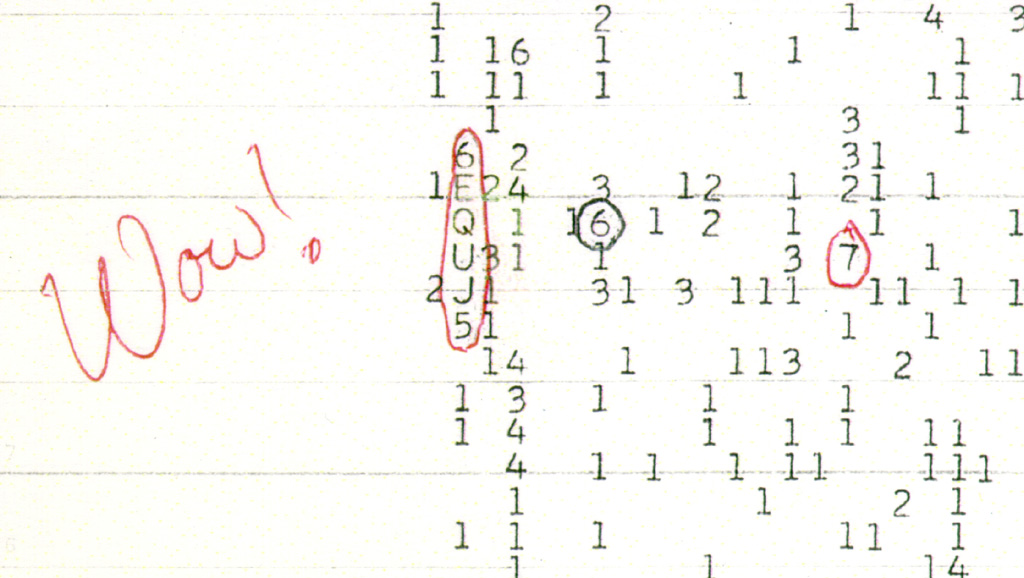
Jerry Ehman was a volunteer. Three days after the fact, sifting through a stack of computer printouts from Ohio State’s Big Ear radio telescope, he found a line of characters that shouldn’t have been there: 6EQUJ5, a code for signal intensity so strong the scale almost couldn’t hold it. He circled it in red pen and wrote a single word in the margin, Wow!, and the name stuck harder than any designation an observatory ever gave a real discovery.
The signal had arrived on August 15, 1977, at 11:16 p.m. local time, on one frequency out of fifty the telescope was scanning. That frequency was 1420 MHz, the exact wavelength at which neutral hydrogen, the most common element in the universe, naturally hums. SETI researchers had picked it years earlier as the most sensible channel for anyone to broadcast on, on the theory that any civilization doing radio astronomy would eventually notice it too. The signal rose from nothing to thirty times background noise, held for most of a minute, and faded on schedule with the sky’s rotation. That fade proved it came from a fixed point out there, not from Earth. It lasted 72 seconds. Big Ear’s design meant it couldn’t have lasted longer even if the source had kept transmitting; the telescope’s fixed dish simply drifted out of alignment.
Astronomers pointed instruments at that patch of sky repeatedly for decades afterward. Nothing ever came back.
The Roadblock
A signal like this should be easy to chase: get its exact coordinates, point something bigger at them, wait. The trouble is that Big Ear recorded frequency and intensity beautifully but position only crudely. The telescope had two feed horns a few arcminutes apart, and the data can’t say for certain which one caught the signal, which leaves two candidate patches of sky rather than one. Decades of follow-up observations, across multiple instruments, have found nothing in either patch resembling a repeat. A one-time event, at the edge of a fifty-year-old instrument’s precision, recorded on paper printouts instead of digital archives, is about as hard a case as radio astronomy gets to close.
Best Guesses
Deliberate transmission
The frequency argument does real work here. 1420 MHz isn’t a channel anyone stumbles onto by accident, and a signal built to attract exactly the kind of listener Big Ear was engineering to be would look a great deal like this one. But a transmission built to be found should, in theory, come back. This one, despite an enormous amount of looking, never has.
Hydrogen cloud flare-up
A 2025 reanalysis of the original data, using modern signal-processing methods on decades-old records, found the signal was even stronger than previously measured, and proposed a specific mechanism: a magnetar or similar high-energy burst striking a cold cloud of hydrogen gas could trigger “superradiance,” a runaway brightening at exactly the hydrogen frequency, bright enough for Big Ear to catch and gone as fast as the trigger passed. Nobody has ever directly observed this happening. It would also, satisfyingly, explain why it never repeated.
Cometary emission
This one is mostly dead, and it’s instructive about how these things go. In 2017 an astronomer proposed that an undiscovered comet, crossing the right patch of sky, had emitted the signal from its hydrogen envelope. The press coverage was enormous. Ehman rejected it flatly. Comets don’t emit anywhere near that intensity, and the comet named wasn’t where the theory needed it to be. Specialists lined up behind him. A widely reported solution and an accepted one turn out to be very different objects.
Terrestrial interference
Big Ear’s whole design was a filter against this: anything not arriving from deep space was supposed to be rejected before it reached the printout. In half a century, no terrestrial source has been matched to the signal’s frequency and drift. It stays on the list because ruling it out entirely would require proving a negative about every transmitter operating in Ohio in August 1977.
The Verdict
Big Ear was bulldozed in early 1998. Developers had bought the land to take a golf course from nine holes to eighteen and put up houses, and the telescope that made the only detection of its kind in the history of the search went down with the rest of it. The printout outlived the instrument that produced it.
Testing the newest explanation doesn’t need Big Ear anyway. If cold hydrogen clouds can flare the way the 2025 model says, the effect should surface again in survey data from instruments far more sensitive than anything available in 1977, and it should look much like this. Ehman was careful from the start never to claim the signal was alien, and he was right to be careful. Half a century on, nobody has been able to tell him what it was instead.
Where do you stand?
That’s one. There’s another every morning at 6 a.m. local time.
Share where you stand
The Rabbit Hole
- The Wow! Signal, Ohio State University Radio Observatorythe observatory's own account, with the original printout
- PHL @ UPR Arecibo: Arecibo Wow!the team behind the 2025 reanalysis, with their full methodology
- SETI Institute: The Wow! Signal — A Lingering Mystery or a Natural Phenomenon?a clear-eyed institutional take on where the debate stands