
№ 009116 NOVEMBER 2026PLACESALISBURY PLAIN, WILTSHIRE, ENGLAND
Stonehenge's Purpose
The Center Stone That Came From 700 Kilometers Away
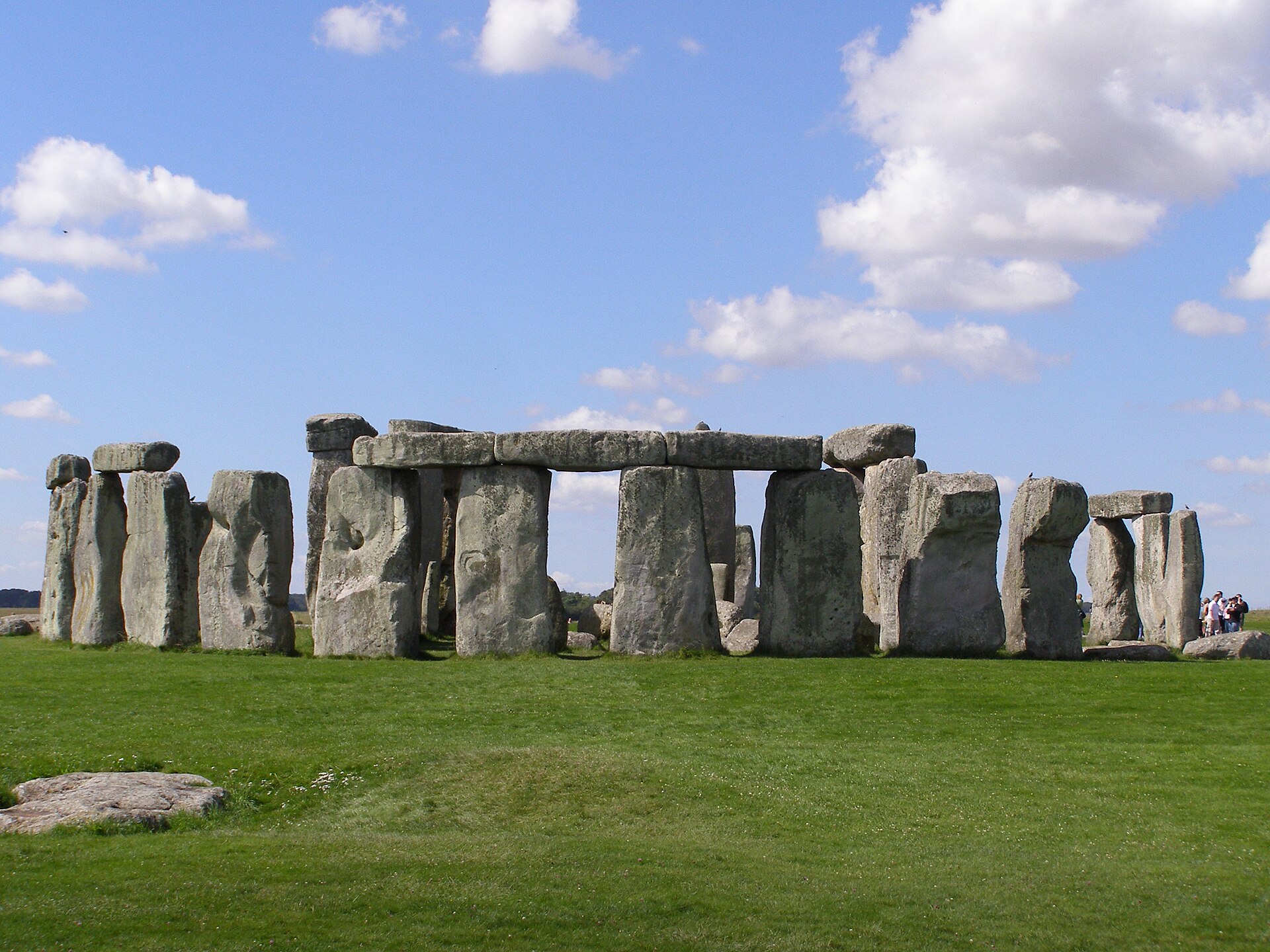
Unsolved since 1901Starting around 3000 BCE, Neolithic Britons dragged multi-ton stones onto Salisbury Plain from Wales — and, geologists confirmed in 2024, from northern Scotland, over 700 kilometers away. A century of the most intensively excavated prehistoric site on Earth still can't agree on why.
What We Know
In August 2024, geologist Anthony Clarke examined two chipped fragments of Stonehenge’s Altar Stone under a laser that reads the age of individual mineral grains. The Altar Stone lies flat at the center of the monument’s inner horseshoe, six tonnes of sandstone that everyone had assumed, for over a century, came from Wales like the bluestones around it. Clarke’s zircon grains said otherwise. Their age signature matched nothing in Wales. It matched the Old Red Sandstone of the Orcadian Basin, in the far north of Scotland, over 700 kilometers away, most of it open sea. There is no overland route in that direction Neolithic Britain’s builders could plausibly have used.
The find reopened a question professional archaeology has worked since 1901, when William Gowland’s dig became the first to treat Stonehenge as a site to be excavated rather than merely admired. The monument’s own construction spans some 1,500 years. Around 3000 BCE, its builders cut a circular ditch and bank into the chalk and set 56 pits inside it, the Aubrey Holes. Within a few centuries they were burying cremated human remains in and around those pits, a practice radiocarbon dating shows continued for roughly five hundred years; an estimated 150 to 240 individual burials are linked to the site, most of them still unexcavated. The sarsens didn’t go up until around 2500 BCE: stones as heavy as 25 tonnes, hauled from West Woods 25 kilometers north and raised into the circle and horseshoe visitors recognize today, oriented on the exact axis where the sun rises at midsummer and sets at midwinter. The bluestones, smaller but still dragged some 240 kilometers from the Preseli Hills in Wales, were rearranged at least twice across that same span.
Sourcing stone from every direction wasn’t incidental, one recent argument holds. It was the point. Nearby Durrington Walls, a timber-and-pit complex two miles off, shows evidence of communal feasts built on livestock driven in from across Britain, and isotope studies of people buried near Stonehenge find a real share of them grew up somewhere else in Britain entirely. Whatever assembled that stone, and those people, on Salisbury Plain did it for five centuries running, then kept modifying the result for a thousand years more.
The Roadblock
What Stonehenge is built from, and roughly when, isn’t contested. Why is the entire fight, and the culture that raised it left nothing to settle it with: no writing, no inscription, no ledger explaining a single decision across five centuries of burying the dead and five more of dragging stone across Britain. Every theory below reconstructs a motive that was never written down.
The record that might help most is also compromised. William Hawley excavated roughly half the monument’s interior between 1919 and 1926, mostly alone; large stretches of what he found were never fully published, and some of it was backfilled without complete documentation. Whatever stratigraphy could have separated one century’s activity at the site from the next is gone in those areas, permanently.
The monument’s own timeline argues against a single answer, too. Construction and rearrangement ran across roughly 1,500 years. Whoever dug the Aubrey Holes and buried the first dead there, and whoever aligned the sarsens on the solstice axis five centuries later, were working about as far apart in time as we are today from the Tudor court. A monument in continuous use that long plausibly changed jobs more than once. Archaeology just can’t yet say which job came first, or which came last.
Best Guesses
Four explanations have real evidence behind them; none has retired the others. Weigh what each buys against what it must explain away: the dead in the ground, the alignment overhead, the hike from Wales, the alliance nobody wrote down.
Built in stone for the dead
Mike Parker Pearson’s Stonehenge Riverside Project makes the plainest case: the monument functioned as a cemetery from its very first phase, for roughly five centuries. A colleague from Madagascar suggested the framing that shaped his reading: stone for the dead, because it lasts, timber for the living, who don’t need it to. Stonehenge’s vanished timber counterpart at Durrington Walls fits that exactly. The wound is timing. The cremation burials thin out well before the sarsens, the monument’s most ambitious phase, go up. A funerary reading covers the beginning. It strains to cover what came after.
A solar calendar in stone
The weakest point of this theory came first, in 2023. Astronomers Giulio Magli and Juan Antonio Belmonte took apart Timothy Darvill’s numbers (30 sarsens for days of the month, five trilithons for intercalary days, four Station Stones for a leap year), calling the scheme unsupported numerology: nothing at the site represents the twelve months a calendar needs. Darvill’s exact calendar is the part the math doesn’t support. The astronomy underneath it is real and older: Stonehenge’s undisputed alignment on the midsummer-sunrise, midwinter-sunset axis, solid enough that crowds still gather there every solstice to watch it work.
Bluestones believed to heal
Timothy Darvill and Geoffrey Wainwright’s 2008 dig, the first inside the stone circle in forty years, tested a specific idea: the bluestones were hauled 150 miles from Wales because people believed the stone itself cured, and Stonehenge worked as a pilgrimage site. Their best evidence lies three miles off, in the grave of the Amesbury Archer, buried around 2300 BCE with a ruined knee and tooth enamel showing he grew up in the Alps. He traveled further than anyone else found nearby. What his burial doesn’t show is a cure. His knee never healed, and injured skeletons turn up in Bronze Age graves everywhere, not unusually often near Stonehenge specifically.
A monument built to unite Britain
This is the theory the Altar Stone’s Scottish origin built. Every stone at Stonehenge, Parker Pearson and colleagues argue, was sourced from a different, distant part of Neolithic Britain: Wales, West Woods, and, newly confirmed, Scotland — though nothing else here traveled anywhere near 700 kilometers by sea, one exceptional stone, maybe, not a general policy. The timing fits: it happened as new farming migrants arrived from the continent, when uniting Britain’s communities had real stakes. The link runs deeper than stone, too. Durrington Walls’ houses even echo Skara Brae’s in Orkney, down to the floor plan — evidence Parker Pearson reads as proof that Salisbury Plain and the Altar Stone’s own corner of Scotland were already in contact.
The Verdict
Archaeology has never recovered a written record, a workshop, or physical evidence of the boat that could have carried six tonnes of sandstone down the British coast — not from this period, anywhere in Britain. An undisturbed Neolithic context is the only kind of find that could still produce one, and most archaeologists don’t expect that to happen soon.
Short of that, the honest fix is chronological, not evidentiary. The Aubrey Holes and the sarsens are five centuries apart; the bluestones’ first arrangement and the newly confirmed Scottish origin of the Altar Stone aren’t separated by much less. A monument built in phases that far apart didn’t necessarily keep one job across all of them. The most intensively excavated prehistoric site on Earth just traced its center stone back further than anyone expected. Nobody has traced it back to a reason.
Where do you stand?
That’s one. There’s another every morning at 6 a.m. local time.
Share where you stand
What Didn't Hold Up
Details that circulate with this case but failed verification against independent sources. Cut from the story above — listed so you know they weren't missed.
“Stonehenge was built by the Druids.”
The link comes from 17th-18th-century antiquarians (Aubrey, Stukeley); modern Druidic groups still hold ceremonies there. Stonehenge's last construction phase predates the earliest textual evidence for druids in Britain by roughly a thousand years -- they could have used it, but did not build it.
“Aliens, or extraterrestrial guidance, built Stonehenge.”
Traces to Erich von Daniken's 1968 'ancient astronaut' framing. No archaeological source consulted treats it as a live hypothesis; antler-pick tool marks and the identified sarsen quarry at West Woods point to ordinary human labor, with nothing at the site left unaccounted for.
“The wizard Merlin magically transported Stonehenge's stones from Ireland.”
Geoffrey of Monmouth's 12th-century literary invention -- no Irish source, no magic. A real dismantled stone circle at Waun Mawn in Wales has been proposed as a folk-memory kernel behind the legend, but archaeologists dispute whether it actually supplied Stonehenge's bluestones.
“Stonehenge was a site of ritual human sacrifice.”
Rests on Julius Caesar's account of Gaulish druids, written centuries after Stonehenge's construction ended, plus sacrifice evidence from unrelated Continental henges. No comparable evidence exists at Stonehenge itself; the 'Stonehenge Archer,' killed by arrows near the ditch, reads as one execution, not a pattern.
The Rabbit Hole
- English Heritage: Understanding Stonehengethe monument's own custodian, laying out every competing theory without picking one
- Nature: the Altar Stone's Scottish origin, in fullthe 2024 zircon-and-apatite study that traced the center stone to the far north of Scotland
- Archaeology International: the unification case, in the researchers' own wordsParker Pearson and colleagues' full argument that sourcing the stones was itself the point
- Antiquity: the astronomers' rebuttal of the "Stonehenge calendar"Magli and Belmonte's math-first case against the 365-day reading, published a year after it
- Antiquity: "The dead of Stonehenge"the radiocarbon study establishing the site as a working cemetery from its very first phase