
№ 007430 OCTOBER 2026PHENOMENONWORLDWIDE, DURING REM SLEEP
Sleep Paralysis and the "Shadow Figure"
Millions Wake Paralyzed, Staring at the Same Figure
Unsolved since 1664In December 1963, a college sophomore woke to his locked door creaking open and something climbing onto his chest, certain it was evil, unable to move a muscle. Millions of people, in nearly every culture studied, describe the same figure. Sleep science still can't fully explain why.
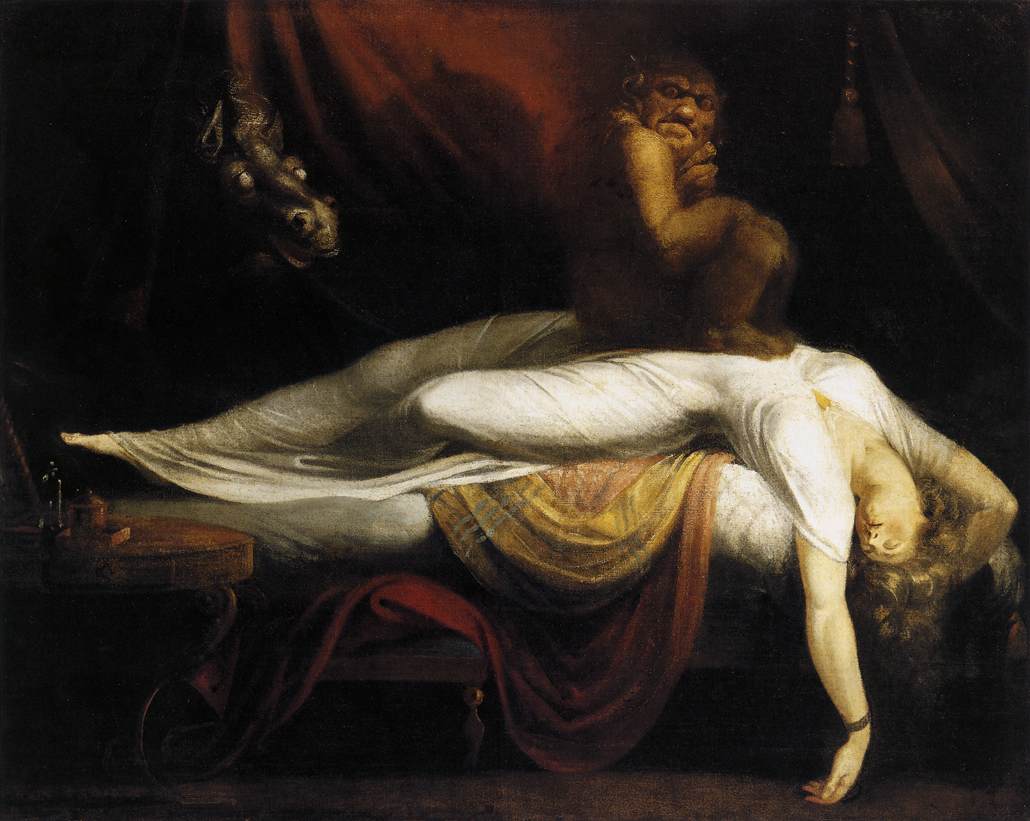
What We Know
David Hufford was in his second year of college, worn down by mononucleosis and exam week, when he went to bed early one December night in 1963. Two hours later he woke to the sound of his own locked door creaking open. Footsteps crossed the floor toward the bed. Something climbed onto his chest, evil and specific, and pressed down until he could barely breathe. His eyes were open. His mind was working. He could not move a single muscle to save himself. Then it lifted, and the room was empty. He told no one for eight years.
Hufford had just lived through what sleep researchers call sleep paralysis, and what a remarkable share of human folklore already has a name for. He wasn’t the first to write it down in careful detail. In 1664, the Dutch physician Isbrand van Diemerbroeck published a case history of a fifty-year-old patient who reported the devil lying on top of her and holding her down some nights, a dog other nights, a thief on others, always crushing her chest while she lay unable to speak or stir.
The paralysis itself is now well understood. As the brain exits REM sleep, the circuit that keeps the body still during dreaming, running from the brainstem down through the spinal cord and flooding skeletal muscle with inhibitory signals, sometimes stays switched on for a few seconds or minutes after consciousness has already returned. The sleeper wakes up literally still dreaming: muscles locked, eyes sometimes free to move, mind fully alert to a threat the body cannot run from.
What that circuit doesn’t explain is the specific shape the terror takes. Among the hallucinations survey data keeps turning up, one recurs across nearly every study: a malevolent presence in the room, not vague dread but a distinct entity, sensed or seen, often bearing down on the chest. It has a name almost everywhere researchers have gone looking: the Old Hag in Newfoundland, kanashibari in Japan, a jinn’s grip in Cairo, the Pandafeche in rural Italy. Seven years after his own night, Hufford went to Newfoundland to study folklore, and heard islanders describe, almost word for word, the thing he had never told anyone.
The Roadblock
Sleep paralysis is common enough to study and nearly impossible to catch in the act. Episodes are brief and unpredictable, most passing in under two minutes though some run past ten, and arrive without warning. They can’t be reliably summoned on command: even the best lab protocols (waking someone during REM sleep, then keeping them briefly still) raise the odds of an episode without guaranteeing one, and never inside a scanner already primed to watch a hallucination form. What researchers have instead is testimony, collected after the fact, from a brain that was, by definition, half-dreaming while it happened.
That leaves every competing theory resting on the same shaky floor: self-report. A questionnaire that asks whether someone sensed a threatening presence gets a different answer depending on whether the respondent’s own language already has a word for it. That means the data used to argue the hallucination is cross-culturally identical is collected through the same channel, translation and category, that could also be quietly manufacturing that appearance. Nobody has found a way to put a number on the shape of somebody else’s hallucination.
Best Guesses
Four groups of researchers, working from the same basic mystery, have landed on genuinely different culprits: a brain circuit, a receptor, a folk narrative, and a flaw in how any of it gets measured.
A misfired threat-detection system
Psychologist J. Allan Cheyne collected more than 28,000 firsthand accounts of sleep paralysis through an ongoing web survey and built a specific model from the pattern: as REM sleep ends, it briefly and automatically switches on the brain’s own vigilance system, the amygdala-driven circuitry that scans for danger, with no actual sensory input to work from. Cheyne has put it plainly: REM-based activation of that system, in the absence of any real threat, is what triggers the sense of “an ominous entity lurking nearby.” It’s the best-developed single account of why the hallucination reads as menacing rather than neutral. What it doesn’t explain is why so many sleepers perceive a specific, humanoid shape, not just danger.
Serotonin receptors turned up too high
Cambridge researcher Baland Jalal proposes a more mechanical culprit: the same serotonin 2A receptor that LSD and psilocybin activate. That receptor firing during the overlap between REM sleep and waking, in his account, is what makes vivid hallucination possible at all, independent of any dedicated fear circuit — though it doesn’t explain why the content so reliably defaults to a menacing figure rather than anything else a hallucinating brain might produce. What the theory has that Cheyne’s doesn’t is an actual pharmacological data point: in small trials, a drug that blocks the receptor reduced how often the hallucinations occurred.
Culture supplies the disguise
Jalal’s own cross-cultural surveys complicate his lab work. Egyptians in Cairo reported sleep paralysis roughly three times as often as residents of Copenhagen, feared it more, and were far more likely to name a supernatural cause: a jinn. Danes mostly called it stress. In Abruzzo, Italy, the culprit is a witch-like figure called the Pandafeche. Across all three populations, believing the cause is supernatural predicted more frequent, more frightening episodes, not the reverse — though correlation doesn’t prove culture originates the shape rather than just coloring how an already-present sensation gets interpreted. What doesn’t move is the shape itself: three cultures, three monsters, the same crushing weight.
One category hides real differences
Psychiatrist Joop de Jong’s clinical casework across Guinea-Bissau, the Netherlands, Morocco, and Suriname makes a quieter argument: what gets filed under one tidy label, “the Intruder experience,” “sensed presence,” may be several genuinely different experiences that researchers’ own questionnaires are built to detect as the same thing. Ask, in translation, whether someone “sensed a threatening presence,” in a culture with no equivalent idiom, and the instrument may manufacture the very uniformity it set out to measure. It’s a caution about method, not a competing account of what causes the hallucination, and it still has to explain why Hufford’s account and the Newfoundland fishermen’s matched as closely as they did, years apart, with no vocabulary shared between them at the time.
The Verdict
Real-time EEG can already flag the exact seconds a sleeper enters paralysis. Pair that with an immediate spoken account, taken before memory has time to smooth the story into a shape borrowed from a word the sleeper already knows, and the hallucination could be caught while it’s happening instead of reconstructed afterward: unpleasant to run, but workable. What nobody has done yet is find people from a culture with no folklore term for this experience at all, and ask what they saw, cold, before any story is offered to explain it.
That would separate the theories cleanly. If a subject with no cultural script still reports a distinct shape looming over them, the brain-circuit and receptor theories look more like plain biology, and the categorization critique loses its footing. If they don’t, the “universal shadow figure” turns out to be something people are taught to see in the instant they most need an explanation. Nobody has run that study. Sleep researchers are still waiting for a subject who has never heard the story.
Where do you stand?
That’s one. There’s another every morning at 6 a.m. local time.
Share where you stand
The Rabbit Hole
- David Hufford's The Terror That Comes in the Night (1982), full textthe book this entire field grew out of, free to borrow
- Scientific American: Sleep Paralysis and the Monsters Inside Your MindBaland Jalal, in his own words, on what culture does to fear
- Science News: Night of the CrusherHufford's 1963 night told in full, alongside Cheyne's two-brain-system theory
- PBS NOVA: The Nightmare of Sleep Paralysisa clear walkthrough of the REM-atonia mechanics — the part that is settled
- Detroit Institute of Arts: Fuseli's The Nightmarethe actual 1781 painting, from the museum that owns it