
№ 005410 OCTOBER 2026ARTIFACTTURIN, ITALY
The Shroud of Turin
A Cloth That Reads Like a Photographic Negative
Unsolved since 1898In 1898, a photographer developing his negative of a cloth watched a face resolve out of the dark, as though the shroud had been printed in reverse before cameras existed. A 1988 test dated it to the Middle Ages. A 2022 study reopened the question. Nobody has explained the image.
What We Know
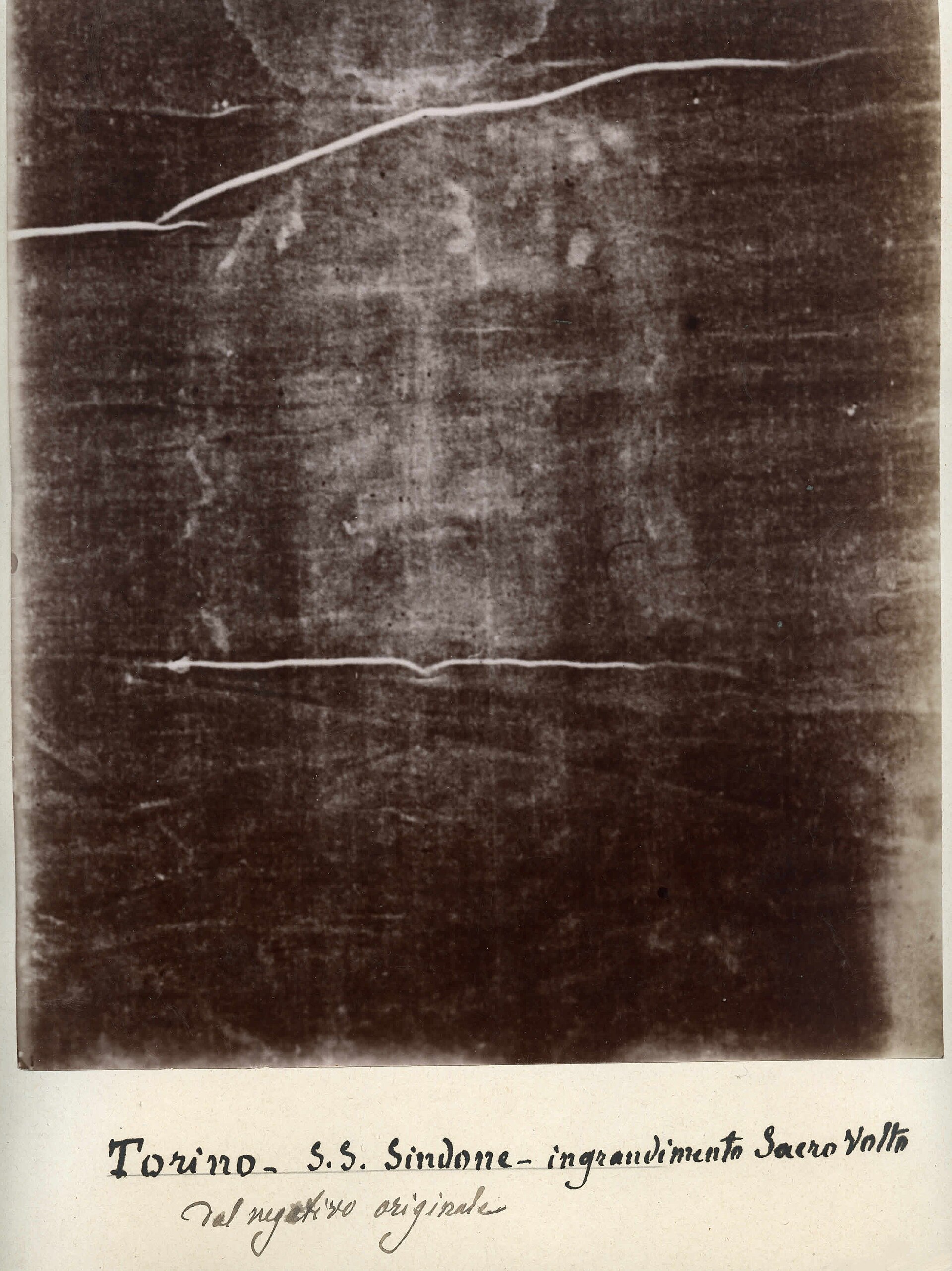
Secondo Pia almost dropped the plate. On the evening of May 28, 1898, the Italian lawyer and amateur photographer was granted permission to photograph the Shroud of Turin, a fourteen-foot linen cloth that had hung in Turin Cathedral since 1578, bearing the faint front-and-back image of a bruised, bearded man. Pia later said the shock nearly cost him the plate: as the negative came up in the tray, a face emerged clear and unmistakable out of the chemical bath, as if the cloth itself had been exposed like film centuries before anyone built a camera.
That night turned a regional devotional object into a subject of physical investigation. The shroud’s documented history runs to the 1350s, when the French knight Geoffroi de Charny displayed it at a church he’d founded in Lirey, and drew skepticism almost immediately. The philosopher Nicole Oresme, writing before his death in 1382, dismissed it in an unpublished manuscript as clergy using a fake relic to solicit donations. By 1389, the Bishop of Troyes was telling the pope that his predecessor had investigated the cloth decades earlier and found an artist who’d confessed to painting it, though no independent record of that confession survives beyond the bishop’s own account. The cloth changed hands, survived a 1532 fire whose scorch marks still cross it, and settled permanently in Turin in 1578.
Then, in 1988, three independent labs radiocarbon-dated a swatch from one corner and published the result in Nature: the linen was medieval, most likely woven between 1260 and 1390, a range that lines up almost exactly with the shroud’s first appearance in Lirey. It looked like the end of the argument. Instead, the raw measurements sat unpublished for nearly thirty years, and when a different lab ran a different physical test on that same corner in 2022, it got a very different answer.
The Roadblock
Every method aimed at the shroud can only test the patch of cloth it’s given, and the results keep failing to agree. The 1988 sample came from a single corner, the same strip generations of handlers had touched, folded, and, after the 1532 fire, doused with water to save the rest. When the underlying measurements became public in 2017, a 2019 statistical re-analysis found the three labs’ numbers less consistent than the published paper suggested, with a pattern across the strip that looks like contamination unevenly cleaned off. A 2022 study, measuring how far the linen’s cellulose has aged, found signs of far older cloth from that same corner — but only if the shroud spent thirteen undocumented centuries at a strikingly narrow humidity and temperature nobody can confirm or rule out. A 2026 fiber study of what’s left of the actual sample found nothing unusual about it.
The image itself is no easier. A five-day, seven-ton examination in 1978 found no pigment, dye, or paint on the fibers carrying the picture, and admitted it couldn’t say what did. Every reproduction since has hit the same wall: getting a faint image onto linen is easy. Getting the color to sit only on the topmost threads, penetrating nowhere, vanishing wherever the blood had already reached the cloth, is not.
Best Guesses
A 1350s Lirey production
The simplest account, and its weakest point up front: nobody has shown how a medieval hand, with paint or without it, produced an image the 1978 examination found no pigment on. What the theory has instead is timing. The 1988 radiocarbon range, 1260 to 1390, lines up almost exactly with the cloth’s documented debut at Lirey in the 1350s, and two separate 14th-century writers, working independently, describe contemporaries treating it as a manufactured devotional object, not a genuine relic — the philosopher Nicole Oresme, and decades later the Bishop of Troyes. A chemical test and a paper trail landing on the same century is a real coincidence to explain away.
A first-century cloth, X-ray dated
In 2022, physicists at Italy’s Institute of Crystallography measured how far the cellulose in a shroud thread had structurally degraded and compared it to linen independently dated to the first century, from the Roman siege of Masada. The two matched more closely than the shroud matched anything medieval — a real result, from a real peer-reviewed method, run near the same corner the 1988 test used. The study’s own authors flag the catch, though: the numbers only reconcile with a first-century date if the shroud spent thirteen undocumented centuries stored within a narrow temperature and humidity range nobody has evidence for, and the method itself hasn’t been validated by blind-dating textiles of already-confirmed age.
A contact imprint from a real body
If the image wasn’t painted, and the 1978 team’s exhaustive search for pigment found none, the remaining possibility is that contact with an actual corpse produced it through some natural process — a scorch, a chemical vapor reaction, a mechanism nobody has fully modeled, and five decades of proposed chemistries have each explained part of the pattern and failed on another. What survives that failure rate is the evidence itself. This theory takes seriously exactly what investigators found and nothing more: color sits only on the topmost fibers, none of it penetrating the weave, and no image appears at all wherever blood had already reached the linen — exactly what you’d expect if the blood arrived before whatever formed the picture did.
No one has replicated the image
Set the age question aside completely, and the picture is still unexplained. In 2009, an Italian chemist built a full-scale reproduction attempt: a volunteer wrapped in linen, pigment applied by hand, then heat-aged in what he called a “shroud machine.” He produced a genuinely shroud-like faint image, and even his sharpest critics don’t dispute that much. What they dispute is whether he matched what makes the original strange — no pigment bleeding into the fiber, no image beneath the blood, a tonal pattern that only resolves into a portrait once photographed and inverted, the way Pia’s negative did in 1898. Every attempt since has produced a faint image. None has produced this one.
The Verdict
The Archbishop of Turin controls access to the shroud, and that control is part of why this keeps not getting settled. A radiocarbon sample, dated blind by multiple labs from a different corner, would test whether the 1988 finding holds up. A blind trial of the X-ray method, run on textiles of already-confirmed age withheld from the researchers, would show whether it measures a fabric’s true age or something else. Neither test has happened. The custodians have reasons not to authorize either: another round on the same disputed patch could resolve nothing while risking damage to an object millions venerate regardless of the outcome.
The Church has never forced the question. Popes have called the shroud an icon, encouraged devotion to it, and left the dating argument to scientists, without asking the faithful to accept it as authentic. That isn’t evasion so much as the only position the evidence supports: two separate questions, how old the linen is and what put the image there, and not one test yet that answers both.
Nobody has run it.
Where do you stand?
That’s one. There’s another every morning at 6 a.m. local time.
Share where you stand
What Didn't Hold Up
Details that circulate with this case but failed verification against independent sources. Cut from the story above — listed so you know they weren't missed.
“The 1988 radiocarbon sample was cut from an invisible medieval reweave or repair patch, not the shroud's original cloth.”
Traced to a 2005 hypothesis that the sampled corner was an invisible medieval reweave. Two photomicrographic studies of the sample material found no evidence for it, and a textile historian disputes the technique existed in period Europe. Confirmed: fragments match the shroud's main fabric, no contamination.
“Pollen grains recovered from the shroud are unique to the Jerusalem/Judea region and prove a Middle Eastern origin.”
Traced to 1970s–80s sticky-tape sampling by a Swiss criminologist. Later review by pollen specialists found only a fraction of his species-level identifications hold up, and other examiners couldn't confirm his most-cited match. Confirmed: pollen was recovered; what it identifies isn't settled.
“Coins minted under Pontius Pilate in 29 AD are visible over the eyes in the image, dating and localizing it.”
Traced to 1970s image-enhancement work reading letter shapes near the eyes as a specific Judean coin. Independent numismatists dispute the identification, and other researchers examining the same region couldn't replicate it. Confirmed: faint irregularities exist there; no coin ID has held up.
“An artist confessed to painting the shroud, exposing it as a known forgery.”
The only source for this is Bishop Pierre d'Arcis's own unsigned c. 1389 memorandum, describing an investigation by his predecessor decades earlier. No independent record of an investigation, an artist, or a confession survives. What's confirmed: a 14th-century bishop wrote that this had happened — not that it did.
The Rabbit Hole
- Nature: the 1989 radiocarbon paper, in fullthe test everyone argues about, in the original three labs' own words
- Heritage: the 2022 X-ray re-dating studyopen access — read the WAXS method and its own storage-history caveat firsthand
- npj Heritage Science: the 2026 fragment analysisthe newest look at what's actually left of the 1988 sample
- National Geographic: why the shroud's secrets keep eluding sciencethe best single overview of more than a century of investigation
- Wikimedia Commons: Secondo Pia's 1898 negative, full resolutionthe print reproduced below, at a size that shows the handwriting on the mount