
№ 007531 OCTOBER 2026ARTIFACTDEIR EL-BAHARI, THEBES (FOUND); CAIRO, EGYPT (UNWRAPPED 1886)
The Screaming Mummy, "Unknown Man E"
A Body Egypt Refused to Prepare for the Afterlife
Unsolved since 1886In June 1886, Gaston Maspero unwrapped an anonymous coffin in Cairo and found a young man frozen mid-scream, bound, unembalmed, wrapped in ritually forbidden goat skin. A 2012 CT and DNA study named a leading suspect and calls him, in its own words, only "a good candidate."
What We Know
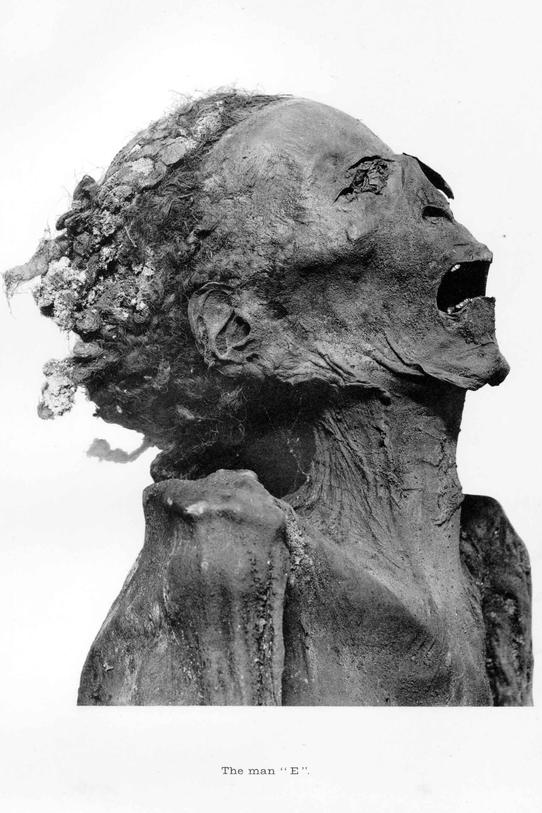
Gaston Maspero pried open a plain wooden coffin in Cairo on a June day in 1886, one more box among the royal mummies pulled five years earlier from a hidden cache at Deir el-Bahari. Nothing on it said who was inside. What Maspero found didn’t match anything else in that room. The body’s head was thrown back, mouth open wide, as if caught mid-scream. His hands and feet were bound. No incision had been cut into his side, so no organs had been removed: no embalming at all, by the standards of every other mummy in the cache. Instead of fine linen, he had been wrapped in goat skin, a material Egyptian ritual texts treated as unclean enough to bar a soul from proper burial. The coffin itself had been hacked wider on the inside to fit him. No name appeared anywhere on it.
Maspero and the physician who examined the body with him, Daniel Fouquet, both read the face as evidence of poisoning. A chemist named Mathey went further and proposed the man had been buried alive. In 1912, the anatomist Grafton Elliot Smith looked at the same face for the museum’s official catalog and disagreed with all three: a slack, dropped jaw, he wrote, is simply what any relaxed corpse does after death, whatever killed it.
For over a century the body carried only a filing label, Unknown Man E. In 2004, the Egyptologist Bob Brier got permission to examine him directly and argued the evidence fit a specific, notorious name: Pentewere, son of Ramesses III, sentenced to death for a plot to murder his own father. In 2012, CT scans and DNA testing gave that guess its strongest support yet. The body belonged to a man in his late teens or early twenties who shared Ramesses III’s own paternal bloodline. The scientists who ran that study call their own conclusion a good candidate for Pentewere. Not a confirmed one.
The Roadblock
The evidence that would normally settle a case like this ran out fast. There’s no name on the coffin, no inscription, and no surviving document naming who specifically ended up inside this particular box. The Judicial Papyrus of Turin records a trial and a sentence, not a burial. It names Pentewere among several men condemned in the plot against Ramesses III, but ancient Egyptian legal writing avoided plain language for executions. The papyrus says only that certain men were “allowed to die by their own hand,” a formula historians read as covering more than one literal method.
That leaves science asking a question a 3,000-year-old body can only half-answer. DNA embalmed and stored for three millennia in a hot climate degrades faster than it would at a cold, dry site, a limitation ancient-DNA researchers flag across the whole field, not just this case. The 2012 team ran their genetic tests in two separate Cairo laboratories and got matching results both times — about as much protection against contamination as this evidence can offer without a wider reference pool of royal mummies to compare against. It still can’t answer a narrower one: which of the king’s sons this actually is. A shared bloodline narrows the field. It doesn’t hand anyone a name.
Best Guesses
Pentewere’s forced poisoning
The Judicial Papyrus never says “executed.” It says several men condemned alongside Pentewere were allowed to die by their own hand, a formula historians read as a privilege withheld from ordinary criminals: a fatal draught, not a public death. That reading has to survive what the CT scanner found in this man’s neck — compressed skin folds and an inflated chest, not what a straightforward poisoning usually leaves behind. Pentewere was still the son Queen Tiye tried to place on the throne in his brother’s stead, and DNA now ties Unknown Man E to Ramesses III’s bloodline, exactly where Pentewere sits. It’s also the oldest identification on record: Maspero floated it within years of the unwrapping, and Brier came back to it in 2004 after examining the body himself.
Pentewere’s forced strangling
Read that same scan differently and the neck evidence stops being an inconvenience and becomes the whole story: an inflated thorax and compressed folds of skin circling the throat, a pattern radiologists associate with violent asphyxiation. “Allowed to die by his own hand” doesn’t have to mean poison. A strangling carried out under official supervision fits the papyrus’s careful avoidance of plainer language just as well, and explains a method state records had every reason not to spell out. What undercuts this theory is the body’s age, not its logic. Three millennia of mummification and slow tissue collapse can distort a corpse’s neck into something that mimics strangulation without any strangulation ever happening, and the study’s own authors won’t rule that out.
The wrong son of Ramesses III
The case for Pentewere rests on one fact DNA can actually deliver: this man fathered no line of his own and shares Ramesses III’s paternal lineage. What it can’t deliver is a name. The Judicial Papyrus lists more than one man condemned in the same conspiracy, deliberately vague about who they were, and if a second son of the king stood trial alongside Pentewere, or in his place, nothing in the genetic evidence tells the two apart. This theory offers no candidate of its own — it argues that certainty is thinner than it looks, not that a better name exists — but it does confirm one number that narrows the field: the skeleton puts him no older than twenty when he died.
A death with no execution at all
Every other theory here assumes the conspiracy killed this man. The Egyptologist Dylan Bickerstaffe doesn’t. He has argued, before and after the 2012 study, that the physical evidence points away from Egypt entirely. A body wrapped in goat skin and boxed in a coffin more typical of the Levant or the Aegean than the Nile Valley reads, to him, like someone who died far from home and was preserved in a hurry with whatever was on hand, closer to the foreign-official theory documented before the DNA study than to a state execution. He also questions the DNA study’s published lab protocols directly. What this theory has to overcome is that same DNA: two Cairo laboratories, working independently, returned the same paternal match to Ramesses III. Explaining that away means rejecting the whole study, not just its conclusion.
The Verdict
A second DNA extraction is the fastest way out of this: run by an outside laboratory, with its own published controls, checked against a wider reference set of royal mummies. It would either confirm the paternal match past Bickerstaffe’s specific objection or reopen the identification entirely. A legible inscription current imaging has missed, even a fragment, on the coffin or the body, would answer the name question directly in a way a CT scanner cannot. Short of new physical evidence, it would take an independent translation of the Judicial Papyrus’s deliberately vague sentencing language, one that states plainly how many condemned men there actually were and what became of each one by name.
None of that exists yet. What’s confirmed is only the shape of the punishment: whoever this man was, someone made sure his body would never work as an afterlife. The name attached to it is still a guess.
Where do you stand?
That’s one. There’s another every morning at 6 a.m. local time.
Share where you stand
What Didn't Hold Up
Details that circulate with this case but failed verification against independent sources. Cut from the story above — listed so you know they weren't missed.
“A widely covered 2024 facial reconstruction of "the Screaming Mummy" — a woman whose CT scan and DNA were newly studied — is sometimes taken as new information about this mummy.”
That 2024 study (Frontiers in Medicine) examined a different, unrelated mummy: an anonymous woman from Theban Tomb 71, also called "the Screaming Woman." She has no connection to Unknown Man E. What's confirmed about him is only what's above: unwrapped in 1886, a candidate — not a confirmed identity — for Pentewere.
The Rabbit Hole
- BMJ: "Revisiting the harem conspiracy and death of Ramesses III"the 2012 CT and DNA study itself, straight from the source
- Museo Egizio: the Turin Conspiracy Papyrusthe actual trial record, in the Egyptian state's own carefully evasive language
- Archaeology: "The Mystery of Unknown Man E" (2006)Bob Brier's account of the pre-DNA theories and his own 2004 examination
- The Royal Mummies (1912), the full scanned catalogG. Elliot Smith's original photographs and notes on every mummy in the royal cache, page by page