
№ 006824 OCTOBER 2026ARTIFACTRAPA NUI (EASTER ISLAND), CHILE
Rongorongo, the Rapa Nui Script
The Script You Have to Rotate to Read
Unsolved since 1864Fewer than thirty wooden tablets survive, carved with a script that matches nothing else on Earth. The people who could read them were gone within a generation of first contact — taken by slave raiders, killed by the disease they brought back. Scholars still can't agree whether it's even writing.
What We Know
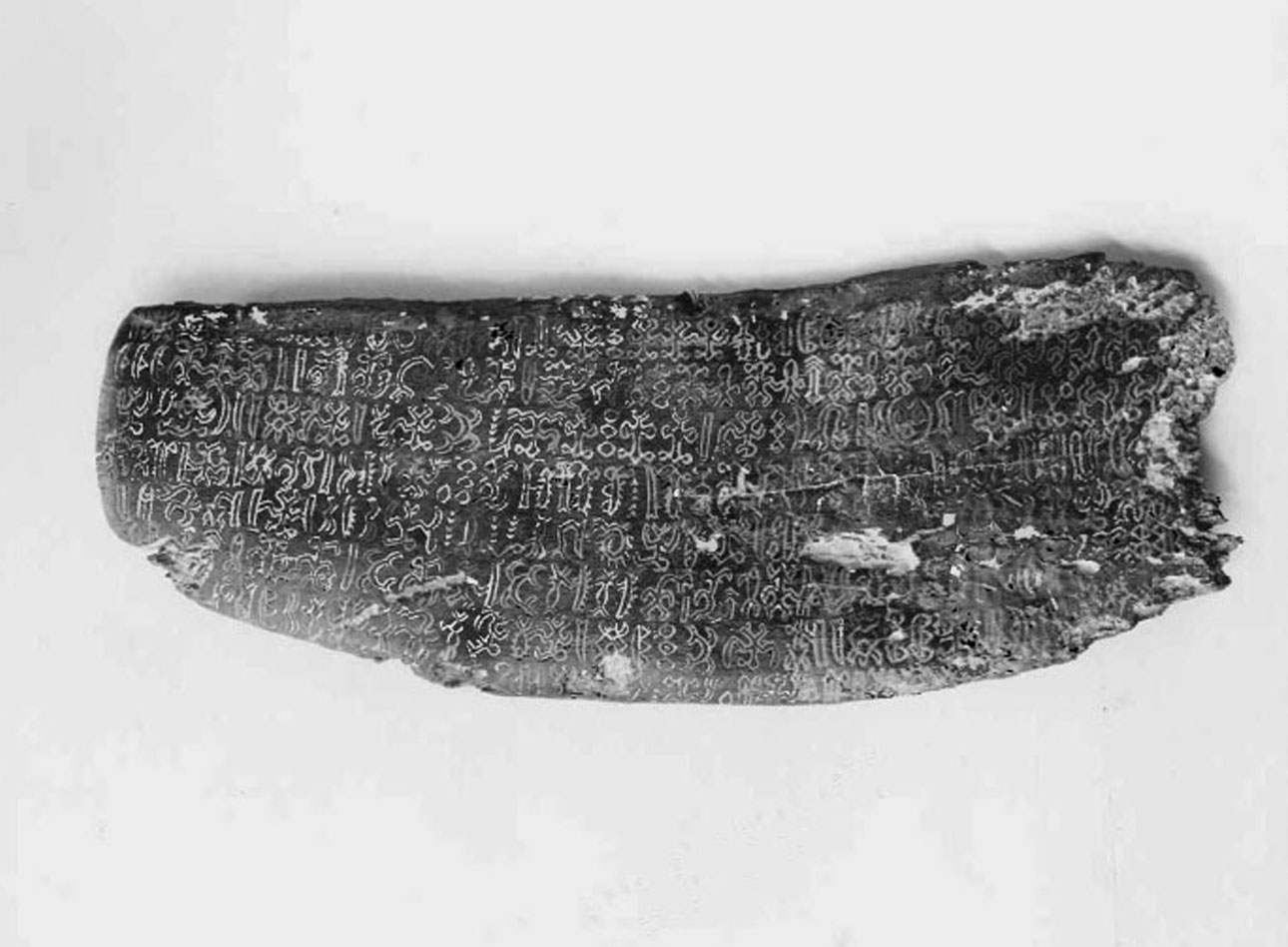
On a stormy night in December 1886, a U.S. Navy paymaster named William Thomson cornered an old man named Ure Vaeiko in his own house on Rapa Nui and would not let him leave. Vaeiko had spent days dodging questions about the wooden tablets islanders called kohau rongorongo, carved edge to edge with rows of tiny figures. He said he’d once trained to read them, before missionaries forbade it, and he wasn’t going to risk his soul explaining them now. Thomson had brought liquor. As the night wore on, Vaeiko agreed to recite the legend attached to a photograph of one tablet, fluently, without hesitation, for hours. Thomson then quietly swapped in a photograph of a different tablet. Vaeiko kept reciting the same story, unbroken. He wasn’t reading the glyphs. He was reciting a memorized legend he associated with a shape he recognized.
That failure sits near the start of almost everything written about rongorongo since. It’s the clearest evidence that even a man with some claim to training, one generation removed, couldn’t decode it sign by sign. The tablets first reached outside notice in 1864, when missionary Eugène Eyraud reported islanders kept them in nearly every house, though few could say what they meant anymore. Bishop Florentin-Étienne Jaussen began collecting them in 1868; within two decades, the Chilean navy, French missionaries, and Thomson’s own expedition had scattered the survivors into museum collections spanning several countries. Twenty-six are now catalogued, carved in a script that resembles nothing else ever found.
What happened in between explains the silence. Peruvian ships raided the island in 1862 and 1863, seizing more than 1,400 people, over a third of the population, to work as forced labor, including Maurata, the island’s last king. Most died within two years. A smallpox epidemic, carried home by the handful who survived the return voyage, cut the population further, to around 110 by 1877. Whoever still held the real key to reading the tablets was very likely among them.
The Roadblock
Every successful decipherment in history has had a bridge to something already known: a bilingual inscription, a living related language, a second sample large enough to test a guess against. Rongorongo has none of these. Twenty-six objects, several of them fragments or near-duplicates of each other, add up to roughly 15,000 glyphs total, a corpus smaller than one chapter of an ordinary book. No bilingual text has ever surfaced. Old Rapa Nui, the language any decipherment would need to fit, survives only in scraps; the language spoken on the island today is heavily mixed with Tahitian, imported after the population collapse.
The corpus itself isn’t even fully trusted. At least one tablet, examined closely, appears to carry a cruder set of glyphs carved directly over a genuine, now-illegible older inscription. Someone apparently faked the real thing on top of the real thing.
Steven Fischer announced in 1995 that he’d cracked the code, reading one tablet’s repeated three-glyph sequences as a chant: X copulated with Y, producing Z. Other researchers later showed that the four glyphs in his central example make up roughly a fifth of the entire corpus by themselves, meaning the pattern he’d found would turn up constantly in almost any sufficiently long, repetitive text, in any language, real message or none.
Best Guesses
Four positions get argued seriously, splitting on two questions that don’t divide the same way: whether rongorongo predates sustained European contact, and whether it’s language at all, spelled out sound by sound, rather than prompts for something already memorized.
Invented on the island before 1770
In 2024, researchers radiocarbon-dated four tablets held in Rome. Three came back 18th- or 19th-century. The fourth, called Échancrée, came from a tree felled between 1493 and 1509 — roughly two centuries before any European reached the island. If the carving is anywhere near that old, rongorongo joins a short list of writing systems invented from nothing, with no outside model to copy. The catch: the wood’s species isn’t native to Rapa Nui, and dating can only say when the tree was cut, not when anyone carved it. Driftwood can sit unused for years before someone picks it up.
Copied after the 1770 Spanish landing
In November 1770, a Spanish expedition claimed the island for its king and had Rapa Nui chiefs mark a formal annexation document alongside the ship’s officers. It’s the earliest confirmed encounter between islanders and European writing, the first document showing them respond with signs of their own — signs that mostly don’t look like rongorongo. Steven Fischer argues the script followed soon after anyway: islanders who’d just watched foreigners make meaning appear on paper went home and built their own version. It’s a clean origin story with a real document behind it. It struggles against the Rome tablet’s fifteenth-century date, and against a separate glyph-shape analysis reading the script’s visual style as centuries older than 1770.
Memory cues, not full writing
Most specialists who’ve studied the corpus doubt rongorongo spells language out sound by sound at all. The alternative: it’s a mnemonic system, glyphs that cued a trained reciter through chants, genealogies, and land claims already memorized by ear, closer to a musical score than an alphabet. It would explain exactly what Ure Vaeiko did in 1886: recite fluently from a shape he recognized, without reading a single sign. Thomas Barthel did identify three lines on the Mamari tablet as a working lunar calendar in 1958, still the one piece of rongorongo anyone can confidently say the function of, even unread.
Real writing, unreadable now regardless
Statistical analysis of the whole corpus found roughly a hundred phrases repeating across tablets, and just 52 signs accounting for nearly everything written, numbers some researchers read as a genuine, structured writing system rather than a loose set of prompts. If that’s right, rongorongo belongs beside cuneiform and hieroglyphs as an independent invention of writing. It just may not matter. Twenty-six objects and 15,000 signs, with the last people who could check a guess against real fluency gone since the 1860s, may fall short of what any script needs to be read back into meaning, whichever kind of writing it turns out to have been.
The Verdict
The Rome tablet gets close and stops short. A piece of driftwood can predate the hand that carved it by decades, and the researchers who dated it say so themselves, so a fifteenth-century date argues for a pre-contact script without quite proving one. A second tablet would close that gap: independently dated to before 1722, on wood that’s demonstrably native and freshly cut rather than salvaged driftwood. More testing is already underway across the surviving 26, and each new date either tightens the case or reopens it. Rarer, and far more decisive, would be a bilingual object — anything pairing rongorongo glyphs with a language someone can actually read. Nothing like that has ever turned up, on the island or off it. Every reading published since Jaussen’s first tablets reached Tahiti rests on the same ground Fischer’s did: internally consistent, structurally plausible, and answerable only to itself.
Where do you stand?
That’s one. There’s another every morning at 6 a.m. local time.
Share where you stand
What Didn't Hold Up
Details that circulate with this case but failed verification against independent sources. Cut from the story above — listed so you know they weren't missed.
“Rongorongo has been fully deciphered — most recently a 2025 academia.edu preprint and a hobbyist GitHub "master lexicon" project, both claiming to have translated all 26 tablets.”
Neither claim is peer-reviewed or has been accepted by any rongorongo specialist. At least 20 proposed decipherments have failed the same way since Fischer's 1995 announcement; the only reading scholars broadly accept is Barthel's 1958 lunar calendar on one tablet, not a translated text.
The Rabbit Hole
- Thomson's full 1891 report, 'Te Pito te Henua, or Easter Island'the officer's own field account, tablets and all, including the night he spent trying to get one read
- The 2024 radiocarbon dating study, in fullthe actual paper behind the pre-contact headlines, caveats included
- The 1770 Spanish annexation documents, translatedthe annexation act Rapa Nui chiefs marked, the document at the center of one origin theory
- Smithsonian Magazine on the 2024 dating studythe clearest plain-language summary of what the radiocarbon result does and doesn't prove
- History.com on the population collapsethe fuller human history behind why no one is left to read the script