
№ 001229 AUGUST 2026DISAPPEARANCEROANOKE ISLAND, NORTH CAROLINA
The Roanoke Colony's Second Disappearance
The Colonists Left a Note Saying Exactly Where They Went
Unsolved since 1590In 1590, John White returned to Roanoke Island and found it empty — the fort dismantled, his belongings dug up, and one word carved into a post as planned if the colonists relocated safely: CROATOAN. He never reached them. Two archaeology teams are digging different sites, and they don't agree.
What We Know
John White sailed for England in the last days of August 1587, nine days after his granddaughter Virginia Dare was born on Roanoke Island, the first English child born in the Americas. He left behind 117 people, including his daughter Eleanor and her husband Ananias, and a plan: if the colony had to move, they would carve their destination into a post; if they were in danger, they would carve a cross above it. He expected to be back within months.
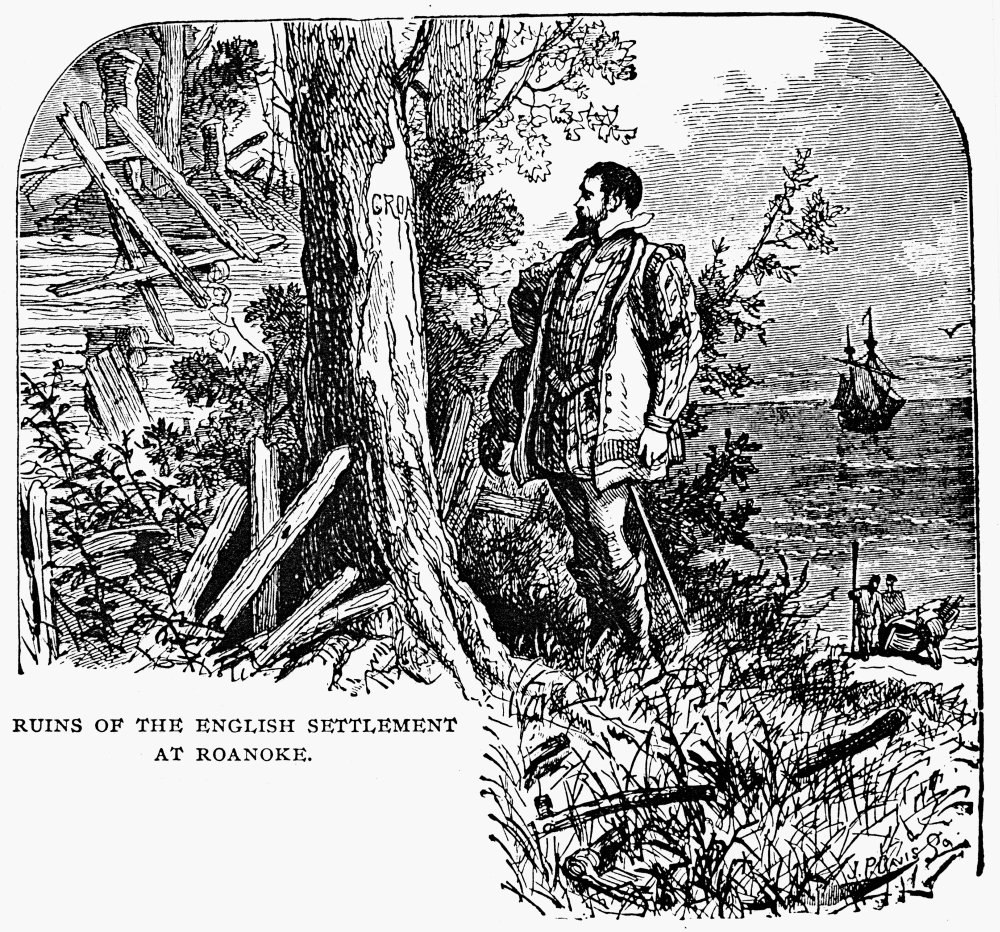
War with Spain kept him away three years. When White finally landed again in August 1590, the settlement he had helped build was gone. Not burned, not wrecked. Dismantled, the houses taken down, the site newly ringed by a high palisade of cut trees. Five chests that colonists had buried before he left had been dug up and broken open, three of them his own; his own books lay torn from their covers, his maps rotted by rain. Carved into a tree near the shore were the letters CRO. At the fort’s entrance, five feet up, in what White called “fayre Capitall letters,” was a whole word: CROATOAN.
There was no cross beside it. By the code White himself had set up, that meant exactly what it looked like: the colonists had left on purpose, for Croatoan Island, and were not in danger. White meant to sail there directly and confirm it himself. A storm damaged his ships’ cables before he could, and his crew, low on supplies and unwilling to risk the coast again, turned for England instead. White spent what money and influence he had left trying to fund another voyage back. He never managed it. His last known letter is dated 1593, and the record goes dark after that — no one knows for certain when he died. He never learned what became of his daughter, his granddaughter, or anyone else he had left on that island.
The Roadblock
The frustrating part isn’t the disappearance. White solved that in an afternoon. The colonists told him, in his own pre-arranged code, exactly what had happened: they had relocated, safely, to a specific place. The frustrating part is that “a specific place” hasn’t turned out to be specific enough to find.
Croatoan Island is now called Hatteras. Fifty miles inland, along the Chowan River, is the other place several colonists told White they might try if Hatteras didn’t work out. Both are real, findable places, and both are being actively excavated right now. Neither has produced a colonist’s grave, a structure that’s unambiguously English, a document, or a name — the things archaeology usually needs to call a case closed. What both sites have instead is fragments that fit more than one story: iron flakes, pottery, a copper ring, a musket ball. Four hundred and thirty-six years of weather, farming, and looting have thinned the physical record down to fragments ambiguous enough that two honest, well-trained people can study them and land on opposite conclusions.
Best Guesses
Assimilation on Hatteras
Since 2009, archaeologist Mark Horton and Croatoan Archaeological Society president Scott Dawson have excavated Hatteras Island and reported a musket ball embedded in a deer’s jawbone, gun parts, wine-glass fragments, and what Horton calls “buckets” of hammerscale — blacksmithing waste that Horton says the Croatoan didn’t otherwise practice. Bioarchaeologist Beth Scaffidi’s isotope analysis of local diet shows a blend of European and Indigenous food signatures. No forge or hearth has turned up to anchor the metalworking to a date, and the findings haven’t cleared peer review. Horton calls the overall pattern “peaceful assimilation.” Charles Ewen, of East Carolina University, isn’t convinced: “I don’t see any evidence that you have Europeans actually living there.”
Inland move to the Chowan
Some colonists told White before he left that if Hatteras fell through, they would try “fifty miles into the maine,” meaning inland. Historian James Horn and archaeologist Eric Klingelhofer’s First Colony Foundation found a hidden fort symbol under a paper patch on White’s own map, pointing to a site on the Chowan River. Digging there since 2012, they’ve recovered English and Algonquian pottery, a German cloth seal, and a hand-wound copper ring, part of what the Foundation calls the largest cache of Elizabethan-era artifacts found in America outside Jamestown. Erosion has already damaged part of the site, and nothing recovered there names a single colonist.
Killed on Powhatan’s order
Chief Powhatan is said to have confessed, years later, that he had ordered the colonists killed for living among a rival people, and to have produced a musket barrel and a mortar and pestle as proof — but the confession survives only in chronicler Samuel Purchas’s secondhand 1625 retelling of a meeting with Captain John Smith, not in anything Smith wrote himself, and William Strachey’s separate, earlier account doesn’t corroborate those specifics. No mass grave, no bodies, and no independent archaeological trace of a massacre has ever surfaced to support the story. Researcher Brandon Fullam has argued that if the account describes a real event at all, it may be about a different, smaller group of Englishmen — not the 1587 colonists.
A split, unresolved fate
Horn’s own current position isn’t a single site: the group likely split, some going to Hatteras and some inland, which would explain why both digs keep turning up real but incomplete evidence instead of one conclusive site. It fits the fragments better than either single-site theory does on its own. It is also, by definition, unfalsifiable in the way the other three theories at least attempt not to be: there’s no one place left to dig that would prove or disprove a divided colony, only more places that might confirm a piece of it.
The Verdict
It would take a marked grave, or an object no one can argue with — a signet ring with a name still legible, an inscription that can’t be read two ways — something dated to a narrow window and tied unambiguously to one named person. Not more hammerscale, not another pottery shard: both camps already have plenty of those, and neither has moved a specialist’s opinion. Genetic testing offers one other path: comparing DNA against colonist family lines the way it has narrowed other centuries-old identity cases. That work, if it ever happens, has to be led by and answer to the descendant communities involved, not the archaeologists racing to publish first. Until then, both teams will keep digging in places fifty miles apart, publishing findings that are individually real and collectively irreconcilable. Horton predicts the argument will never fully close, because people like the mystery too much to let it. He may be the only person in this argument everyone agrees with.
Where do you stand?
That’s one. There’s another every morning at 6 a.m. local time.
Share where you stand
The Rabbit Hole
- Encyclopedia Virginia: John White's 1590 'Fifth Voyage' narrativeWhite's own account of returning to a settlement he could not find again, in his own words.
- NPS Fort Raleigh: Major Theories of the Lost Colonythe National Park Service's own even-handed rundown of all six historical theories.
- First Colony Foundation newsongoing primary dispatches from the Chowan River excavation, as the digs happen.
- Live Science: the Hatteras findings, and the case against themthe fullest published account of Charles Ewen's skepticism toward the assimilation claim.
- Coastal Review: 'Science on the Sound' lecture writeupthe most recent dispatch from the field as of this writing, March 2026.