
№ 004127 SEPTEMBER 2026IDENTITYPILTDOWN, SUSSEX, ENGLAND
Piltdown Man
The Hoax That Buried Its Own Maker
Unsolved since 1953In December 1912, a Sussex solicitor unveiled a skull that supposedly made England the missing link's birthplace. Scientists believed it for forty-one years, until 1953 chemistry exposed a filed orangutan jaw stained to match a human skull. A 2016 forensic study narrowed the suspects. It has never named one.
What We Know
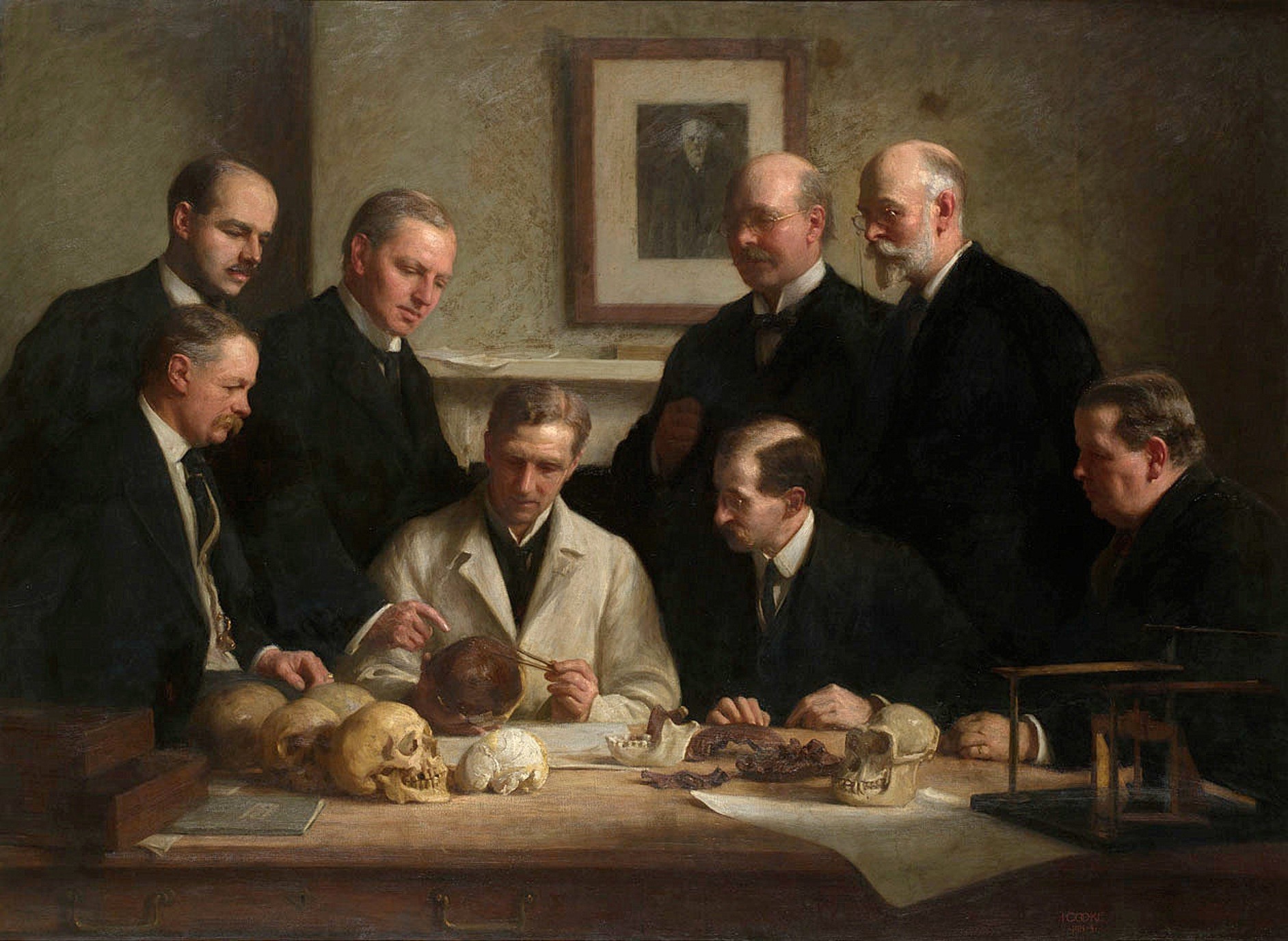
Charles Dawson wanted into the Royal Society more than he wanted almost anything else. A Sussex solicitor with no training in geology or anatomy, he had spent two decades sending the Natural History Museum an unbroken run of finds: a fossilized toad sealed inside a flint nodule, a hybrid boat half rowing skiff and half sailing cutter, Roman tiles stamped with an inscription nobody else could place. In 1908, workmen digging a gravel pit near the Sussex village of Piltdown handed him a chunk of what looked like an unusually thick human skull.
By December 1912, Dawson had enough to bring to Arthur Smith Woodward, the Natural History Museum’s Keeper of Geology. Together they announced Eoanthropus dawsoni to the Geological Society of London: a braincase built like a modern human’s, paired with a jaw built like an ape’s. If it was real, the human brain had evolved before the human jaw did, and it had happened in England, not Africa or Asia.
A British anatomist said within a year that the skull and jaw came from different animals; two American scientists reached the same conclusion later on, working independently. Nobody with real institutional standing backed any of them. In 1915, Dawson reported a second site two miles off, yielding more fragments in the same pattern, and this time nobody but Dawson had ever stood on the ground they came from.
He died in 1916, at fifty-two, thirty-seven years before anyone examined what he’d built closely enough to see the file marks.
It took chemistry, not anatomy, to finish the job. In 1953, Kenneth Oakley ran a fluorine test measuring how long bone sits absorbing groundwater minerals; the jaw hadn’t been buried nearly as long as the skull. Joseph Weiner and Wilfrid Le Gros Clark followed the thread under a microscope and found file marks on the molars: an orangutan’s teeth, ground flat and stained to pass as a fossilized human’s. Forty-one years after Dawson unveiled it, Piltdown Man wasn’t extinct. It had never been alive.
The Roadblock
Dawson died three decades before anyone thought to ask who had built the fake, which means the one person with certain knowledge left no chance to be questioned. Everyone else who might know is a step removed. Woodward vouched for the finds and co-published them, but no letter or ledger puts a tool in his hand. A museum technician could have had the skill without anyone thinking to name him.
The physical evidence has real limits too. Chemistry and CT scanning can establish how a fake was built, and that one method produced both sites; they cannot put a name on the hands that filed a molar in 1911. Fingerprints do not survive a century of handling. Nobody wrote down a confession.
Then there’s the opportunity problem, which cuts against the tidiest answer rather than for it. Dawson was the only witness at the second Piltdown site, but he wasn’t the only person with access to the museum’s own skeletal collection, or to the stains later found on the bones. Ruling accomplices out means proving a negative no surviving document was ever going to settle.
Best Guesses
Four names keep surfacing, none attached to a signed confession or a witness who watched the fossils get planted. What survives instead: a single orangutan specimen, a repeated staining recipe, file marks visible only under magnification, and records of who had access to Piltdown’s gravel pit or the museum’s skeletal collection. Opportunity, motive, and forging skill rarely line up behind one name. Here is how each case holds up.
A Lone Forger Named Dawson
The strongest evidence argues for exactly one person. A 2016 forensic study traced every fragment from both Piltdown sites to the same orangutan and the same handful of human skulls, prepared with identical staining and filing: the mark of one forger, not a changing cast. The workmanship was crude, not expert: cracked teeth, fractured bone, putty set too fast, fitting an untrained solicitor better than anyone else here. Add his run of thirty-eight earlier fakes and a failed bid for the Royal Society, and even the study’s own authors stop short of closing the file: “whether Dawson acted alone is uncertain,” they wrote.
Woodward Supplied the Specimens
Dawson had the ambition; a 1994 academic case argues he lacked the raw materials. That premise took a hit in 2016: the forensic study found the actual forging crude, not expert, which cuts against the idea that Dawson needed a specialist’s help at all. Gerell Drawhorn’s AAPA poster still lines up nearly every specimen later faked into Piltdown against Arthur Smith Woodward’s own career: hippo fossils from a Maltese cave he described in 1894, elephant fossils he excavated in Greece in 1901, orangutan bones his museum catalogued in 1899, thick Tierra del Fuego skulls reaching his department that same year. Woodward also steered the chemical testing toward an inexperienced local analyst instead of his own mineralogist.
Hinton’s Initialed Trunk
In 1978, seventeen years after zoologist Martin Hinton’s death, museum staff clearing storage found a trunk with his initials, packed with bones stained in the same iron-and-manganese recipe used on the Piltdown fossils. The museum’s 2012–2016 investigation, using far more sensitive instruments than existed in the 1990s, barely mentions Hinton, pointing at Dawson instead — though that doesn’t settle what the trunk itself proves. Researchers who argued the case in 1996 and 2003 read it as rehearsal material for the hoax; a live alternative reads it as Hinton testing, and doubting, a hoax he only suspected. His motive is not in question. As a young volunteer, Woodward simply never paid him for his cataloguing work.
Conan Doyle, for Spite
Arthur Conan Doyle lived seven miles from the dig, played golf on a course that overlooked it, and had spent years mocked by scientists for believing in spiritualism. In 1983, researcher John Winslow built a circumstantial case, in Science 83 magazine, that Doyle staged the hoax to embarrass the men who’d embarrassed him, reading a line from Doyle’s 1912 novel The Lost World — “a bone can be faked as easily as a photograph” — as something close to a signed joke. Most Piltdown historians reject it: a 2016 rebuttal notes Doyle visited the dig only once against twenty-plus recorded recovery trips, and that the geography Winslow leaned on doesn’t match the novel. The theory persists anyway, mostly on the strength of the name attached.
The Verdict
The museum, the Sussex Archaeological Society, and multiple biographers have combed the obvious archives since 1953, and nothing has surfaced. What’s missing is small and specific: a letter, a diary entry, a receipt naming a role in the fabrication, written by someone other than Dawson.
What forensic science can still add is narrower than it sounds. A sharper isotopic or genetic technique might further pin down which specimens were used, but it cannot read a signature off a filed tooth, because there was never one to read.
Barring a document nobody has found in seventy-plus years of looking, the honest answer stays what the study’s own authors wrote in 2016: most likely Dawson, possibly not only Dawson. Nobody has published anything since that moves it either way.
Where do you stand?
That’s one. There’s another every morning at 6 a.m. local time.
Share where you stand
What Didn't Hold Up
Details that circulate with this case but failed verification against independent sources. Cut from the story above — listed so you know they weren't missed.
“A 2016 genetic and forensic study finally solved who committed the Piltdown Man hoax.”
Overclaims a hedged finding: the study's own authors wrote 'whether Dawson acted alone is uncertain.' It names Charles Dawson as most likely sole forger, not a solved case, and nothing published since has closed it.
“Arthur Conan Doyle confessed to the Piltdown hoax in a line from his 1912 novel The Lost World — 'a bone can be faked as easily as a photograph.'”
Traces to a 1983 circumstantial case. Doyle visited the dig only once against twenty-plus recorded recovery trips, and the geography the theory relies on doesn't match the novel; no document or confession has ever surfaced.
“Zoologist Martin Hinton was the real forger, proven when a trunk of stained bones bearing his initials turned up in a museum attic in 1978.”
The trunk and staining are real, but the 2012–2016 forensic investigation, using far more sensitive instruments, barely mentions Hinton and points to Dawson instead. It's at least as consistent with Hinton testing a hoax he suspected as building one.
The Rabbit Hole
- De Groote et al., 'New genetic and morphological evidence suggests a single hoaxer created Piltdown man' (Royal Society Open Science, 2016) — full textthe DNA analysis, the CT scans, and the sentence that keeps the case open
- Gerell Drawhorn, 'Piltdown: Evidence of Smith-Woodward's Complicity' (AAPA poster, 1994) — full textthe fullest written case that the museum's own keeper was involved
- Linda Hall Library: Martin Alister Hintonthe trunk, the grudge, and why the case for Hinton faded after 2016
- Darren Naish, 'Piltdown Man Came from The Lost World... Well, No, It Didn't' (Scientific American, 2016)a working paleontologist takes the Conan Doyle theory apart, claim by claim