
№ 002410 SEPTEMBER 2026ARTIFACTPHAISTOS, CRETE
The Phaistos Disc
241 Signs, One Object, No Second Copy
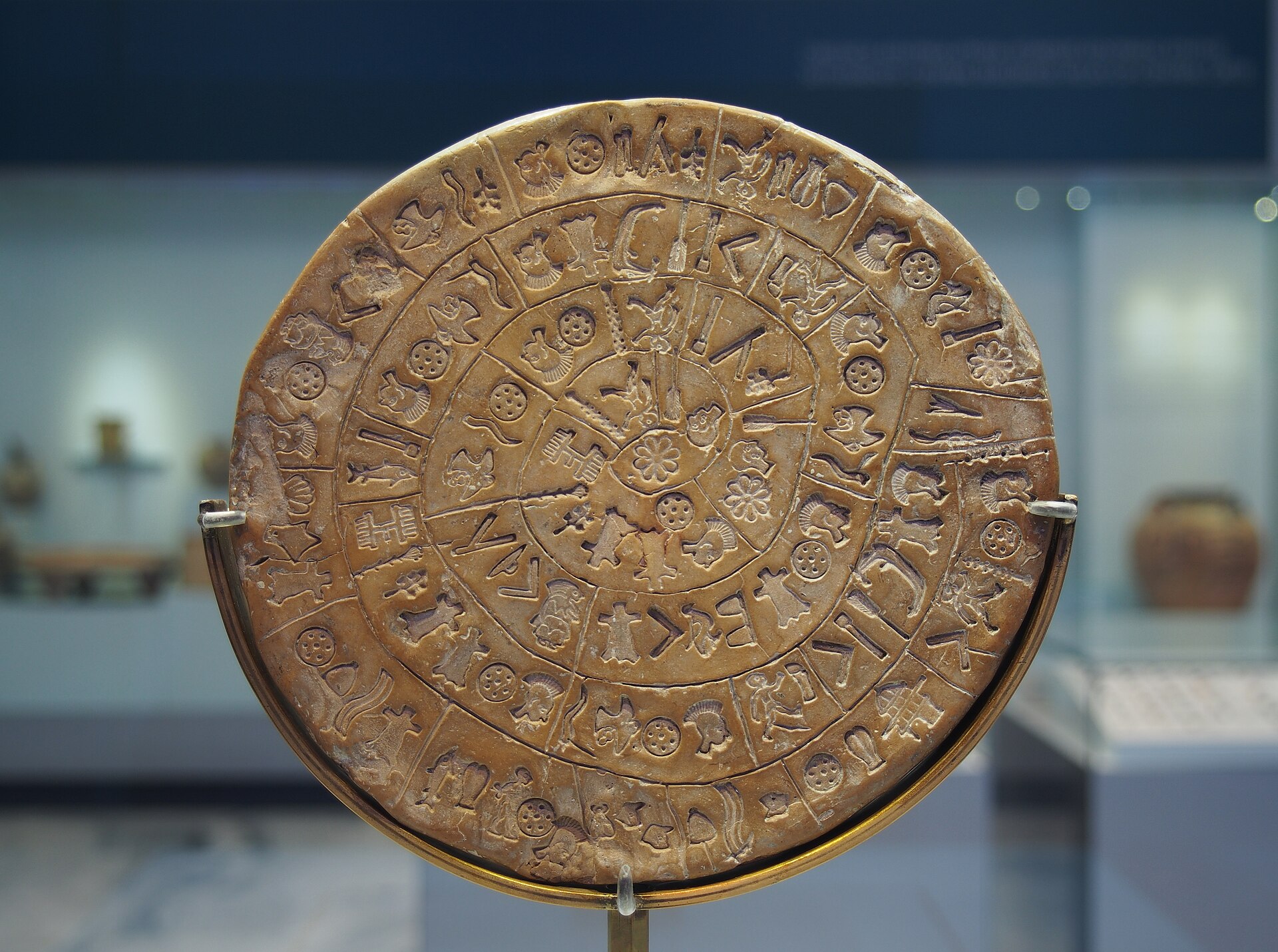
Unsolved since 1908In 1908 a Cretan foreman turned up a clay disc stamped, not carved, with 241 signs in a spiral — meaning someone first had to cut 45 reusable seals, centuries before movable type existed anywhere else. No one has ever found a second object in the same script.
What We Know
On the evening of July 3, 1908, Zacharias Eliakis was working through a half-cleared room at the Minoan palace of Phaistos, on Crete’s south coast, when something in the debris caught the light. Eliakis was a foreman on the Italian Archaeological Mission led by Luigi Pernier, the man who usually gets the credit, though it was Eliakis who actually saw it first. What he’d found was a disc of fired clay, about the size of a saucer, covered on both faces with a spiral of tiny stamped pictures: a boat, a helmeted head, a flower, a running man. It had been buried alongside a Linear A tablet and pottery, in a layer disturbed since antiquity. That was enough to place it in time. It wasn’t enough to pin the date exactly.
Later fieldwork narrowed it further. Excavations led by Pietro Militello in 2013 and 2015 re-examined the same stratum and pointed to the very start of the Neopalatial period, roughly 1750 BCE, the age of the great palace at Knossos. The disc itself looks nothing like that era’s other writing. Its 241 signs, drawn from a set of 45 distinct pictograms, weren’t scratched into the clay by hand. They were pressed, each sign its own individual stamp, driven into the wet surface before the disc went into a fire. Someone had to cut 45 reusable seals, probably metal, before a single sign went down. That’s manufacturing logic centuries ahead of anything else known from the Bronze Age — a disassembled alphabet, ready to print, at a time when everyone else was still carving one letter at a time.
A second example doesn’t exist. Not at Phaistos, not anywhere else in the Aegean, across more than a century of digging. One candidate gets raised anyway: a fragmentary inscription on a bronze axe found at Arkalochori, twenty miles away. Even Brent Davis, the Melbourne scholar who raises it, calls it only a “perhaps,” not a genuine match. Whatever language, if any, is spiraling toward the disc’s center, it exists, as far as anyone has found, exactly once.
The Roadblock
Effort isn’t the missing ingredient here. No amount of it can turn a guess into an answer anyone else could check.
A proposed reading is only as good as what it can be tested against. The Rosetta Stone gave Egyptian hieroglyphs a check: the same decree, carved a second time in Greek, a language nobody had to guess at. Linear B got its check more slowly — Michael Ventris tested guessed sound-values against hundreds of tablets until they resolved into an actual, checkable language. The Phaistos Disc offers no such second data point. Its 241 signs are the entire surviving corpus of its script, split across one physical object. Brent Davis, an Aegean-scripts specialist at the University of Melbourne, put it plainly: the script “is found on no other object,” and the corpus is “far too small to be deciphered in any reliable way.” Thomas Palaima, who directs the University of Texas’s Program in Aegean Scripts and Prehistory, makes the same point from the opposite direction: a claimed decipherment can’t meet “the standard of ‘probability,’” because there isn’t enough data to prove any one reading right, or every rival reading wrong.
That’s the actual shape of the problem. The disc isn’t too hard to read. Reading it correctly and reading it wrong would look, from the outside, identical.
Best Guesses
Prayer to a Minoan goddess
Gareth Owens has spent more than thirty years on the disc. His method: read its signs using the sound-values already worked out for Linear B, then test the resulting syllables against Indo-European vocabulary. By his own account it gets him most of the way there: “there is no doubt,” he says, “that we are talking about a religious text,” a hymn to a pregnant mother goddess and, on the reverse, to Astarte, an eastern love-goddess later folded into the Greek pantheon. Owens calls it 99 percent solved. The method’s flaw sits underneath the confidence. It assumes an older, unrelated script shares Linear B’s pronunciation as well as its shapes, an assumption the field rejects outright.
Unconfirmable script
The field’s own position is less satisfying and, it argues, more honest. The signs are almost certainly writing, probably syllables, judging by how they repeat and recombine. But with one object, one script, and no second inscription to test a reading against, no decipherment can be confirmed or ruled out. Not Owens’s, not anyone’s before him. Yves Duhoux, reviewing decades of attempted solutions, made the sharper point: a sample this small lets a determined reader produce a plausible answer in nearly any language they choose. Plausible isn’t provable. The ceiling here is built into the evidence, not the effort behind it.
Ancient board game
The newest theory, posted in January 2026, ignores meaning entirely and asks how the disc was made. Constantinos Ragazas points to its stamping: one face is deeper and more evenly pressed than the other, as if the clay had partly dried between sessions, work spread across more than one sitting, not composed at a single desk. The layout fits too: figures around the rim face outward, toward a viewer, while the spiral’s figures face inward. He compares the design loosely to old spiral race-games. The paper hasn’t been peer-reviewed, and it doesn’t explain the disc’s own recurring sign-groups — signs that repeat like a refrain across the spiral, the kind of patterning that reads as language, not as game notation.
Pernier’s 1908 hoax
The minority view doubts the disc is ancient at all. In 2008, forgery specialist Jerome Eisenberg argued that Pernier fabricated it to rival better-funded contemporaries digging elsewhere on Crete, and that an object this isolated is exactly what a forger’s shortcuts would leave behind. The stronger evidence runs the other way. Decades after Pernier’s death, excavators independently turned up the disc’s distinctive “comb” sign three more times: on a stamped pot in 1965, on a sealing recovered in 1955, and among a wider set of impressed pottery designs identified since, all pulled from sealed, dated deposits no one in 1908 could have reached or planted.
The Verdict
Two different questions get asked about this object, and only one of them is actually converging. Whether the disc is genuine keeps getting easier to accept: sealed deposits from the 1950s and 60s have turned up its “comb” sign three separate times, in contexts nobody from 1908 could have reached, and every new match makes deliberate fabrication harder to credit. What the disc says is a different problem, and it isn’t converging at all. A second inscription, even a fragment, even a handful of the same 45 signs stamped onto something else entirely, would give scholars the one thing every proposed reading has lacked since Pernier’s team logged the find: a place to check a guess against something other than itself. Nothing like that has surfaced yet, at Phaistos or anywhere else on Crete. Every reading proposed since 1908 — Owens’s included — is still waiting on the one object that could confirm it or kill it.
Where do you stand?
That’s one. There’s another every morning at 6 a.m. local time.
Share where you stand
The Rabbit Hole
- Heraklion Archaeological Museum: the disc's own exhibit pagethe object's official record, from the museum that holds it
- Ancient Near East Today: the authenticity evidence, in fullthe potmarks and sealings that argue against the forgery theory, with photographs
- Biblical Archaeology Society: two epigraphists explain why decipherment failsthe clearest public explanation of the field's structural objection
- GreekReporter: Gareth Owens's goddess-hymn reading, in his own wordsthe decipherment claim itself, as its author describes it
- GreekReporter: the 2026 board-game hypothesisthe newest theory, and the manufacturing evidence behind it