
№ 00473 OCTOBER 2026ARTIFACTMITTELBERG HILL, NEAR NEBRA, SAXONY-ANHALT, GERMANY
The Nebra Sky Disc
A Sun, a Moon, and a Fight Over a Thousand Years
Unsolved since 1999In 1999, looters pickaxed a gold-inlaid bronze disc out of a German hillside and sold it on the black market for years before a sting recovered it. Since 2020, two teams of archaeologists have publicly disagreed about its age — by a thousand years.
What We Know
In a hotel bar in Basel, Switzerland, on February 23, 2002, museum director Harald Meller stalled for time. He’d come to buy a looted Bronze Age hoard from two antiquities dealers for 700,000 Deutschmarks, and one seller had the centerpiece taped to his stomach under a towel. Meller staged a fake authenticity test with a chemist’s testing liquid, excused himself to the restroom, and called the police. When he sat back down, detectives moved in.
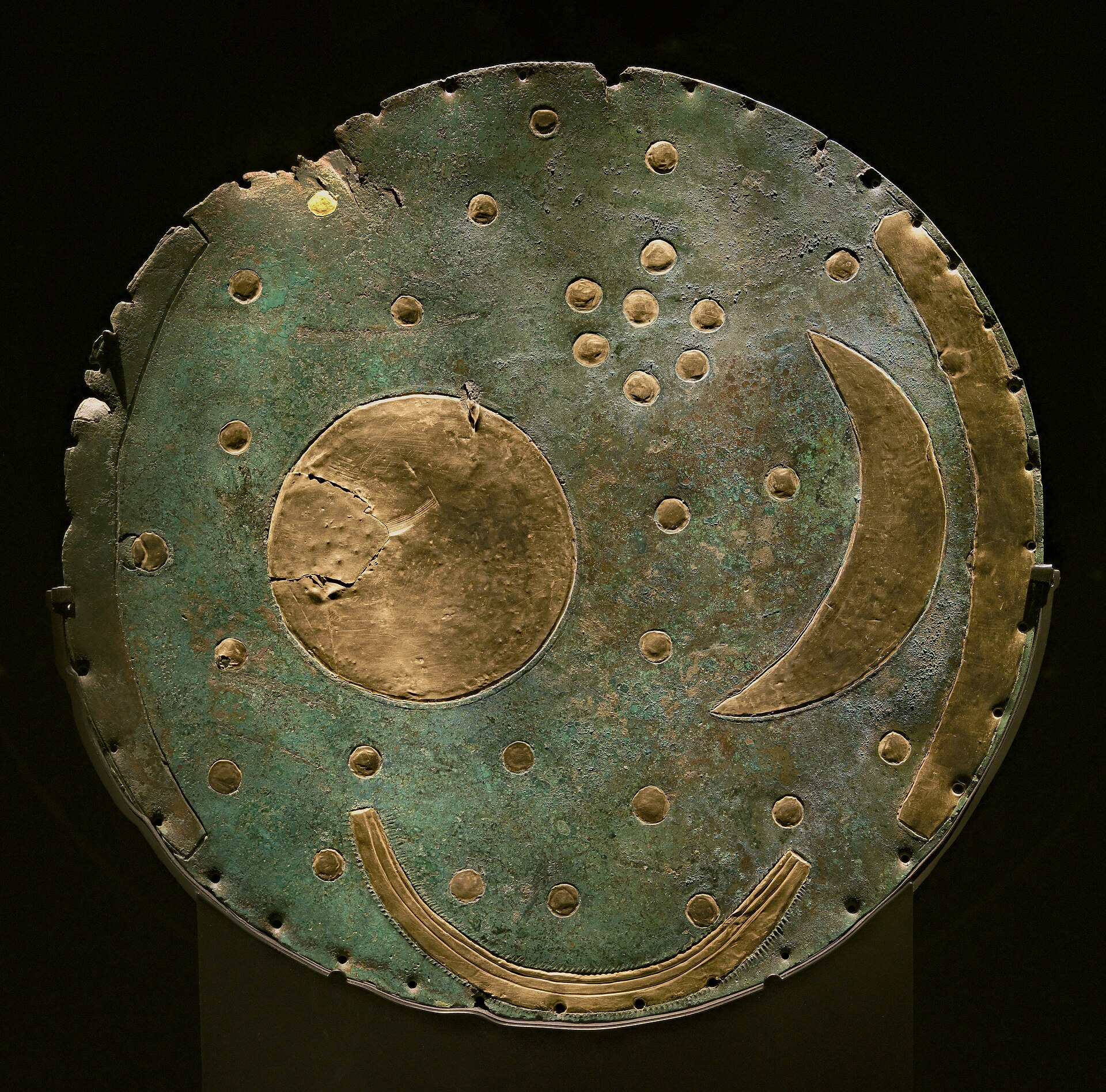
The object under the towel was a bronze disc the size of a dinner plate, its corroded green surface inlaid with gold: a full circle for the sun or moon, a crescent for the other, and a scatter of small gold dots, including one tight cluster of seven widely read as the Pleiades. Two and a half years earlier, two unlicensed treasure hunters had dug it out of a hillside near Nebra with a fire-fighter’s pickaxe, chipping its rim and losing at least one star. They sold it that same day for 32,000 Deutschmarks. It passed through two more sets of hands before Meller’s sting brought it home.
Archaeologists couldn’t date the disc itself, since no lab test dates bronze or gold directly, so they dated what had allegedly been buried with it: two swords, two axes, arm-spirals, and a chisel, recovered from the site the following August. Birch bark packed into a sword’s hilt radiocarbon-dated to 1600–1560 BCE. The disc’s corrosion was consistent with the same age. As a check against modern forgery, its bronze carried no trace radioactivity, ruling out anything cast after 1945. Two gold arcs added later mark the angle between summer- and winter-solstice sunsets at the site’s latitude, correctly, to the degree.
That case made the Nebra disc, by the museum’s own account, the oldest known concrete image of the sky. It held until 2020, when two archaeologists said the dating rested on evidence that couldn’t bear the weight.
The Roadblock
The problem isn’t that nobody has looked hard enough. It’s that the one method that would settle this doesn’t exist. No lab test dates bronze or gold directly: only radiocarbon, which needs organic material Bronze Age smiths didn’t leave inside a disc. Every date the Nebra disc has ever been given is borrowed from the objects buried around it, and those objects are known only because two looters, then a chain of dealers, handled and resold them for three years before anyone with a trowel reached the site.
In 2020, Rupert Gebhard, a Munich museum director, and Rüdiger Krause, a Frankfurt professor, both specialists in exactly the periods in question, argued the disc’s corrosion and damage don’t match how the finders said it lay in the ground, and that the metal chemistry linking it to the swords is weaker than claimed. Ernst Pernicka and Harald Meller’s team, working from a larger dataset and the criminal trials’ cross-examined testimony, rebutted them point by point. Neither side has recanted. Two credentialed teams are reading the same evidence and reaching opposite conclusions. That’s what happens when the chain of custody, not the age of the metal, is the actual open question.
Best Guesses
A Bronze Age lunisolar calendar
This is the state museum’s position, and what most popular accounts repeat uncritically. Typological dating, radiocarbon-dated birch bark, the disc’s corrosion structure, and its absence of modern radioactivity all point to the Early Bronze Age. Astronomer Rahlf Hansen has proposed the moon-and-Pleiades pairing encodes a rule adapted from Babylonian calendar texts: when the crescent moon appears too thick next to the Pleiades in spring, insert a leap month to bring the lunar year back in line with the solar one. But every one of those dating methods tests the hoard, not the disc itself, and whether the hoard is one undisturbed burial is exactly what’s contested.
A misdated Iron Age object
No comparable Iron Age disc has ever surfaced. Gebhard and Krause argue from swords, not another object like this one, and Pernicka’s team says a larger chemical dataset makes the hoard look more uniform than they reported. Even so, the case isn’t hand-waving. Gebhard, an Iron Age and Celtic-art specialist, points to a fifth-century-BCE iron sword from Munich-Allach, inlaid in gold with a full moon, crescent moon, and five stars — the closest stylistic match, he argues, on record. He reads the disc’s bottom arc as a rainbow, a known Celtic motif, not a solar boat. If he and Krause are right, the disc isn’t a thousand years older than the swords buried near it. It’s roughly their age, buried later among them.
A dating no excavation can close
Emilia Pásztor, an archaeologist studying the disc from outside both camps, has described it as the kind of find that gets argued over indefinitely until an accurate absolute dating method exists for metal itself. None does yet. That’s a claim about the toolkit, not agnosticism for its own sake: every argument on either side is inference from context, and the context here comes from three years of black-market handling, not an excavation. Gebhard and Krause, and Pernicka and Meller’s team, have pored over the same chemical data and trial transcripts and stayed in opposite, confident places. The standoff marks a limit in the toolkit, not a failure by either side, and it leaves a reader with no answer, only an honestly named limit.
A ruler’s symbol, not a working clock
Even scholars who accept the Bronze Age date don’t agree what the disc was for. Meller himself leans toward reading it as a political object: proof a Bronze Age elite could claim authority over the calendar, the way a coin claims authority over value, whether or not it ever tracked a leap month. The disc’s history fits a symbol better than an instrument, too: arcs added, then apparently removed, holes punched around the rim just before burial. There’s no angle to measure here, no calculation to check against the sky, only a pattern of changing use that looks more like shifting symbolism than a fixed tool.
The Verdict
Two things could break this deadlock, and neither exists yet: a second Nebra-type object, found by archaeologists instead of looters, with a documented findspot nobody had three years to rearrange, or a genuinely new way to date bronze and gold directly, one that doesn’t lean on nearby organic material. Absent both, the two sides stay locked in the same trial transcripts and the same isotope ratios, each reading internally consistent enough that neither side has forced the other to concede. The honest description of the Nebra disc, until one of those two things turns up, isn’t “the oldest known image of the cosmos.” It’s a bronze disc two archaeological teams, working from the same evidence, cannot agree how old it is. Nobody planted it. Nobody’s proven it’s fake. They just can’t agree when it was made.
Where do you stand?
That’s one. There’s another every morning at 6 a.m. local time.
Share where you stand
What Didn't Hold Up
Details that circulate with this case but failed verification against independent sources. Cut from the story above — listed so you know they weren't missed.
“In 2004, an archaeologist publicly declared the Nebra Sky Disc a modern forgery, its patina faked with acid, urine, and a blowtorch.”
Peter Schauer never examined the actual disc and never published the claim in a peer-reviewed journal — he had to admit this in court. The roughly 18 scientists who did study it directly, including chemical and microscopic patina analysis, rejected the forgery claim.
The Rabbit Hole
- The Hunt for the Sky Discthe museum's own telling of the black-market sale and the Basel sting, in full
- Gebhard & Krause's dating challenge, in their own wordsthe 2020 press release laying out all three of their arguments, with photos
- State Museum of Prehistory Halle: the disc's official recordthe institution that holds the original, on how it dates and displays it
- Smithsonian Magazine on the 2020 disputea clear, accessible walk-through of both sides as the story broke
- Astronomy.com: is it even a map?a deeper look past the dating fight, at what the disc's imagery might mean