
№ 009217 NOVEMBER 2026DEATHLONGWOOD HOUSE, SAINT HELENA
The Death of Napoleon
The Doctor Who Wouldn't Sign Napoleon's Autopsy
Unsolved since 1821On May 6, 1821, Napoleon's physician cut open the body and found advanced stomach cancer. The British doctors in the room signed a report contradicting him on almost everything else. Arsenic had been in his hair for years. No one has ever agreed on why, or how much it mattered.
What We Know
Francesco Antommarchi was thirty years old, Corsican, and by his own era’s standards not a particularly seasoned physician, when British soldiers at Longwood House sent for him on the afternoon of May 6, 1821. He had spent nearly twenty months as Napoleon Bonaparte’s personal doctor on Saint Helena, the remote South Atlantic island where the British held their prisoner after Waterloo, watching his patient’s stomach pain worsen into vomiting, then fever, then the black, coffee-ground vomit that preceded his death the day before. Now it was Antommarchi’s job to open the body and say why.
He worked in a room crowded with witnesses: seven British medical officers, sent to observe an autopsy on the man their government had exiled. On the stomach, everyone agreed. It was a mass of cancerous disease covering nearly the whole gastric wall, with a perforated ulcer near the outlet large enough to admit a finger, the organ filled with dark fluid from internal bleeding. On the lungs and liver, the room split in two. Antommarchi’s own notes describe tuberculosis in the lungs and a liver swollen with chronic hepatitis. The British doctors’ official report, principally written by Dr. Thomas Shortt, called the lungs “quite sound” and the liver ordinary size. Antommarchi refused to sign it.
That refusal is easy to lose in the larger story, but it’s the whole problem in miniature: two physicians, over the same open body, on the same afternoon, couldn’t agree on what they were looking at. Layered on top of it was something neither man could test for. Decades later, chemists analyzing preserved locks of Napoleon’s hair would find arsenic at roughly ten times a modern reference level, not only in hair cut near his death, but in a sample dated to 1805, sixteen years before Saint Helena existed as a possibility for anyone.
The Roadblock
Every explanation for what killed Napoleon has to survive three obstacles at once. The body itself is out of reach: buried on Saint Helena, exhumed to Paris in 1840, entombed for good in 1861, never opened for modern forensic testing. Every theory since has had to work from what survived secondhand: preserved hair and two centuries of competing paperwork. The hair testing that anchors the poisoning case has its own history of trouble. The earliest analyses, in the 1960s, used unwashed samples with no control group and no way to separate arsenic absorbed into the growing hair shaft from arsenic in the powder used at the time to keep keepsake locks safe from insects. Later, more careful re-testing didn’t settle this so much as widen it, turning up comparably elevated arsenic in hair from Napoleon’s own childhood and from Joséphine, his first wife, years before anyone had a motive. And the human record from his final months is contested by design: the people attending him were split by nationality and loyalty, and in the Comte de Montholon’s case, a substantial inheritance, which means even the eyewitnesses have to be read as interested parties, not neutral observers.
Best Guesses
Poisoned by his own household
Sten Forshufvud, a Swedish dentist, spent the 1950s cross-referencing the exile diary of Napoleon’s valet against the known pattern of chronic arsenic poisoning and found an uncomfortably close match. Neutron activation analysis on preserved hair in 1961 appeared to confirm it: the finding that launched the modern poisoning case. Its weak point showed up almost immediately: comparable arsenic turned up in hair cut in 1805, a decade before Forshufvud’s named suspect, the Comte de Montholon, gained any access to Napoleon at all. The case, developed further by the historian Ben Weider, rests on what Montholon had, not what anyone saw him do: control of Napoleon’s wine, and two million francs under his will. Access and motive, never a documented act. No investigator has ever charged him.
Arsenic from the wallpaper
In 1982, a British chemist and a Glasgow forensic scientist tested a scrap of the green wallpaper from Napoleon’s death room and found it saturated with copper arsenite, known as Scheele’s Green, a pigment common in the era’s wallpaper and fabric, capable of releasing arsenic vapor in damp, moldy conditions. Saint Helena’s climate supplied plenty of both. Napoleon really was absorbing arsenic for years here, just not from anyone’s hand: his own sitting-room walls, plus the hair powders and medicines already ordinary among European elites. It doesn’t obviously explain why his decline tracked one disease’s textbook progression so closely — but it’s the one account that explains why comparable arsenic turns up in hair from people who never set foot near Saint Helena.
Hereditary stomach cancer
Every stomach finding from the May 1821 autopsy, the spreading ulcerated lesion, the hemorrhage, the swollen lymph nodes, reads to a modern pathologist as a distinct, advanced disease. Napoleon’s father died in his thirties of what his own era’s doctors called a stomach tumor, part of a family pattern argued since a 1938 study first raised it. The arsenic in his hair is real but beside the point: elevated, unremarkable for the period, not what killed him — a reading that treats decades of findings from independent labs as coincidence needing no further explanation. What it doesn’t have to strain to explain is the tumor itself. Working from nothing but the 1821 descriptions, an eight-pathologist panel reached the same staging conclusion for his 2021 bicentenary that a modern oncologist would write today: a stage IIIA gastric tumor.
Real cancer, incidental arsenic
A smaller group of researchers argues the honest answer sits between the others. The tumor was real. So was the arsenic. What actually killed Napoleon in his final forty-eight hours may have been neither, directly. His doctors, treating a dying man’s symptoms, gave him a dose of calomel roughly five times standard two days before he died, on top of antimony-based medicine he’d already taken for weeks. Both disrupt heart rhythm; a 2004 toxicology paper proposed that, combined with his arsenic load, they triggered a fatal arrhythmia, faster and distinct from the slow bleed his cancer alone would likely have caused. It’s the theory built to fit the most evidence at once, and exactly why it’s hardest to test: a cascading interaction that happened once and can’t be run again.
The Verdict
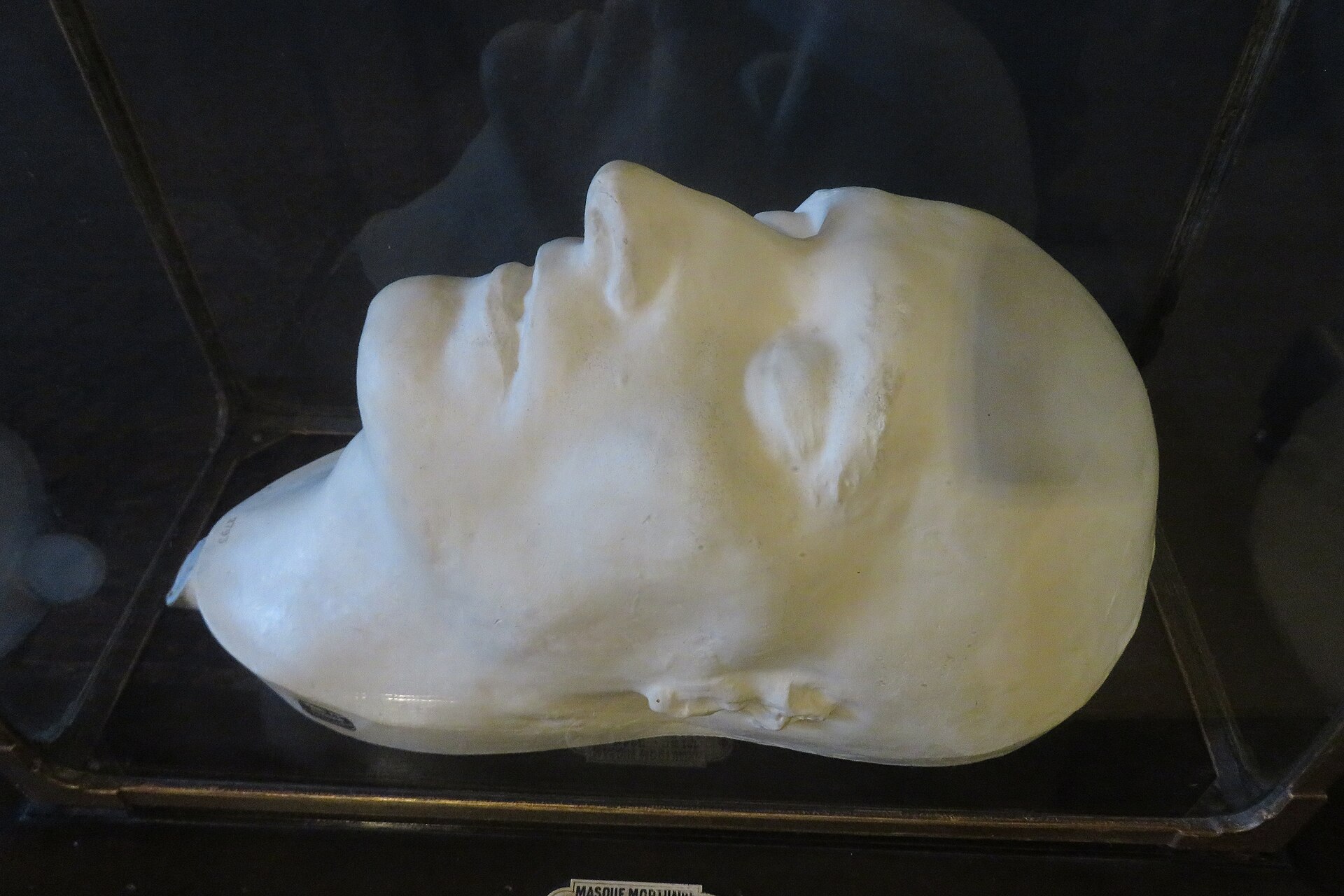
Napoleon’s body has already been moved twice, and a third exhumation is effectively off the table — two centuries underground would leave little for a modern pathologist to add to what Antommarchi and the British doctors already disagreed about, that afternoon in 1821. What could still move the needle is narrower and stranger: a verified, unbroken chain of custody for one surviving hair sample, segmented and tested with modern speciation methods that can tell arsenic absorbed into a growing hair shaft apart from arsenic applied to its surface after death. That test has never been run on hair anyone can prove is genuinely his, cut at a documented time, from a documented place on his head. Without it, both camps keep reading the same ten parts per million and finding what they already believed. Antommarchi’s death mask, at least, isn’t ambiguous about anything.
Where do you stand?
That’s one. There’s another every morning at 6 a.m. local time.
Share where you stand
What Didn't Hold Up
Details that circulate with this case but failed verification against independent sources. Cut from the story above — listed so you know they weren't missed.
“Napoleon accused the British of murdering him with his own dying words, in his will's line about being 'murdered by the English oligarchy and its assassin.'”
The line is real, from his April 1821 will, but it's a dying, embittered man's political framing of his captivity in general — not a diagnosis, and it predates the toxicological evidence by a century. It's often presented as if it points at poisoning specifically; it names no cause.
“Napoleon's cause of death has been 'definitively solved,' as headlines have periodically declared since at least 2007.”
Each 'solved' headline attaches to one single study — never the same one twice — while the field's own most recent systematic review (2021) describes the toxicological literature as heterogeneous and unresolved on how much arsenic actually contributed. No study has closed the dispute this article covers.
The Rabbit Hole
- Virchows Archiv: the pathologists' bicentenary reportthe 2021 case for cancer, argued by eight gastrointestinal pathologists
- Journal of the Royal Society of Medicine: the drug-interaction theoryarsenic, antimony, and a massive dose of calomel — the case for how it all came together
- Fondation Napoléon: Arsenic and the Emperorthe official Napoleon foundation's own history of the poisoning debate
- Original Napoleonic Society of America: the two autopsy reportsAntommarchi's and the British doctors' accounts, quoted side by side