
№ 006622 OCTOBER 2026PLACEPOHNPEI, FEDERATED STATES OF MICRONESIA
Nan Madol
The Only Test of How It Was Built Sank Immediately
Unsolved since 1910Off Pohnpei's coast, nearly a hundred artificial islands rise from a coral reef, built from basalt columns weighing up to fifty tons apiece. Geochemistry has traced the stone to a quarry twenty kilometers away, settling where it came from. Nobody has explained how it got there.
What We Know
Rufino Mauricio, who died in 2022, held a PhD in anthropology; a 2009 Smithsonian profile called him Pohnpei’s only archaeologist. Talking about Nan Madol, the walled city his office was charged with protecting, he once described the one time he tried to test how it might have been built: he strapped a column of the site’s basalt to a bamboo raft. It sank straight to the bottom.
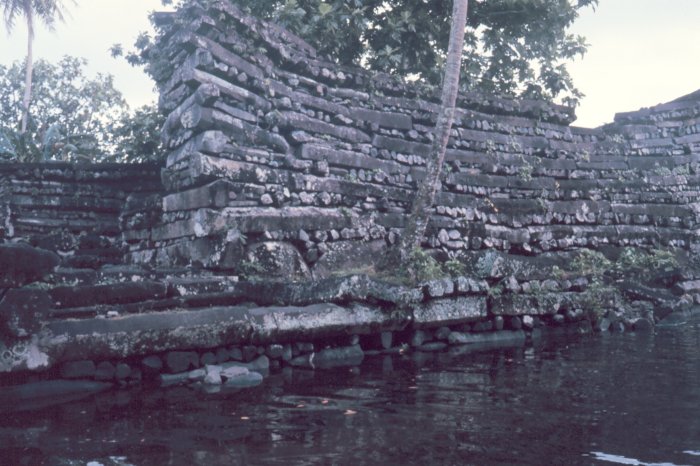
Nan Madol sits on a shallow coral reef off Pohnpei, in the Federated States of Micronesia: nearly a hundred artificial islets laced with canals, covering roughly eighty hectares of lagoon. Its walls are built from basalt columns, naturally six-sided from how the lava cooled, stacked without mortar in courses like a log cabin. Some single columns weigh dozens of tons, and none of that stone comes from anywhere near the site. Geochemical testing, expensive but conclusive, Mauricio said, has traced a large share of it to quarries more than twenty kilometers away, across the island.
The people who moved it aren’t a mystery. Nan Madol was the ceremonial and administrative seat of the Saudeleur dynasty, which ruled a unified Pohnpei from here for centuries. The earliest precisely dated construction, a royal tomb complex, has been pinned to a twenty-year window around AD 1180–1200. A larger 2024 study, dating corals across the whole site, found building happened in at least two long phases stretching from roughly the 10th century to the early 15th, not one campaign but an effort sustained across something like four centuries. By one widely cited estimate, the total stone moved comes to around 750,000 metric tons: roughly 1,850 tons a year, for a population that likely never topped thirty thousand.
What nobody has answered is the physical part. No wheels, pulleys, metal tools, or draft animals are attested in the record, and no tool, sledge, or ramp built to move stone has ever turned up, in more than a century of survey since the site was first fully mapped in 1910. Mauricio’s raft is the only documented attempt anyone has made to test a proposed answer, and it’s still down there.
The Roadblock
The obstacle isn’t a lack of attention. Archaeologists have surveyed Nan Madol since 1910, when the German explorer Paul Hambruch produced the site’s first complete map; a full GPS re-survey followed in 2012. Two separate geochemical studies have pinned down where the stone came from. What keeps failing is reconstructing the how.
Every proposed mechanism runs into the same wall. Moving even one column the size found here, by canoe, raft, or roller, at the scale needed to account for 750,000 tons, requires either equipment nobody has found physical evidence of, or coordinated, sustained labor that’s hard to verify centuries later from stone alone. Written records don’t help: the Saudeleur builders left none, and the effort survives only in the walls and in oral tradition. The site works against its own investigation, too — Nan Madol joined UNESCO’s List of World Heritage in Danger the same year it joined the main list, because silt and mangrove growth are burying the very walls a researcher would need to examine for tool marks or construction debris.
So the study keeps narrowing the edges of the problem (sharper dates, surer sourcing) without touching its center. Mauricio’s own field test, a real column on a real raft, went straight to the bottom. No source describes anyone since doing better.
Best Guesses
Canoe rafts and log rollers
The standard reconstruction: basalt columns lashed to canoe rafts, floated on tidal currents to the site, then walked into place on log rollers and levered up wall by wall. The field’s one real-world test of it failed outright — Mauricio’s own basalt-log-on-a-bamboo-raft experiment sank on the spot, and no source describes anyone since moving a comparable column this way at full scale. What still argues for the theory is the wall itself: the header-and-stretcher stacking looks exactly like logs handled the way a boat-and-timber culture handles logs, and it needs no equipment beyond watercraft the Saudeleur already had.
A technique the story still hints at
Pohnpeian oral tradition holds that Nan Madol was raised by twin sorcerers, Olisihpa and Olosohpa, who flew the stones into place with a dragon’s help. Mauricio, who spent his career on this site, didn’t take that account literally, but he didn’t wave it off either: “the flying stones are a myth,” he said, “but the story indicates that the ‘logs’ probably came from far away,” which is exactly what the geochemistry later confirmed. If the tradition got that detail right, this theory holds, it may be carrying real technical knowledge under its supernatural framing, a specific method nobody outside it has ever pinned down. Its wound is the same as its promise: nobody, Mauricio included, ever identified what that method actually was.
A four-century relay, not one feat
The newest dating work complicates the puzzle by shrinking it: building happened across at least two long phases from roughly the 10th to the early 15th century, not in one heroic push. That timeline still can’t explain any individual lift — a fifty-ton column has to leave the ground once, however many centuries the whole project took, and slow doesn’t make one heavy stone lighter. What it does explain is the total: spread evenly, moving 750,000 tons at under 2,000 tons a year is a modest yearly quota for even a few thousand people working with ordinary canoes and manpower, repeated across generations until it added up, no single remarkable trick required.
The evidence needed to know is gone
The site has been surveyed since 1910, mapped with GPS since 2012, and studied by archaeologists throughout, and in all that time nobody has recovered a roller, a sledge, a rope, or a ramp built to move stone. The Saudeleurs left no writing, so there’s no account to check a theory against. What remains is disappearing: Nan Madol sits on UNESCO’s danger list for the same silt and mangrove growth that’s burying the walls a future excavation would need. The method may simply be unrecoverable, though the same was once said about where the stone came from, before chemistry answered that half.
The Verdict
The geochemistry already did the one job a supernatural explanation might otherwise get credit for: it settled the “where.” What would move the “how” forward is something specific: construction debris at the quarry end rather than the city end (a fragment of rope, a rolling log abandoned mid-use, a wear pattern at a loading point), something a century of survey at Nan Madol itself hasn’t turned up, because nobody has dug as hard at the quarry as at the walls. Or a full-scale reconstruction that doesn’t sink: someone actually moving a multi-ton column the necessary distance, the way experimental archaeology has settled comparable questions elsewhere. Short of either, this stays exactly where the chemistry left it: an answered where, an open how. Mauricio spent his career a few kilometers from the puzzle. He never got it.
Where do you stand?
That’s one. There’s another every morning at 6 a.m. local time.
Share where you stand
The Rabbit Hole
- UNESCO World Heritage Centre: full listing for Nan Madolthe site's official description, and why it's also on the endangered list.
- Quaternary Research: the 2016 coral-dating and sourcing studythe paper that pinned the first royal tomb to a 20-year window.
- PNAS Nexus: the 2024 climate-and-chronology study (open access)22 authors, the largest re-dating of the site yet, tied to centuries of sea-level and climate stress.
- Archaeology magazine: the full Rufino Mauricio interviewMauricio's own account of the sinking raft, in full.
- Smithsonian Magazine: 'The City Built on Coral Reefs'the fullest single overview of the site's scale, with Mauricio's own tonnage math.