
№ 000522 AUGUST 2026DISAPPEARANCESOUTH PACIFIC OCEAN, NEAR FIJI
The MV Joyita
The Ship That Couldn't Sink Lost Everyone Anyway
Unsolved since 1955In 1955, a cargo ship vanished in the Pacific with 25 people aboard. Five weeks later it turned up adrift, half-flooded, radio tuned to a distress frequency, and empty. The ship was built so it couldn't sink. Everyone on it disappeared anyway.
What We Know
The Joyita left Apia, Samoa, on the evening of October 3, 1955, bound for the Tokelau Islands, a crossing of a few hundred miles that should have taken about two days. Twenty-five people were aboard: sixteen crew, nine passengers, including a government doctor headed to treat an outbreak on the islands. Early the next afternoon, the port engine overheated and had to be shut down. The ship pressed on toward Tokelau on its remaining engine. It never arrived.
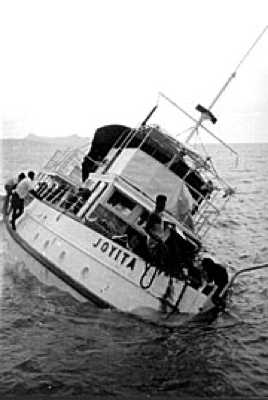
Five weeks later, a merchant vessel spotted the Joyita drifting more than 600 miles off her intended course, listing hard to port, decks nearly awash. She was empty. Every one of the 25 people aboard was gone, and none was ever found, alive or dead. The ship’s logbook and navigational instruments were missing. Three life rafts were gone from their mounts. The radio was tuned to a distress frequency, though no distress call was ever received by anyone. Medical supplies, food, and personal belongings sat untouched. There was no blood, no sign of struggle, nothing broken by force.
What made all of it stranger: the Joyita was built with cork lining packed into her holds, insulation for fish refrigeration that also made her nearly impossible to sink. Fully flooded, waterlogged, listing at a dangerous angle, she still floated. An official inquiry the following year confirmed a cause for the flooding, a corroded engine cooling pipe that let seawater into the bilges, but on the ship’s own unsinkability, its final word was blunt: the fate of the people aboard was “inexplicable on the evidence submitted.”
The Roadblock
Every theory has to clear the same bar the inquiry couldn’t: explaining why 25 people would abandon a ship that, by any technical measure, was safer to stay on than to leave. Whatever happened, it happened fast enough and completely enough to leave no bodies, no wreckage from the missing rafts, and no witnesses in one of the more heavily fished stretches of the Pacific. Seven decades on, there’s no logbook to consult, no survivor to interview, and the physical evidence that does exist, the ship itself, argues against almost every theory proposed for why it was left behind.
Best Guesses
Panicked abandonment
The flooding was real and documented. If it happened fast, in bad weather, in the dark, a crew that didn’t know the cork lining made the ship this resistant to sinking could reasonably have judged her lost and taken to the rafts. Three overloaded, low-freeboard rafts in open Pacific swells, in a location well outside the search area anyone would think to check, is a grim but entirely sufficient explanation for 25 people vanishing without a trace. It requires no conspiracy. It also can’t be proven; nothing survived to confirm it.
Staged disappearance
The ship’s owner and captain, Thomas Miller, carried real financial troubles from a series of failed fishing ventures on the Joyita. A staged sinking, for the insurance payout, is a tidy motive. It runs straight into the evidence: no insurance claim was ever filed or paid, the classic seacocks-opened signature of a deliberate scuttling was never found, and a staged disappearance doesn’t obviously require every single person aboard, including nine passengers with no stake in Miller’s debts, to vanish along with him.
Attack at sea
Foreign fishing fleets, some operating in disputed or gray-area waters nearby, gave rise to theories of piracy or a violent confrontation. The complete absence of blood, damage, or forced entry anywhere on the ship weighs heavily against it; a boarding violent enough to remove 25 people without a single struggle mark is a hard scenario to sustain against a ship this thoroughly, calmly searched.
Sudden wave or squall
A single freak wave or squall, catching the crew mid-evacuation or on deck, could explain a fast, near-total loss of life without requiring foul play or organized panic. It’s consistent with the physical evidence, in the sense that it leaves none. That’s also its weakness: it’s close to unfalsifiable, a theory shaped to fit an absence rather than tested against a presence.
The Verdict
The ship was salvaged, repaired, and auctioned in 1956. She ran aground that January, and again after that, until crews took to calling her jinxed and declined to sail her. She was sold for scrap in the 1960s and had disappeared piece by piece by the 1970s. The only witness to that night was dismantled slowly, over twenty years, by people who wanted the hardware.
Twenty-five people left a vessel that was still afloat five weeks later. Everything after that sentence is inference, and seventy years of inference has not produced a body, a raft, or one name to attach to what happened.
Where do you stand?
That’s one. There’s another every morning at 6 a.m. local time.
Share where you stand
The Rabbit Hole
- National Library of New Zealand: Joyita (Ship) catalog recordarchival holdings on the ship and inquiry
- Historic Mysteries: MV Joyita, the ghost ship that couldn't sinka detailed account of the search and inquiry
- Samoa Observer: MV Joyita, the mystery of Samoa's ghost shipregional coverage with local context