
№ 008914 NOVEMBER 2026PHENOMENONFERMILAB, BATAVIA, ILLINOIS
The Muon g-2 Anomaly
One Magnet, Two Decades, No Agreement
Unsolved since 2001In 2001, muons at Brookhaven wobbled slightly faster than physics said they should. Fermilab spent a decade rebuilding around that same magnet, moved 3,200 miles intact, to check. In 2025 it confirmed the gap, sharper than ever — while rival theorists published a competing calculation that would erase it entirely.
What We Know
Chris Polly was a University of Illinois graduate student the first time he watched Brookhaven’s calorimeters count decay particles for the experiment that would make Yale physicist Vernon Hughes stand up in February 2001 and say a sentence a scientist doesn’t say lightly: “There appears to be a significant difference between our experimental value and the theoretical value from the Standard Model.” What the machine had measured was a wobble. Send a muon, a heavier, unstable cousin of the electron, into a magnetic field, and its spin doesn’t just point one way. It precesses, tracing tight circles as it travels, the way a spinning top wobbles before it falls. Physics can predict exactly how fast that wobble should be, to better than eleven decimal places, by accounting for every virtual particle that might, for an instant, wink in and out of existence near the muon and give it a nudge. Brookhaven’s muons wobbled a little faster than the prediction said they should.
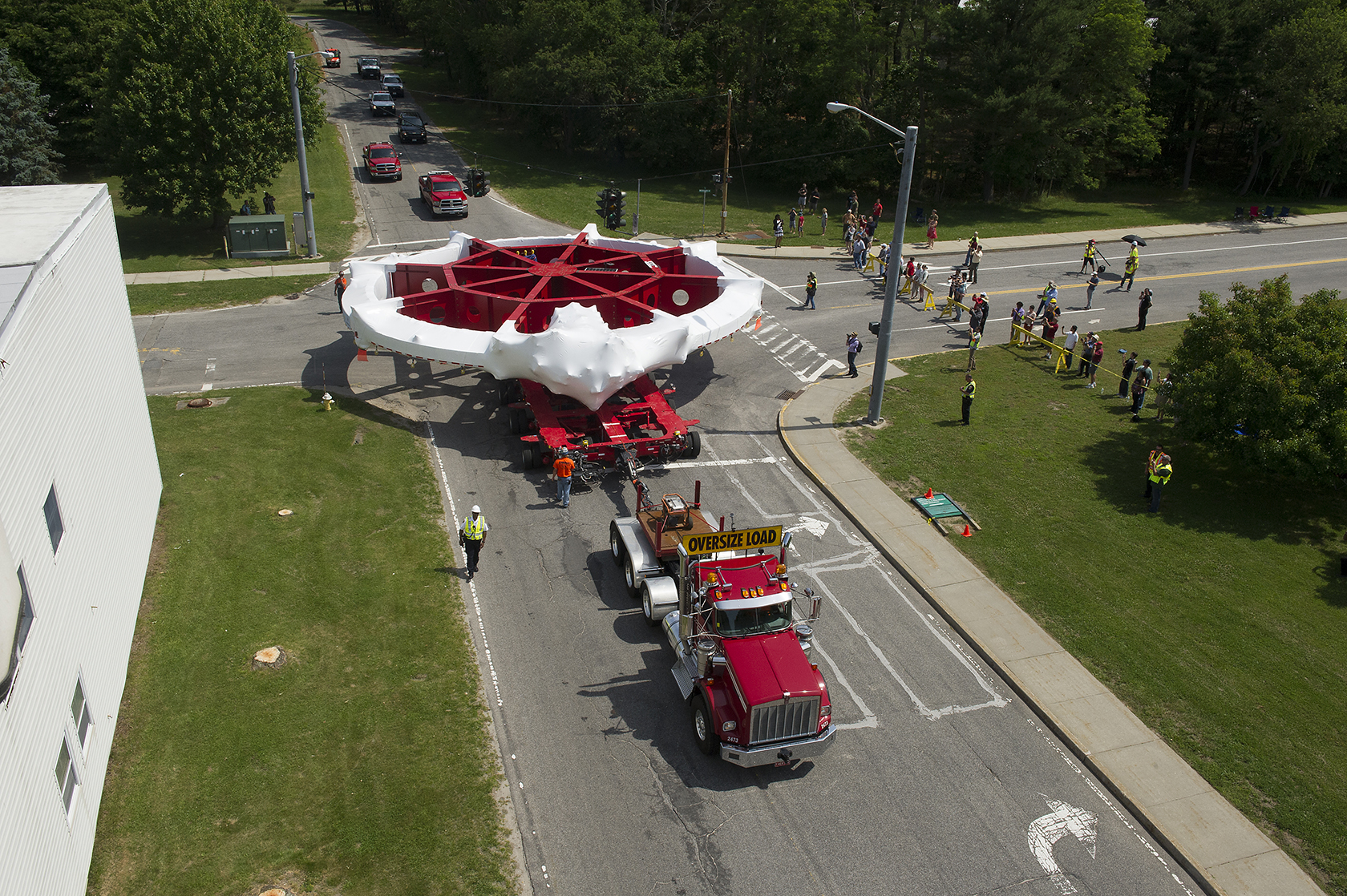
One hint doesn’t prove anything. So Fermilab built a bigger, more precise version of the same experiment, using the literal same magnet, shipped 3,200 miles from Long Island because moving a 50-foot ring that can’t tilt more than a few degrees without wrecking its own wiring turned out to be about ten times cheaper than building a second one. Polly, the graduate student, became the new experiment’s project manager, and later its co-spokesperson. Across six years of data and three published results, 2021, 2023, and a final measurement on June 3, 2025, the wobble held. That last result reached a precision of 127 parts per billion, the most precise accelerator-based measurement ever made of a fundamental particle’s own properties. Measured against the older prediction, the gap didn’t close. It grew.
The Roadblock
The trouble isn’t obviously the measurement. Fermilab spent six years tightening its own systematic uncertainty down to just 78 parts per billion of the total result, and the same anomaly held up in Brookhaven’s original run and in all three of Fermilab’s published results since, built with overlapping but not identical hardware. A number that survives that much independent scrutiny starts to look less like a mistake waiting to be caught.
The trouble is the other side of the equation. Calculating that eleventh decimal place requires accounting for the strong nuclear force’s pull on the muon, a quantity so hard to compute from first principles that physicists spent decades approximating it from real particle-collider data instead. Then a landmark 2021 lattice-QCD calculation, simulating the strong force directly on a supercomputer rather than inferring it from collisions, landed much closer to the experiment than the old method did. For years, both approaches had at least agreed with each other, even while disagreeing with Fermilab. Now physics has an anomaly with two rival definitions of what it’s even being measured against.
Best Guesses
Two theoretical camps, one gap that keeps getting sharper, and an open question: is nature doing something new, or is physics simply miscounting a number nobody has ever calculated by hand? Four positions compete for the answer, none of them a strawman — each has physicists defending it in peer-reviewed literature, disagreeing with each other by more standard deviations than most physics results ever have to survive.
An extra particle muons feel
The oldest reading, still live, and its wound sits upstream of the muon: the two collider experiments feeding its reference prediction, KLOE and CMD-3, disagree with each other by roughly five standard deviations. Yet the comparison hasn’t moved in the theory’s favor — measured against that same prediction, the gap now exceeds five standard deviations, a size physicists don’t get to shrug off. If that’s the right comparison, something outside the Standard Model’s known roster is tugging on the muon, the kind of crack theorists have hunted since supersymmetry became fashionable in the 1980s.
The lattice number is right
A newer calculation, built by simulating the strong force on a supercomputer instead of inferring it from collisions, lands within roughly 0.9 standard deviations of Fermilab’s measurement — close enough that the gap all but disappears. Multiple independent lattice groups agree with each other, a cross-validation the older method never had, and the Theory Initiative’s 2025 update leaned toward trusting it. Its wound: lattice QCD is brutally difficult, its leading result already shifted materially between 2021 and 2024, and the field’s own consensus chair says on the record that nobody yet knows whether it and the older method will agree.
An undetected instrument flaw
The least dramatic explanation, and the hardest to defend given what’s already been checked: some still-unidentified systematic error in Fermilab’s own apparatus, not either theoretical camp, is quietly inflating the number. Its wound is the weight of cross-checking already done: years of independent beam-dynamics analysis, a systematic uncertainty trimmed to 78 parts per billion, and the same result reproduced across four runs on overlapping hardware — each a fresh chance for a flaw to surface. None has. Every measurement carries this risk in principle, and it’s the one theory that would resolve the fight without either camp of theorists turning out to be right.
The theory methods haven’t met yet
The patient position: neither camp is finished, and the field’s honest state is unresolved, not settled either way. The collider data feeding the older method are still being reconciled with each other, and a genuinely independent third measurement, CERN’s MUonE experiment, extracting the same quantity from muon-electron scattering rather than collisions or a lattice, is built to arbitrate without inheriting either side’s assumptions. Once that lands, this theory holds, and the anomaly resolves as an arithmetic correction, not a discovery. Its wound: “wait for convergence” isn’t falsifiable on any near-term calendar, and it’s just a patient way of admitting nobody currently knows.
The Verdict
Fermilab isn’t taking any more data — the experiment’s six-year run had already ended before the June 2025 announcement, which was the collaboration’s last word on its own measurement, not a new one. So no future result from that specific machine will move this number again. What happens next depends entirely on theory, and specifically on two things that haven’t yet converged. CERN’s MUonE experiment, still assembling its full dataset, extracts the same hadronic quantity through muon-electron scattering rather than collisions or a lattice, inheriting neither camp’s assumptions. And the collider measurements underneath the older prediction, KLOE and CMD-3, need to stop disagreeing with each other before that prediction can be trusted again either way.
Until one of those lands, the field is stuck comparing one exquisitely precise number against two predictions that don’t agree with each other, let alone with the experiment. Chris Polly has spent more than half his life inside this exact question, present for both announcements twenty-four years apart. The machine that started it is still sitting in Illinois — not because anyone solved anything, but because it was cheaper to move than to build twice.
Where do you stand?
That’s one. There’s another every morning at 6 a.m. local time.
Share where you stand
What Didn't Hold Up
Details that circulate with this case but failed verification against independent sources. Cut from the story above — listed so you know they weren't missed.
“The muon g-2 anomaly has been "solved" or "resolved at last" — several 2025–2026 popular-science pieces declared this outright once a new lattice-QCD calculation landed close to the experimental value.”
CERN Courier's June 2026 account of the Breakthrough Prize still calls this an unresolved tension between the two predictions, and a Dec. 2025 academic review found the same. Confirmed: lattice calculations now sit close to Fermilab's number. Not confirmed: the older prediction retracted, or the two methods reconciled.
The Rabbit Hole
- Muon g-2 Theory Initiative — White Paper 2025the theory side's own reasoning, in its own words, before it reaches a headline
- MUonE: a new path to hadronic vacuum polarizationthe independent third measurement built to arbitrate the dispute
- Physics World: Muon g-2 achieves record precision, but theoretical tensions remainan accessible walkthrough of exactly where the theory fight stands
- Fermilab Muon g-2: The Big Move (photo gallery)the storage ring's 3,200-mile journey, in pictures