
№ 002511 SEPTEMBER 2026SIGNALCHICAGO, ILLINOIS
The Max Headroom Signal Hijacking
The Mask Nobody Has Ever Matched to a Face
Unsolved since 1987On November 22, 1987, someone in a rubber Max Headroom mask cut into two live Chicago television broadcasts hours apart, first silently, then for almost a minute and a half with a taped skit. The FCC and FBI investigated for years. No one was ever charged.
What We Know
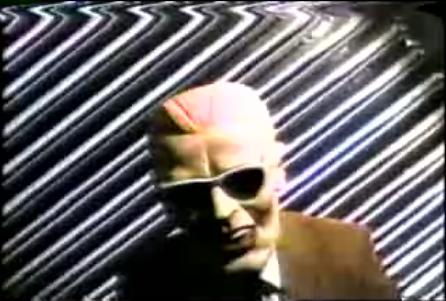
At 9:14 p.m. on November 22, 1987, Dan Roan was midway through highlights of a Bears–Lions game on WGN-TV’s Nine O’Clock News when the picture cut away from him entirely. In his place: a person in a glossy latex Max Headroom mask and a suit jacket, swaying in front of a rippling corrugated-metal panel built to mimic the look of the syndicated show the mask was borrowed from, saying nothing intelligible over a loud, steady buzz. It lasted well under a minute. WGN’s engineers found the studio-to-transmitter link the intrusion had ridden in on and switched it to a different frequency, and Roan’s broadcast came back mid-sentence. His only comment, live and on air: “Well, if you’re wondering what’s happened, so am I.”
Two hours later, at roughly 11:15 p.m., the same figure interrupted WTTW, Chicago’s PBS station, in the middle of a Doctor Who episode. This time nobody was standing by the transmitter to react as fast as WGN’s engineers had, and the intrusion ran nearly a minute and a half, long enough for actual, if badly distorted, speech. The masked figure taunted WGN sportscaster Chuck Swirsky by name and mocked WGN’s own on-air slogan. Then it hummed the theme from a cartoon WGN used to air and mugged through a bit built around a soda can and a rival’s advertising jingle. It ended on a segment that had clearly been taped in advance, elsewhere: the figure, pants down, swatted with a flyswatter by someone dressed as a French maid.
Both intrusions worked the same way: not by seizing the transmitter itself, but by overpowering the signal feeding it on its way from the studio, which meant getting physically close to one of two specific rooftop antennas (the Hancock Center for WGN, the Sears Tower for WTTW) with a broadcast strong enough to simply drown out the real one. The Federal Communications Commission opened a case within days. So did the FBI. Neither agency has ever named a suspect.
The Roadblock
The FCC’s lead investigator, Dr. Michael Marcus, concluded early on that the hijacker hadn’t needed anything exotic: roughly $10,000 in broadcast gear bought new, less than that on the secondhand amateur-radio market, a dish antenna, and specific knowledge of which frequencies WGN’s and WTTW’s studio-to-transmitter links used that particular night. That last part is the whole case. It rules out a casual prankster with no technical background, but it doesn’t shrink the suspect pool much past “someone technically fluent,” and nothing recovered from either intrusion, no equipment, no fingerprint, no scrap of tape, ever narrowed it further.
What actually stalled the investigation, according to reporting from people who spoke with those inside it, wasn’t a shortage of leads but a jurisdictional one: the FCC’s Washington office reportedly developed a specific tip pointing toward whoever held the pre-taped video, while the Chicago field office running point on the case was reluctant to knock on doors. By the time anyone agreed on how hard to push, the five-year federal statute of limitations was most of the way to expired; it ran out entirely in 1992. Roughly two hundred people phoned in unsolicited confessions during that same stretch, and every one of them was false, noise a real lead would have had to be found underneath.
Best Guesses
A WGN insider settling a score
If the grudge here was really with WGN, the longer, more elaborate broadcast that night hit WTTW instead: a different station, different staff, nothing in the tape that mocks WTTW at all. What argues past that gap is specificity. Every joke in the WTTW segment still points at WGN: the hijacker named sportscaster Chuck Swirsky, mocked WGN’s own on-air slogan, and hummed the theme from a program WGN used to run, details a casual viewer wouldn’t reach for but a WGN employee would have on hand without thinking. Rick Klein, who curates a Chicago television archive, doesn’t believe an outsider could have pulled off either intrusion.
Hobbyists exploiting an open relay
By Marcus’s own account, the equipment wasn’t the hard part. A studio-to-transmitter link in 1987 was an unencrypted microwave signal, and a transmitter close enough to WGN’s or WTTW’s receiving antenna, tuned right and pushing more power, would simply overwrite it: no station badge, no inside contact, just a few thousand dollars of amateur-market gear and the patience to find out where Chicago’s rooftop antennas sat. On this reading, the two stations weren’t chosen out of anger; they were just reachable, whichever frequencies happened to be open that night. What the theory struggles to explain is precision: hitting two separate stations’ transmission paths cleanly, hours apart, took site-specific knowledge past a weekend hobbyist’s usual reach.
A small crew that stayed silent
Somebody built a working double of the Max Headroom set on what looks like a home budget, ran a camera, cued a second costumed performer for the closing bit, and carried out two remote broadcasts hours apart the same night: a short list of jobs for one person alone. A small group, bound by nothing more than an agreement never to talk, can keep something like this quiet in a way a lone operator prone to bragging can’t. What it costs the theory is time. The statute of limitations expired decades ago and removed even the legal risk of saying so. Thirty-nine years on, not one person involved has leaked.
A trail too thin to ever retrace
No equipment was ever recovered, and nothing pulled from either broadcast was ever matched to a name. The FCC’s Washington office and its Chicago field office reportedly disagreed about how hard to chase the one real lead either side had, and by the time that got sorted out, the trail was cold. In 2022, a public-records request asked the FCC for its own investigative file. The agency’s answer: no such file could be found. On this reading, there’s nothing left to solve with, only the shape of where the evidence used to be. That an investigation stalled once is not proof it could never have succeeded.
The Verdict
In July 2022, a researcher named Emily Crose asked the FCC for its own file on the Max Headroom case. The agency’s written answer: no responsive documents. Whatever paperwork the 1987 investigation produced either was never kept, or can no longer be found by the people who would have to look for it.
Nobody has carried any legal risk in naming themselves since the statute of limitations expired in 1992, and thirty-four years of that immunity have bought silence, not a confession. What would actually close this is one specific, checkable detail: something only the person behind the mask could know, corroborated by someone who never bought a mask for anyone. Not a resemblance. Not a hunch. The strongest lead anyone has after thirty-nine years is a Reddit post with the names redacted.
Where do you stand?
That’s one. There’s another every morning at 6 a.m. local time.
Share where you stand
The Rabbit Hole
- Vice/Motherboard: the fullest account of the FCC's own stalled investigationthe lead investigator, in his own words, on what the equipment cost and why the trail went cold
- WBUR Endless Thread: 'Revisiting the Masked Mystery'a podcast interview with the case's two most dedicated amateur researchers, on why they still won't publish a name
- Wikisource: the WTTW intrusion, transcribed line by linethe actual dialogue and stage directions, for readers who want the primary text rather than a description of it
- Internet Archive: the WGN-TV intrusion itselfthe surviving off-air recording of the shorter, silent first broadcast
- MuckRock: the FCC's 2022 response to a records request for its own case fileone page, thirty-five years later: 'no responsive documents'