
№ 00849 NOVEMBER 2026SIGNALSIGNAL HILL, ST. JOHN'S, NEWFOUNDLAND
Marconi's 1901 Transatlantic Signal
Three Faint Clicks, One Witness, 2,200 Miles
Unsolved since 1901Marconi held a telephone receiver to his ear in a hilltop hut in Newfoundland and heard three faint clicks — the Morse letter S, sent 2,200 miles away in Cornwall. The only witness worked for him. No instrument recorded it. By the physics of 1901, it shouldn't have been possible.
What We Know
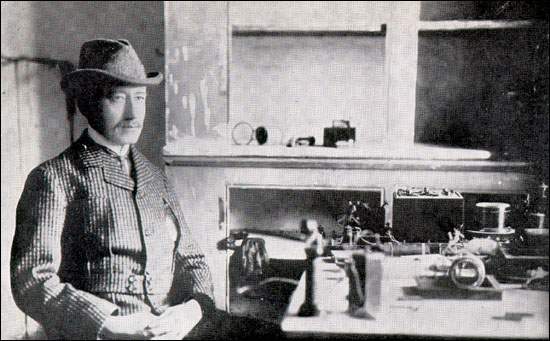
Guglielmo Marconi was twenty-seven years old when he climbed Signal Hill above St. John’s, Newfoundland, in December 1901, with a kite, a telephone receiver, and an assistant named George Kemp. He was trying to prove something almost nobody in his field believed: that radio could cross the Atlantic Ocean.
His company had staked everything on it. Three months earlier, a gale had torn down the transmitting antenna at Poldhu, Cornwall. Twenty masts, four hundred wires, gone in one night. Investors had put in a sum since estimated at the equivalent of $3.5 million, and the antenna meant to prove their bet lay in pieces. Marconi rebuilt it smaller, shifted his receiving site from Cape Cod to Newfoundland to shave miles off the distance, and kept going.
On December 11, a 500-foot aerial lifted by balloons picked up something faint on the tuned receiver: signals that, in Kemp’s words, “threatened to appear on the tapper,” but never resolved into anything certain. Then the wind took the balloon.
The next day, they flew a kite instead. It moved too erratically to keep the receiver tuned, so Marconi switched to an untuned one, cruder but steadier. At 12:30 in the afternoon, receiver against his ear, he heard it: three short clicks, repeated, the Morse code for the letter S. He logged two more receptions that afternoon, at 1:10 and 2:20. Kemp, standing nearby, heard the same thing.
Nothing recorded it. The signal was too weak to drive the automatic Morse inker built for exactly that purpose. No photograph, no printout, no third witness — only two men’s word, one of whom worked for the other, and a diary entry. Marconi cabled the news to London anyway. Newfoundland’s telegraph monopoly threatened him with a lawsuit within days; he’d broken their monopoly just by trying. He believed he’d also proven that radio had no horizon.
The Roadblock
Marconi’s claim is easy to believe and impossible to check. Every piece of hard evidence that could settle it vanished by design or by accident: the signal was too faint to record, the only two witnesses had a financial relationship, and the diary is a century past anyone who could cross-examine it.
Making it harder, not easier: two months later, Marconi ran the one controlled, independently monitored test meant to answer the skeptics, a fully instrumented voyage aboard the SS Philadelphia. It didn’t reproduce the claim. The voyage proved transatlantic reception was possible at night, with a tuned receiver. It could not push daytime reception past about 700 miles, a third of the distance from Cornwall to Newfoundland. The event under dispute is specifically the one condition Marconi’s own follow-up experiment never matched again: daylight, full distance, untuned.
And the physics that could have resolved it didn’t exist yet. The mechanism now offered as the likeliest explanation, signals skipping off a layer of the upper atmosphere nobody had detected, wasn’t confirmed for another two decades. Marconi was defending a result with a theory of radio that turned out to be wrong, about a phenomenon he couldn’t have explained even if it was real.
Best Guesses
Strip away which side someone starts on, and the same disputed hour supports four different readings. Two find Marconi genuinely right, for reasons he didn’t understand. Two find him wrong, one by accident, one on purpose. All four have to explain the same gap: what worked for skeptics in February 1902 didn’t happen in December 1901.
A real signal, misunderstood physics
Two technical readings agree Marconi heard something real, if not what he thought. Historian Sungook Hong argues the Poldhu signal reached Newfoundland by reflecting off a layer of the upper atmosphere nobody had detected yet. That’s the mechanism later radio science confirms makes transatlantic transmission possible, just not the earth-hugging path Marconi believed in. Engineer Henry Bradford’s technical reconstruction goes further: Poldhu’s spark transmitter radiated broadband noise outside its intended frequency, and Marconi’s untuned receiver may have caught a stray shortwave harmonic a tuned set would have filtered out. Neither explains why the instrumented February follow-up never caught the same trick again.
Static, heard as the expected pattern
Three days of straining to hear one specific rhythm is a documented way to start hearing it whether or not it’s there. Lightning-driven atmospheric static can mimic a repeated three-dot pattern closely enough to fool an experienced ear, and Marconi was listening for exactly three dots, at the times he’d told Poldhu to send them. The theory’s own likeliest advocate is also its harshest critic — Bradford, who built the case for a genuine reception, argues against this reading. Marconi’s account, from a listener he considers unusually experienced, struck him as too clear and too confident to be static. That confidence is exactly what a primed ear would produce.
Telegraph crosstalk, not Poldhu
Newfoundland in 1901 wasn’t radio silent. Land-based telegraph lines, run by the same company that later threatened Marconi’s lawsuit, were already operating nearby, and one technical retrospective on the case raises a real possibility: a spark-driven telegraph circuit can radiate a Morse-shaped signature into the air as a side effect of normal use. It’s the thinnest-sourced of the four readings; no named engineer has built the case the way Bradford or Belrose did for theirs. It doesn’t require anyone to have lied, though, and it doesn’t require static to have organized itself into a pattern — only one unshielded wire, already carrying dots and dashes, sitting closer to Signal Hill than Cornwall did. Nobody has ever identified which line, if any, might have done it.
A claim inflated for investors
Three months before Signal Hill, Poldhu’s antenna had collapsed in the gale — a costly setback inside a project investors had already put an estimated $3.5 million into, all of it raised to prove wireless telegraphy could replace the transatlantic cable. Engineer John Belrose, whose own propagation analysis concludes the claimed reception was likely impossible in daylight, is blunter than most: he and others have suggested Marconi simply reported a success he didn’t have. On this reading nothing needs a technical explanation, because nothing real happened. Only a young inventor under real financial pressure, telling his backers what they needed to hear before the money ran out.
The Verdict
December 12, 1901 left behind exactly one document: a diary entry, kept by a company that needed a win, in the hand of the one man with something to lose if it turned out to be wrong. No instrument ran that afternoon capable of recording the signal instead of a person’s ear. None ever will, because the afternoon is gone.
Two engineers have done the same math on the same diary lines and landed on opposite sides: one concludes the physics rules the claim out entirely, the other that the physics, read differently, lets it back in. Both know the propagation formulas cold. Neither has moved the other.
Two men, a diary, and an afternoon nobody else was there to check: the case in 1901, and the case now.
Where do you stand?
That’s one. There’s another every morning at 6 a.m. local time.
Share where you stand
What Didn't Hold Up
Details that circulate with this case but failed verification against independent sources. Cut from the story above — listed so you know they weren't missed.
“Marconi proved transatlantic radio communication that day — the standard framing in general-audience retellings of December 12, 1901.”
That framing drops the single-witness problem, the unrecordable signal, and the monitored follow-up run two months later. Confirmed: transatlantic radio was proven repeatedly, under conditions matching known physics, from February 1902 on. December 12 itself was never independently verified, and can't be now.
The Rabbit Hole
- Marconi's Achievement, McClure's Magazine (Feb. 1902)the contemporaneous magazine account, built on Marconi's own words two months after the fact
- Did Marconi Receive Transatlantic Radio Signals in 1901? (Henry M. Bradford, Antique Wireless Association)the deep technical reconstruction, aerial by aerial, diary quote by diary quote
- Milestones: Reception of Transatlantic Radio Signals, 1901 (IEEE ETHW)IEEE's own curated record of the event, its witnesses, and its skeptics
- Wireless: From Marconi's Black-Box to the Audion (Sungook Hong, MIT Press)the historian's full case for what actually crossed the Atlantic, and why Marconi's own theory of it was wrong