
№ 006521 OCTOBER 2026DISAPPEARANCEDIJON–PARIS RAILWAY, FRANCE
Louis Le Prince's Disappearance
He Boarded a Train in Dijon. Paris Never Saw Him.
Unsolved since 1890In September 1890, days before a trip to New York to unveil the first moving-picture camera, French inventor Louis Le Prince boarded a train in Dijon for Paris. He never stepped off. In 136 years, nobody has found his body, his luggage, or a single witness.
What We Know
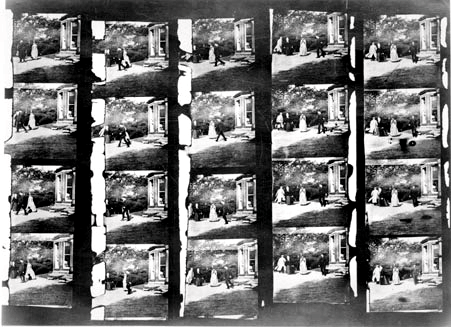
Two years before he vanished, Louis Le Prince stood in a garden in Roundhay, Leeds, and pointed a wooden box with one lens at his son, his in-laws, and a family friend. He turned a hand crank. What came out, recorded — his son would later note — at ten to twelve frames a second, showed four people walking and turning in front of a house, for just over two seconds. It is, as far as anyone has proven, the oldest surviving film on Earth. One of the people in it, his mother-in-law Sarah Whitley, died ten days later; her death is how historians have dated the footage so precisely.
Getting to that garden had taken Le Prince years. He filed for a US patent on a sixteen-lens motion-picture camera in 1886, watched the design wobble on projection like a cheap flicker-book, and rebuilt it around a single lens and a shutter that let light through only while the film sat still. By 1888 he held patents in both the United States and Britain. He was also deep in debt: the accumulated cost of years spent turning down paid work to keep at the camera instead. In September 1890 he booked passage to New York, where he planned to give the first public demonstration anywhere of a moving-picture camera.
He never got there. On September 13 he was in Dijon, staying with his brother, Albert. Three days later, Albert watched him board the express train to Paris. When it reached the city, Le Prince’s compartment held no one, and his luggage was gone with him. Not one of the other passengers, questioned afterward, remembered seeing him at all. It was a train with no corridor connecting its compartments, on a route with no scheduled stop in between. French police and Scotland Yard both investigated. Neither found a body, a bag, or a witness who could place him past Dijon. Seven years later, to the day, a French court declared him legally dead.
The Roadblock
Part of the problem is the train itself. Continental compartment carriages of 1890 had no interior corridor: each compartment was its own sealed room, reachable only from the platform, with no attendant walking the length of the train to notice an empty seat or a locked door. Whatever happened to Le Prince happened somewhere no other passenger could have seen, in a design built for privacy that also built in the perfect blind spot.
The rest of the problem is that both investigations that mattered, the French police’s and Scotland Yard’s, were looking for the same thing, and neither ever found it. A body is what closes a case like this one; it’s the single piece of evidence that turns a theory into a fact. Without it, every account stayed exactly as plausible as every other account, indefinitely.
The closest anyone has come was worse than nothing. A photograph of a drowned man, pulled from the Seine in 1890 and filed in the Paris police archives, didn’t surface until 2003, a hundred and thirteen years later, when no living witness remained to look at it and say yes or no with any authority. It resembles Le Prince. It has never been matched to him. It just sits there, evidence-shaped, answering nothing.
Best Guesses
Fell from the train
No conspiracy is required for a man to die on a train. Compartment carriages of the period latched from the outside, with no corridor to walk between them and no attendant checking each one in transit, a design flaw period rail companies documented themselves: one 1860s British accident register records a passenger who fell from a moving carriage after a defective fastening let the door “fly open” in transit. Nobody has produced evidence that anything mechanical failed on Le Prince’s actual train that day. Nobody has produced evidence that it didn’t, either. An accident requires no motive, no accomplice, and no cover-up, only an unlucky thirty seconds.
Took his own life
He was deep in debt, the accumulated cost of years spent refusing paid work to finish the camera, at the exact moment he needed capital to launch it commercially in America. That is real pressure. It is also where the theory runs out of material: no letter, no note, no remark to a colleague or a family member has ever surfaced expressing despair or an intent to disappear. Everyone who described him in the weeks before September 16 described a man with a plan, not a man in crisis: booked passage, a scheduled unveiling, a business to launch. A theory built entirely on motive, with nothing on the record to support the act itself.
Killed by his brother
Journalist Paul Fischer’s 2022 investigation names the last person who saw Le Prince alive: his brother, Albert, who hosted him in Dijon for three days and watched him board the Paris train. Fischer’s case, as reported, is circumstantial. Albert owed him money, is said not to have formally reported him missing, and reportedly discouraged Le Prince’s wife, Lizzie, from coming to France to search. It runs against an older, equally secondhand picture: family letters describing the brothers as close, and Albert among those who helped fund the search once Louis didn’t arrive. Both pictures of Albert survive in the same record, unresolved.
Silenced over patent priority
The least evidenced theory, and the most repeated one online, holds that a rival with a stake in motion-picture patent priority arranged for Le Prince to disappear before he could stake his own claim in America. Lizzie Le Prince came to believe this specifically of Thomas Edison, after Edison’s Kinetoscope was unveiled the following year and went on to define, for a century of popular history, who “invented” the movies. It’s a motive a jury could follow. It isn’t a case: no document, no witness, no confession, nothing beyond the coincidence of timing has ever tied Edison, or anyone else, to what happened on that train.
The Verdict
A piece of paper would end this, and it would be an embarrassingly ordinary one. The Paris–Lyon–Méditerranée railway kept passenger and staff records for its trains, and if any of it survived the century and a half since, uncatalogued in a regional French archive, a single detail could turn four abstract possibilities into one demonstrated fact: a compartment checked at Dijon and unremarked at Paris, a conductor’s name, a report filed and forgotten.
Short of that, a positively identified body would do just as well. The 1890 Seine photograph is the closest anyone has come, and it has never been matched to a name; whatever forensic standard could still settle that, more than a century on, hasn’t been applied to it in public.
So far, none of that has turned up. Every theory here explains the disappearance. None of them explains why nothing else ever has.
Where do you stand?
That’s one. There’s another every morning at 6 a.m. local time.
Share where you stand
The Rabbit Hole
- Roundhay Garden Scene, restored and playablethe actual two seconds of footage Le Prince was carrying toward New York
- The camera itself, in the Science Museum Group's collectioncatalog record for the single-lens camera, including Adolphe Le Prince's own provenance note
- Daily Beast: the case for the brother theorythe fullest public account of Paul Fischer's circumstantial case against Albert Le Prince
- National Science and Media Museum: the man and the machinethe Bradford museum that still holds his camera, telling the story in its own words