
№ 005915 OCTOBER 2026PLACELONGYOU COUNTY, ZHEJIANG, CHINA
The Longyou Caves
Twenty-Four Caves That No Record Mentions
Unsolved since 1992In June 1992, a farmer testing a village legend rented four pumps to drain a pond everyone called bottomless. It emptied into a hand-carved stone hall the size of a cathedral. Two dozen more caves turned up nearby. No document explains them, and nothing found inside does either.
What We Know
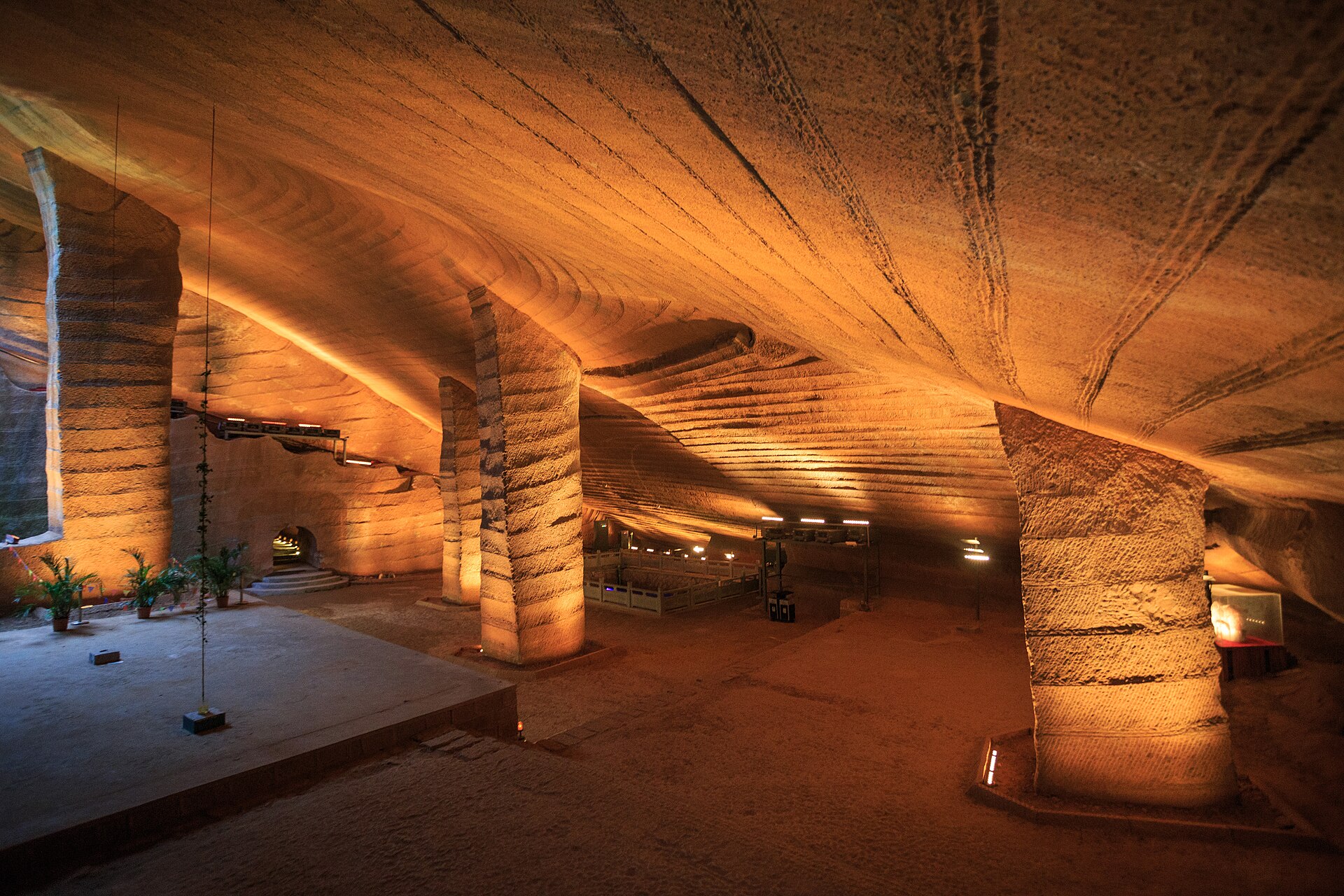
Every household near Shiyan Bei, in China’s Zhejiang province, agreed on one thing about the pond down the road: it had no bottom. Nobody who’d ever tried to find one had succeeded. Wu A’nai, a farmer, decided to find out anyway. In June 1992, he and three neighbors rented four water pumps and ran them in shifts, day and night. As the water dropped, a stone wall appeared where there should have been mud, then a flight of carved steps, and finally, after seventeen days of pumping, an underground hall large enough to lose a small building in. Its ceiling and pillars were covered edge to edge in chisel marks, laid down in identical parallel bands, as if one hand had worked to one plan.
Word got out, and the pattern kept repeating. Villagers and archaeologists eventually pumped out two dozen caves scattered across less than a third of a square mile of hillside — five of them large enough now to walk into as a visitor. Individual chambers run past 2,000 square meters. Ceilings reach 30 meters overhead, held up by tapered stone pillars carved, not stacked, from the surrounding rock. Engineers who’ve spent more than a decade surveying the site put the total volume of stone removed at somewhere close to a million cubic meters.
Nobody knows when the digging started. The clearest physical clue is negative: pottery shards recovered from silt on the cave floors date to the Western Han dynasty, more than two thousand years ago, meaning the caves were already empty, flooded, and collecting sediment by then. That pushes the real excavation date back further still, into a stretch of Chinese history covered by unusually careful records: court chronicles, local gazetteers, tax registers that survive to this day. None of them mention a project like this one. A hillside this size doesn’t hollow itself out unnoticed, and nothing written down says who noticed.
The Roadblock
Two things make this case unusually hard, and they compound each other. The first is the total absence of a paper trail: no inscription inside the caves, no reference in Longyou’s own local histories, nothing in the wider Chinese record naming who ordered this built, who built it, or why. For a bureaucracy that tracked granary counts and border garrisons in writing for centuries, that silence is itself strange, and it leaves every theory arguing from architecture and geology alone.
The second is that the site can’t safely be dug into harder to find out more. The rock is a soft, clay-rich siltstone that survives mostly because standing groundwater slowly deposits calcite into hairline cracks, sealing them, a self-repair process that stops the moment a cave is drained and kept dry for tourists. The same twelve-year engineering study that mapped the caves’ construction also concluded that each of the five show caves faces a real risk of roof collapse, and that the surviving chisel marks could weather away within about a century if left unprotected. Every cave opened further for study is a cave that starts, slowly, coming apart.
Best Guesses
Four explanations survive contact with the evidence, each accounting for part of the puzzle while leaving another part untouched. None requires a lost technology or a vanished culture: every theory here fits inside documented Chinese history, somewhere between the Spring and Autumn period and the Han dynasty. The disagreement isn’t who could have built this. It’s which of several plausible reasons someone did.
A quarry for dressed building stone
This is the simplest possible answer: the caves are a source of stone, nothing more. The rock is soft and easy to cut, and this exact material was quarried elsewhere in the region for building; straight walls and floors are an ordinary byproduct of extracting blocks. What it can’t explain is the workmanship. Quarrying doesn’t require load-bearing pillars carved to a taper, staircases finished to a walking surface, or chisel strokes kept in identical parallel bands across two dozen separate caves. Nobody has identified the building project this stone supposedly went into, either.
Goujian’s hidden garrison
Yang Hongxun, an archaeologist with the Chinese Academy of Social Sciences, has argued the caves were dug on the order of King Goujian of Yue to hide troops or war supplies during his kingdom’s long rivalry with the state of Wu, in the fifth century BCE — a real war, with a documented fear of discovery. The dating window fits, and so does the site’s total absence from any surviving Wu-era record, exactly what a hidden project should produce. Against it: a single narrow entrance per cave is a poor way to move an army quickly, and nothing resembling a barracks, a weapon, or military-grade dating evidence has ever turned up inside.
A Han-dynasty granary and arsenal
Emperor Xuan’s Han-dynasty edict ordered every border commandery to build granaries for grain, goods, and war matériel — a documented policy, not a modern guess dressed up as one. Chu Liangcai, at Zhejiang University, is the scholar who has pressed the match to Longyou. What’s missing is everything a granary should leave behind: no grain residue, no storage jars matched to the space, no administrative markings of the kind other Han-era storage sites have produced. What isn’t missing is the fit between architecture and job — dry, climate-stable, cut into a hillside for strength rather than height, exactly how you’d build a warehouse meant to outlast an emperor.
An unfinished royal tomb
The bluntest theory: someone began a mausoleum here, for a ruler or noble whose name is lost, and stopped before it ever held a body. Tombs built for anyone with the resources to hollow out a hillside are exactly the sites that leave inscriptions, grave goods, or a name behind somewhere nearby, and this one has left none of the three. What abandonment explains, though, is the one fact every other theory struggles with: formal, symmetrical chambers, finished staircases and pillars, holding nothing valuable and nothing personal at all.
The Verdict
Nothing here needs new physics or a lost civilization — every theory on this ballot fits comfortably inside documented Chinese history. What’s missing is something much more ordinary: a second site to compare this one against, one whose date and purpose are already confirmed, so investigators could match its construction signature against Longyou’s chisel bands and pillar shapes instead of arguing from first principles every time. A single dated inscription anywhere on the hillside, even a fragment of one, would collapse three of these four theories overnight.
None of that has turned up in more than thirty years of looking, and looking harder carries its own cost. The same soft rock that makes the caves so easy to read is slowly failing under its own weight, calcite seals notwithstanding. Study it too aggressively, and the evidence goes with it. The clock on this one may run out before the argument does.
Where do you stand?
That’s one. There’s another every morning at 6 a.m. local time.
Share where you stand
What Didn't Hold Up
Details that circulate with this case but failed verification against independent sources. Cut from the story above — listed so you know they weren't missed.
“Steel chisels were found inside one of the caves, proving what tool cut the stone.”
No academic paper, museum record, or Chinese-language report describing a recovered tool could be found. Experts who examined the marks themselves describe inferring a probably soft metal — bronze or copper — from the chisel-stroke pattern alone, not from any artifact pulled out of a cave.
“A 17th-century poem by 'Yu Xun' is the one historical document that mentions the caves before their 1992 discovery.”
No Chinese-language source — including a detailed Chinese-language history of the site — quotes this poem, names an author by this name, or discusses it. The closest real 17th-century reference nearby is an unrelated poem about a natural 'cave heaven,' tied to a 1617 pavilion, not to this excavated complex.
“The ponds and caves drained in 1992 are arranged in the shape of the Big Dipper constellation, by design.”
This traces to the county tourism board's own history page and pages that repeat it. It's absent from both academic engineering studies of the site and the more sober state-media journalism covering the same discovery, and even sources that repeat it call the arrangement's intentionality unresolved.
The Rabbit Hole
- Yang, Yue, Li (2011): the full 12-year engineering studyevery measured detail of how the caves were designed and cut, including the open question of how workers lit the space
- Li, Yang, Yue, Zhang (2009): the original site surveythe multi-national research team's first published field investigation, cave by cave
- Zhejiang Online: the chisel marks have about a century leftthe preservation study behind a national engineering award, and its warning about what's left to lose
- Wikimedia Commons: inside the cavesbrowse the interior chambers for yourself, cave by cave