
№ 008813 NOVEMBER 2026IDENTITYPARIS, FRANCE
L'Inconnue de la Seine (The Unknown Woman of the Seine)
The Mold-Makers Who Don't Believe Their Own Best Seller
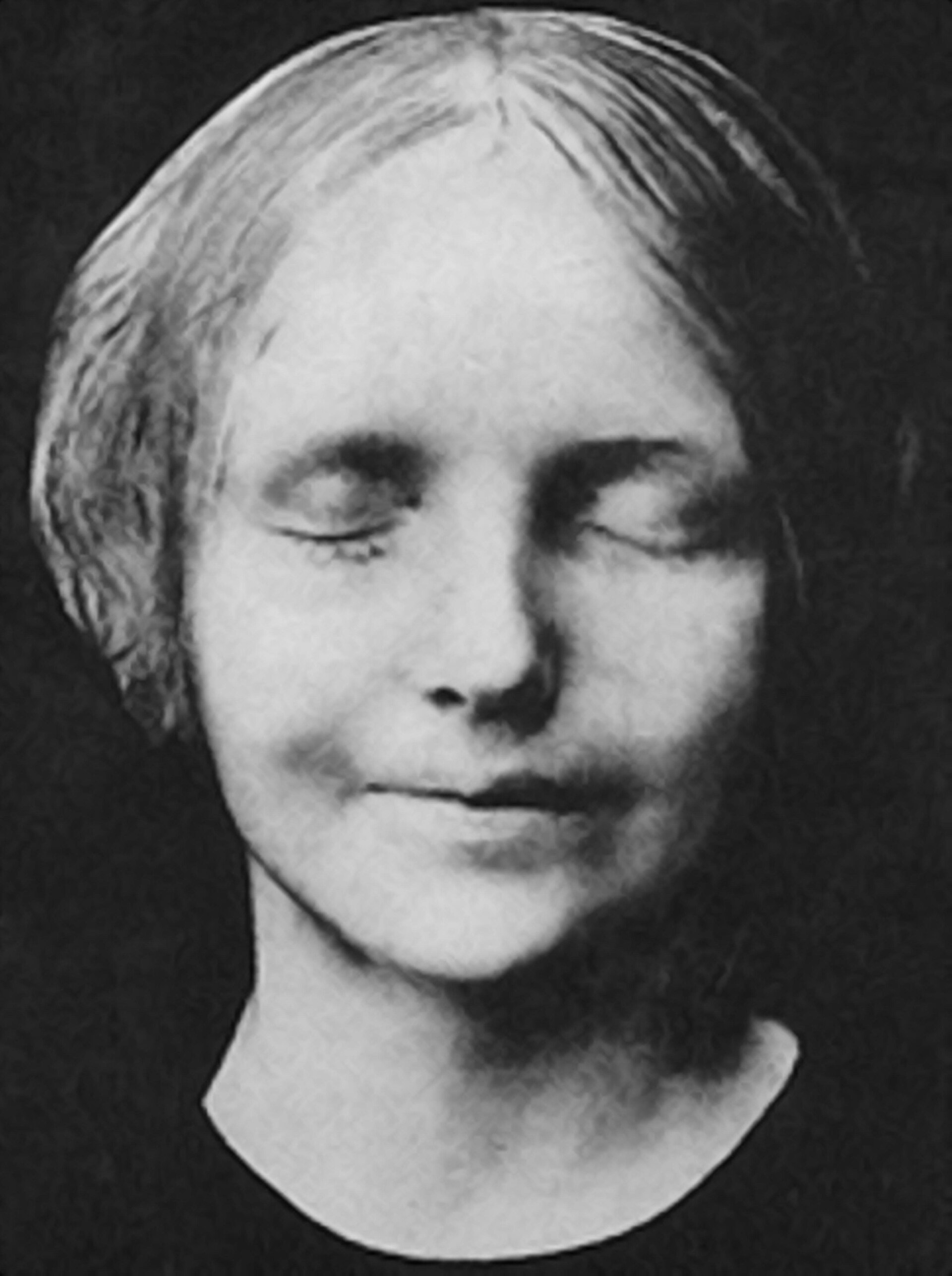
Unsolved since 1898A plaster death mask of an unnamed young woman has been the best-selling item at a Paris mold shop for a century, used to train 300 million people in CPR as the face of the dummy "Resusci Anne." The family that sells her doubts she was ever a corpse.
What We Know
Sometime before 1898, a plaster cast of a young woman’s face began turning up in the windows of mold shops on the Paris Left Bank. Her eyes are closed. One corner of her mouth lifts, just slightly, as if she’s noticed something no one else can see. By the time the English writer Richard Le Gallienne turned her into a novella villain in 1899, she already had a name that wasn’t a name: L’Inconnue, the Unknown Woman.
The story that made her famous arrived with the object, and nobody can say who told it first. A young woman’s body, pulled from the Seine. No wounds, no sign of a struggle: a drowning, maybe, or a suicide nobody witnessed. Paris morgues of the era displayed unclaimed bodies behind glass so the public could help identify them, and this is supposedly where a pathologist saw her face and couldn’t let her go into an unmarked grave unrecorded. He called in a moulder. The moulder cast her in plaster. The morgue moved on. The mask stayed.
It spread fast for an anonymous woman. Rilke saw her hanging in a shop window on the rue Racine in the early 1900s and gave her a page in his 1910 novel. Albert Camus later called her “the drowned Mona Lisa.” Vladimir Nabokov wrote her as a Russian water-spirit in a 1934 poem. By then her face was standard décor in fashionable European rooms, sold alongside masks of Napoleon and Beethoven, and outselling both, at the workshop that still makes her today.
That workshop is Lorenzi, in the Paris suburb of Arcueil, run by the same family since the 1870s. In 2013, a BBC crew brought the mask to the river police, the people whose actual job is pulling bodies out of the Seine, and asked what they saw. Chief Brigadier Pascal Jacquin didn’t recognize the face at all. “Everyone we find in the water, the drowned and suicides,” he said, “they never look so peaceful. They’re swollen, they don’t look nice.” Michel Lorenzi, standing over the mold his family has used for four generations, said much the same thing in his own way: this isn’t what death looks like. It’s what a very good model looks like, holding a smile.
The Roadblock
The obstacle isn’t a lack of interest. People have picked at this for over 125 years, starting with Le Gallienne’s own readers. It’s that the case was never opened as a case. If there was a body, no one recorded a name for it. Paris morgue logs from the period are incomplete, and even a complete one wouldn’t distinguish this particular woman from the dozens of other unclaimed drowning victims recorded most years.
The one thing that could settle it, the original mold examined by an actual forensic specialist rather than by the family that sells copies of it, has never been offered up for that kind of study. What survives are worn plaster descendants of a mold and the Lorenzi family’s own testimony, not a body, not an autopsy, not a signed receipt from whoever cast her.
That leaves the case running entirely on secondhand accounts: a moulder’s relative recalling what he once said, a painter’s student recalling what his teacher once said, a police chief’s professional read on how a drowned face actually looks. It’s real evidence, attached to real, named people. It is also, in a courtroom sense, nothing. It’s also the only evidence anyone is ever going to get.
Best Guesses
Three explanations survive contact with what little evidence exists. None can be tested against a body, because nobody agrees there ever was one to test.
Cast from a real drowning victim
This is the version repeated by Camus, by Rilke, and by nearly every popular retelling since 1899: an actual young woman drowned, her body went unclaimed at the Paris morgue as period practice required, and a pathologist had her cast before she could be buried without a name. It fits how death masks were genuinely made in the era: pathologists and anatomists commissioning casts of striking or notable corpses wasn’t unusual. Its wound is that no one has ever produced the thing that would nail it down: a named pathologist, a morgue log entry, a newspaper notice from the 1890s. A century of digging through Paris archives has turned up nothing.
Cast from a living professional model
A family retelling what a relative once said isn’t a document, and it’s a retelling from the same family that has profited for four generations by selling the romantic version they say isn’t true. That’s the wound in this theory before it even reaches its evidence. But the family’s account doesn’t stand alone. Michel Lorenzi and Claire Forestier both say the skin is too firm and the smile too composed for a corpse: “it would be impossible to take such a perfect face from a dead woman,” Forestier has said. An outside expert independently agrees: river-police chief Pascal Jacquin, who has pulled real drowning victims from the Seine for a living, called the mask’s serenity “surprising” next to what he actually sees on the job.
A real death mask, but not by drowning
A third account, traced through painter Jules Joseph Lefebvre to his student Georges Villa, says the mask is real and was cast from an actual corpse, but that the corpse belonged to an artist’s model who died of tuberculosis around 1875, more than twenty years before the mask’s documented public trail even begins. On this version, drowning was added later because a doomed beauty pulled from the Seine made a better story than a model who died slowly of an ordinary disease. It’s the only account not told by someone with a stake in the mask’s fame or sales — but that twenty-year gap has never been explained, and no one has traced the original cast to confirm any of it.
The Verdict
The original mold could still settle this: examined by a forensic specialist with no financial stake in the answer, tested for whatever a plaster cast can still reveal, over a century later, about the difference between living and dead tissue at the moment it was taken. That’s almost insultingly simple to describe and likely impossible to get: no outside forensic examiner has ever done it. Short of that, one period document (a morgue register, a newspaper notice, a moulder’s signed receipt) naming an actual date and an actual body would do it. Neither has surfaced in over 125 years of people wanting badly to find one.
What has surfaced instead is more testimony, from people standing closer to the actual object than anyone else alive: a family that has sold her face for four generations and doesn’t believe in the story that sells her, and a police chief who spends his working life around exactly the kind of body she’s supposed to be, saying plainly that she isn’t one. The mask keeps smiling either way.
Where do you stand?
That’s one. There’s another every morning at 6 a.m. local time.
Share where you stand
What Didn't Hold Up
Details that circulate with this case but failed verification against independent sources. Cut from the story above — listed so you know they weren't missed.
“The mask belonged to a Hungarian actress named Ewa Lazlo, murdered by her lover Louis Argon — a specific, named solution to who she was, citing a discovered carte de visite as evidence.”
Traced to its root: artist John Goto invented the identity and its 'supporting evidence' as an art-fiction project, then said on the record he never expected it to be taken as real. It still circulates as fact on blogs and fan sites. Confirmed: her actual identity remains unknown; this is a documented hoax, not a lead.
The Rabbit Hole
- BBC News: Resusci Anne and L'Inconnue: The Mona Lisa of the Seinethe fullest account of the story, including the river-police interview and a fabricated identity that got mistaken for real research.
- The Drowned Muse (Anne-Gaëlle Saliot, Oxford University Press, 2015)a full scholarly book on the mask's 125-year cultural afterlife, for readers who want the deep version.
- Undying Faces (Ernst Benkard, 1929), full text on the Internet Archivethe period survey of death masks that helped cement her place among the form's most famous examples.
- Museum of Medicine: L'inconnue de la Seine, a prototype for the CPR manikin Resusci Annethe medical-history half of the story, for readers who arrived via Resusci Anne rather than the mask.