
№ 00827 NOVEMBER 2026ARTIFACTKENSINGTON, DOUGLAS COUNTY, MINNESOTA
The Kensington Runestone
A Farm in Minnesota, a Date From 1362, No Agreed Forger
Unsolved since 1898In the fall of 1898, a Minnesota farmer clearing a hillside found a 200-pound slab tangled in a tree's roots, carved with runes and dated 1362 — a century before Columbus. Scandinavian philology has called it a forgery since 1899. It has never produced a confession or an agreed forger.
What We Know
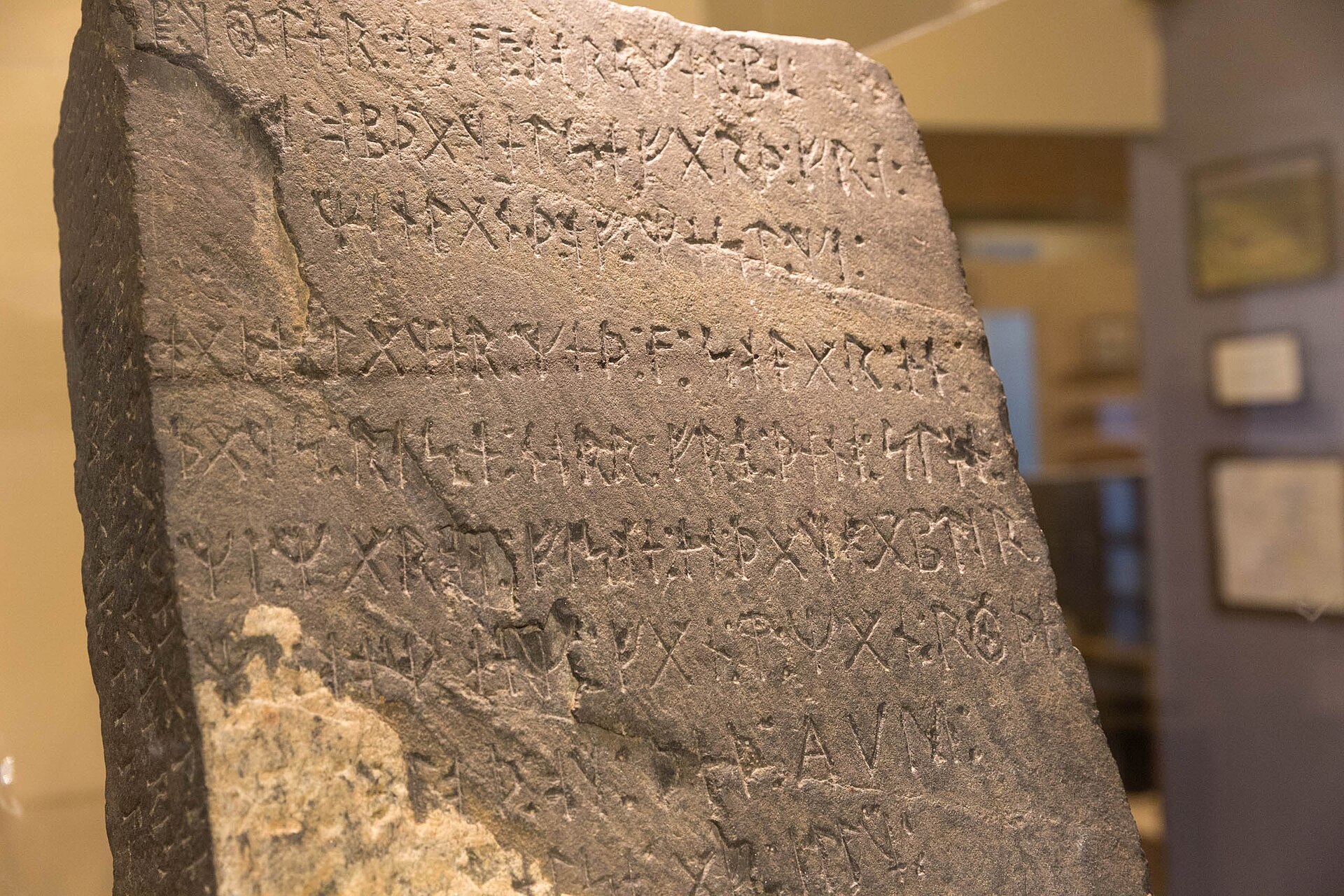
Olof Öhman was clearing a low hill on his farm outside Kensington, Minnesota, in the fall of 1898 when an aspen root, wound tight around a flat gray slab, stopped his plow. He and his teenage son dug the stone free: 200 pounds of graywacke, carved on its face and one edge with symbols neither of them recognized. Even the date slips depending on whose account you trust (Öhman’s own later affidavit says August; the Minnesota Historical Society’s 1910 report says November 8), but what happened next isn’t in dispute. A Swedish immigrant farmer with a grade-school education had turned up something written in an alphabet older than his own.
Öhman mailed a rubbing to a Swedish-language newspaper. Within months it reached two university professors, George Curme in Chicago and Olaus Breda in Minneapolis, who translated it independently and agreed on what it said: eight Swedes and twenty-two Norwegians on an exploration from Vinland, camped by two skerries, returning from a day’s fishing to find ten of their party “red with blood and dead.” It closed with a prayer to the Virgin Mary and a date: 1362, a century and a quarter before Columbus. Curme and Breda agreed on something else, too: the language wasn’t medieval. Breda sent copies to five of Scandinavia’s leading philologists. All five called it a fraud.
Öhman got the stone back in the mail in March 1899. By his own account, he used it as a doorstep into his granary, face down, for the better part of a decade, until a Norwegian-American historian named Hjalmar Holand bought it from him in 1907 and spent the next fifty-six years, until his death in 1963, trying to get the verdict reversed. Holand got the stone onto display at the Smithsonian. He never got the philologists to change their minds. Öhman died in 1935, having asked for no money and claimed no credit for a hoax he may never have needed to confess to.
The Roadblock
Runes are, in principle, a dateable technology, tied to known letterforms and documented sound changes the way handwriting styles date a manuscript. Weigh the Kensington text against the roughly 6,000 catalogued Scandinavian runic inscriptions and something should either match a known century or not.
Almost nothing does, cleanly. The stone’s vocabulary reads far closer to nineteenth-century Swedish than to 1362. In 2012, runologist Henrik Williams traced two of its supposedly impossible archaic words to pages 62 and 64 of an 1891 Swedish-language reference encyclopedia that Öhman is documented to have owned. That kind of match usually ends a debate. It hasn’t, because a handful of the stone’s other unusual forms cut the other way: genuinely difficult to explain as ordinary nineteenth-century Swedish, and not resolved by anything found since, including Williams’s own search. No forger’s toolkit, practice stone, or reliable confession has ever surfaced. No dating method, linguistic or geological, has produced a result its critics couldn’t credibly dispute. A century of expert attention has narrowed the field without closing it.
Best Guesses
Öhman carved it himself
No signed confession has ever surfaced, and no one ever witnessed the carving — the two gaps this theory has never closed. What fills them instead is essentially the whole field: professors George Curme and Olaus Breda judged the inscription impossible as medieval Swedish since 1899, five leading Scandinavian philologists endorsed that verdict within the year, and every subsequent specialist in Scandinavian, English, or German philology has agreed with it, according to Henrik Williams’s own 2012 survey of the field. The strongest new evidence is oddly domestic: two of the stone’s supposedly unexplainable archaic words sit two pages apart, on pages 62 and 64, inside an 1891 encyclopedia Öhman owned.
A hoax, but not Öhman’s
Öhman had a neighbor with real qualifications for the job: Sven Fogelblad, a Swedish-trained former Lutheran pastor documented to own rune references. Minnesota Historical Society historians have floated him for decades as the likelier author of a text this demanding, on the theory that Öhman, by every surviving account a plain, unpretentious farmer, lacked the reach the inscription shows. The trouble is that nothing ties Fogelblad to the stone beyond plausibility. No letter, no witness, no account of the two men working together has ever surfaced.
A genuine 1362 expedition marker
Richard Nielsen, an engineer who has spent decades combing published Old Swedish charter material word by word, argues the case against a medieval origin is thinner than it looks. Williams checked Nielsen’s parallels directly and found most invalid. Not all, though: a few of the stone’s odd words, he writes, are “nicely balanced” between forms hard to explain in either century. Two credentialed academics from adjacent fields, Cornell linguist Robert Hall and Copenhagen ethnologist William Thalbitzer, argued outright for authenticity; anthropologist Alice Beck Kehoe still does. What it doesn’t have is a single working runologist — the specialists who actually study carving practice — willing to endorse it.
The dating tests don’t agree
Newton Winchell’s own report for the 1910 committee contradicts itself before it settles: the chiseling’s edges, he first wrote, were sharp and showed “no apparent alteration by weathering” — the mark of a recent cut, not an ancient one. He judged the weathering consistent with real age anyway. More recent geological work claiming to reproduce his results has never been peer-reviewed or independently replicated, and nobody has run a rigorous, published, modern dating study on the stone at all. Contradiction and all, over a century later, Winchell’s verdict is still the strongest physical evidence anyone has offered for authenticity.
The Verdict
A second inscription would break this stalemate — but not just any inscription. It would need a documented, undisturbed context, the same unmistakable hand, and the same mix of nineteenth-century-looking spelling and genuinely hard-to-place archaism: proof a forger working in 1890s Minnesota could plausibly have produced this exact combination twice. Nobody has found one. Short of that, the strongest unfinished work is philological, not geological: a full, word-by-word accounting of the stone’s text against the actual medieval Old Swedish charter record, not the literary handbooks earlier critics used, the comparison Nielsen began and nobody has finished or independently repeated end to end. Whatever the answer, it isn’t really about Öhman’s character. Even scholars convinced he carved it agree he sought no money and claimed no fame, then or ever. It’s about a specific stone, a specific granary doorstep, and one unfinished comparison.
Where do you stand?
That’s one. There’s another every morning at 6 a.m. local time.
Share where you stand
The Rabbit Hole
- Henrik Williams, "The Kensington Runestone: Fact and Fiction" (2012)the full academic case, including the runologist's own translation and his find of Öhman's likely source book
- The 1910 Minnesota Historical Society report, in fullthe original committee document that exonerated Öhman personally without ever settling the larger question
- Mats G. Larsson: the Kölsjön connectionthe 2022 genealogical find tying Öhman's own family to the exact Swedish parish where the stone's 'impossible' runes were already circulating
- MNopedia: Kensington Runestonea concise overview from the Minnesota Historical Society, with further reading on Sven Fogelblad and the Runestone Museum