
№ 003622 SEPTEMBER 2026HEISTGHENT, BELGIUM
The Ghent Altarpiece's Just Judges Panel
Thirteen Letters and a Borrowed Photograph
Unsolved since 1934A note in French sat in the empty frame: taken from Germany by the Treaty of Versailles. Then came ransom letters signed D.U.A., and half the stolen plank returned as proof. By November 1934 the letters had stopped. Belgian investigators searched a villa for it in October 2024.
What We Know
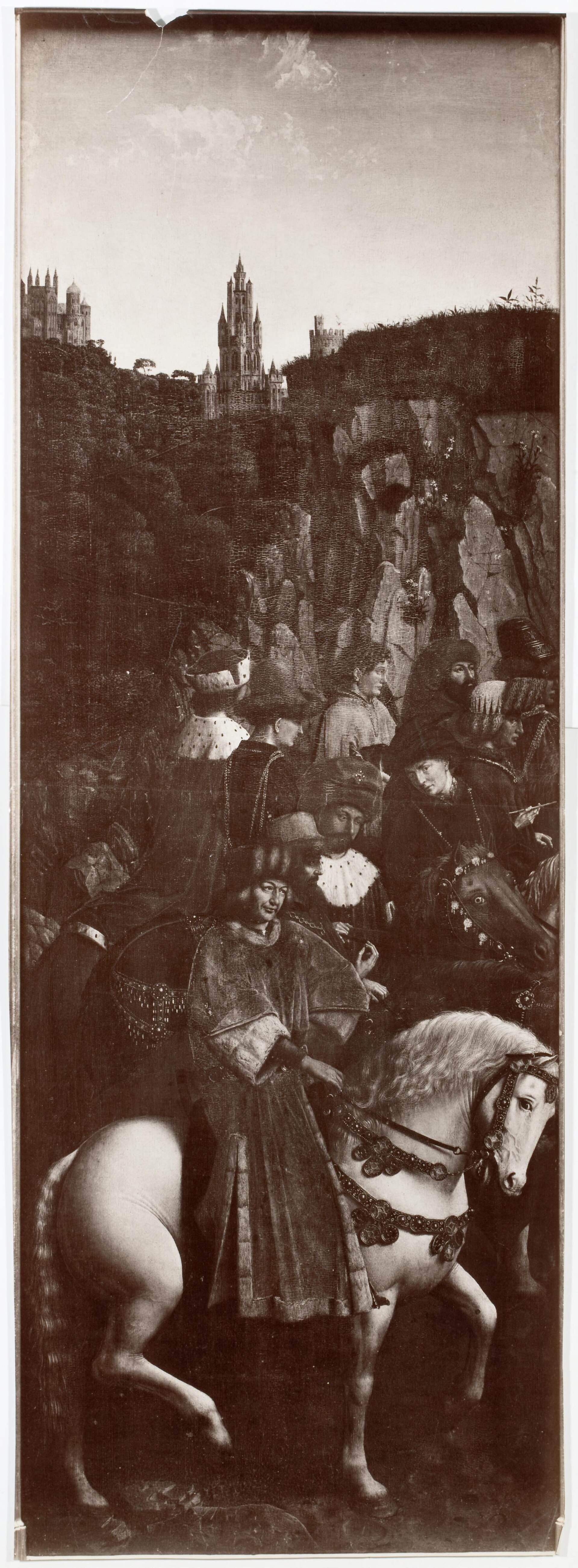
The sexton of St Bavo’s Cathedral in Ghent made his morning rounds on 11 April 1934 and found a hole in the most famous painting in Belgium. One of the twelve panels of the Adoration of the Mystic Lamb was gone: the lower left wing, a column of riders in fur hats moving toward the Lamb, known as the Just Judges. A chapel door had been forced and the hinges taken off, by somebody who knew how the altarpiece came apart.
The taunt about Versailles was a fair description of how the panel had got there. The wings had spent decades in Berlin, where the Kaiser Friedrich Museum sawed each of them in half through its thickness so both painted faces could hang at once, and Germany handed them back in 1920 as reparations. So by 1934 the Just Judges was one thin board and its old grisaille reverse, a St John the Baptist, was another. The thief took both and kept one.
On 30 April, Bishop Honoré Coppieters of Ghent received a demand for a million francs signed D.U.A. More followed over five months, to the diocese and the police, and the bishop answered where the writer told him to: the classified columns of the Brussels newspaper La Dernière Heure. In late May, as proof, D.U.A. posted a left-luggage ticket for Brussels-North station. The St John the Baptist was in the locker, returned free. In June, 25,000 francs of the million changed hands. The correspondence cooled after that, then stopped.
On 25 November, a stockbroker from Wetteren named Arsène Goedertier collapsed at a political meeting and died. By his lawyer’s account he said, dying, that he alone knew where the Mystic Lamb was, and sent him to an envelope in his desk marked mutualité. Inside were carbon copies of the D.U.A. letters, thirteen of them by the police file’s count, and one among those had never been posted. It said the panel lay somewhere it could not be taken away without attracting the attention of the public. The lawyer waited about a month before taking any of it to the police. Every search in the ninety-two years since has been an argument about that one sentence.
The Roadblock
Goedertier was never charged with anything. He died before the police had his name, and everything known about his role is paper he left behind: the carbons, the unposted draft, a lawyer’s recollection. That is enough to make him the centre of the case and not enough to make him the answer to it, and it is why the file the Ghent prosecutors still keep runs past two thousand pages without narrowing to an address.
The clue itself is the problem. A place from which the panel cannot be removed without public attention describes a cathedral, a city square, a bank vault, a chimney breast, a house on a street where everyone knows everyone. It was written by a man who expected to be paid and to hand the thing back. It was never meant to be the only instruction anyone would ever have.
And there is no wound on the wall to keep anyone honest. In 1945 the restorer Jef Van der Veken slotted his own copy into the gap. By the RKD’s account he worked from a black-and-white photograph borrowed from Max Friedländer, took his colours from painted copies in Antwerp and Brussels, and gave one of the judges the face of Leopold III, the king who came to the throne the year the panel vanished. Ghent has looked complete ever since.
Best Guesses
Still inside St Bavo’s
In the 1970s a marble slab in St Bavo’s was broken out on one investigator’s reading of Goedertier’s sketches. Nothing behind it. The building has been scaffolded, rewired and restored since, around whatever is or isn’t in it. The theory survives that because of Karel Mortier, who ran the Ghent police until 1991 and published four books on this theft between 1966 and 2005, a longer relationship than most detectives get with any case. He read the unposted letter literally: a place you cannot empty without the public noticing is a church that never closes. He put the panel behind panelling in the choir, the chapter house, the tower or the organ, hidden by somebody with keys and probably not by Goedertier alone.
A cache nobody has reached
Warrant after warrant has tested this one. In 2019 the prosecutors took seriously a book by Marc De Bel and the amateur investigator Gino Marchal placing the panel under the Kalandeberg, a square a few minutes from the cathedral. Ghent dug. The hole was refilled, and the notable find was an old iron ladder. In late October 2024 investigators searched a villa in East Flanders on a fresh tip and found nothing. Each search was specific, argued and empty, which is either bad luck or the shape of a theory that cannot be wrong.
A Ghent family kept it
Paul De Ridder, a historian and former Brussels MP, went public in 2014 with a claim he credits to the constitutional lawyer Robert Senelle: a prominent Ghent family has held the panel since the 1930s, keeps it in good condition, and will not return it because of the scandal. On this reading the theft was leverage over a bank where Catholic families had money, which would explain a bishop who negotiated for five months instead of handing everything to the police. De Ridder took it to the prosecutor. The people questioned denied it. Senelle died in 2013, and the journalist Rik Van Cauwelaert has said Senelle never spoke to him about the Just Judges.
Destroyed while hidden
The journalist Rudy Pieters has argued in print that the panel was destroyed in 1971, while conceding that nobody has ever claimed to have watched it happen. The physical case is easier to make than the documentary one. This is an oak board about a metre and a half tall, already sawn down to half the thickness it was built at, hidden in April 1934 by someone who expected to hand it over within weeks. Ninety-two Belgian winters in a cellar or a wall cavity would be enough. Caroline Dewitte, the magistrate who has carried the file for two decades, doubts it: to her, destruction seems unlikely.
The Verdict
Nobody has ever had a board to put in front of a laboratory. If one turns up, the wood decides it: fifteenth-century oak with a growth-ring line back to a Ghent workshop, or a copyist’s later stock. Nor has St Bavo’s fabric had the survey the last conservation campaign gave the panels; the building gets a slab broken out here, a square of paving lifted there. The likelier ending needs none of it. A death in Ghent, a house cleared by heirs, a tall dark panel coming out of a cupboard with nothing on the back to explain it.
The letters have been read to pieces, the man whose desk held their carbons has been dead since 1934, and the diggings have produced a ladder. The altarpiece stands there looking whole: eleven panels by the Van Eycks and one by a restorer working from a borrowed photograph of the thing he was replacing. It is very good. It is not the panel.
Where do you stand?
That’s one. There’s another every morning at 6 a.m. local time.
Share where you stand
What Didn't Hold Up
Details that circulate with this case but failed verification against independent sources. Cut from the story above — listed so you know they weren't missed.
“The Nazis stole the Just Judges. Hitler wanted it, and it went into the Altaussee salt mine with the rest of the looted art the Monuments Men pulled back out in 1945.”
The rest of the altarpiece did go to Altaussee and did come home. The Just Judges was already gone six years before the occupation, taken in April 1934. Goebbels sent an art detective to hunt for it in occupied Ghent, and he never found it either.
The Rabbit Hole
- Closer to Van Eyck (KIK-IRPA)the whole altarpiece at absurd magnification, in visible light, infrared and X-ray
- RKD: the photograph Van der Veken borrowedthe Dutch art-history institute's own account of lending out its picture of the missing panel
- The Art Newspaper, 1995: seeking out the Just JudgesKarel Mortier making his case for the cathedral while he was still making it
- VRT NWS: excavation work draws a blankthe Kalandeberg dig, from the book that started it to the hole being filled in
- Monuments Men and Women Foundation: The Righteous Judgesthe panel's entry on a standing wanted list, reward terms included