
№ 006319 OCTOBER 2026IDENTITYWHITECHAPEL, LONDON, ENGLAND
Jack the Ripper
Mary Ann Nichols Died First, and the File Never Closed
Unsolved since 1888In the early hours of 31 August 1888, Mary Ann Nichols was found in a Whitechapel street with her throat cut. Four more women died the same way within eleven weeks. Scotland Yard's own files ran to hundreds of suspects. None has ever survived cross-examination.
What We Know
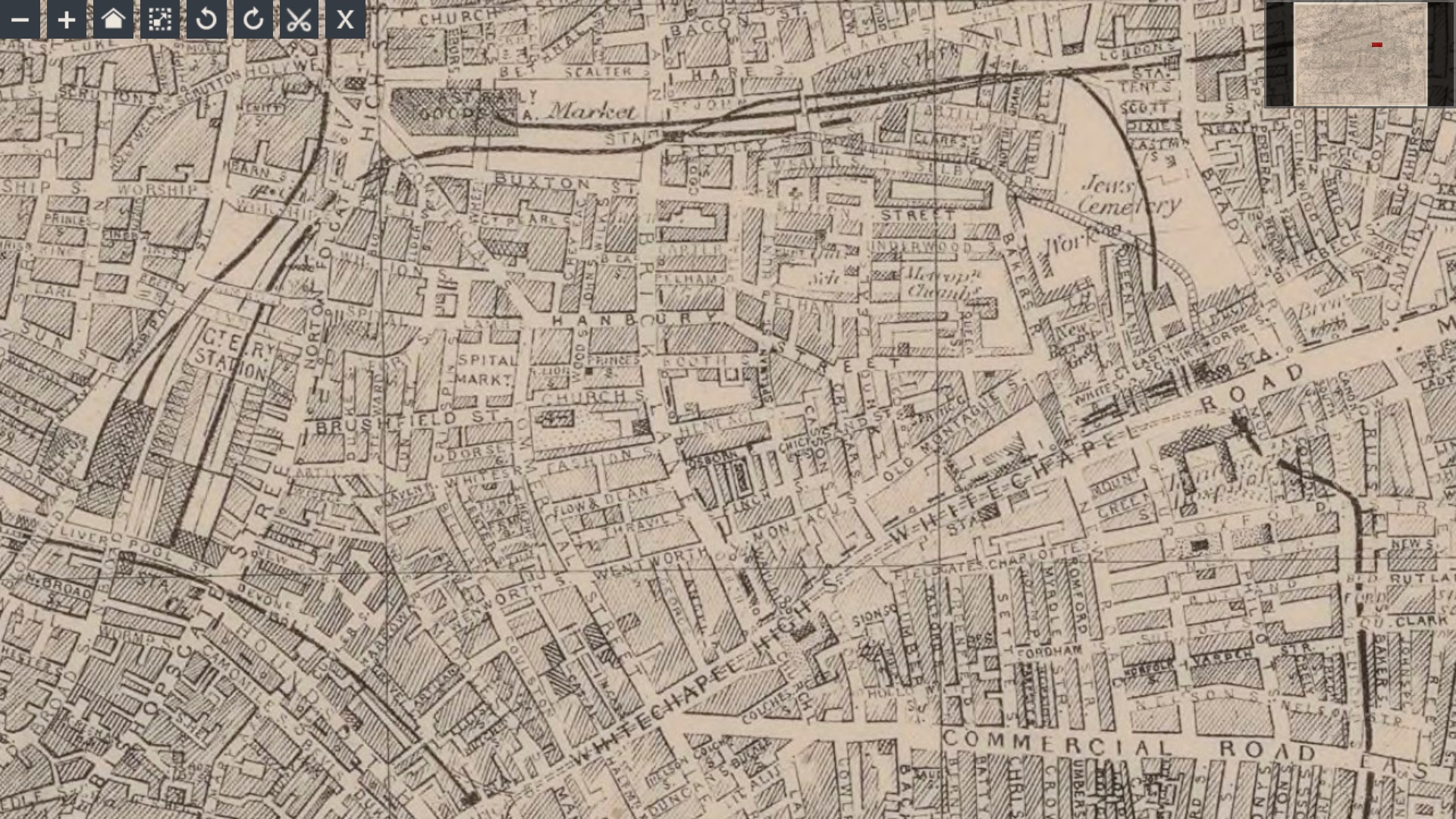
Mary Ann Nichols spent the last hour of her life about four pence short. Turned out of a Thrawl Street lodging house near 1:20 a.m. on 31 August 1888 for lack of a bed fee, she told the deputy keeper not to worry: she’d soon have her doss money, look at the fine new bonnet she had. An hour later she ran into her roommate, Ellen Holland, on Whitechapel Road and said she’d already earned that fourpence three times over that night and spent it each time. She set off to earn it a fourth. Just before 4 a.m., a policeman’s lamp found her on her back in Buck’s Row, her throat cut nearly to the spine.
She was forty-two. Her father’s inquest testimony gives the rest of what’s known: separated from her husband for seven or eight years, five children, work in domestic service, a struggle with drink he didn’t try to soften.
Within eleven weeks, four more women were killed within roughly half a mile of that spot, each with her throat cut: Annie Chapman on 8 September; Elizabeth Stride and Catherine Eddowes on the same night three weeks later, forty-five minutes and one police-force boundary apart; Mary Jane Kelly, the last and most extensively mutilated, found indoors on 9 November. A letter postmarked late September, signed “Jack the Ripper” and sent to a press agency, gave the killer the name that outlived every one of the more than one hundred suspects Scotland Yard eventually logged, though the letter itself, historians largely agree, was almost certainly a hoax, probably written by a journalist chasing readers rather than by whoever held the knife.
Two police forces investigated in parallel, interviewed thousands of people, and made no arrest that held. The file stayed open past the deaths of every officer who worked it. A hundred and thirty-eight years on, five murders and one borrowed nickname remain the only parts of this case nobody disputes.
The Roadblock
Whitechapel in 1888 sat across two police jurisdictions, the Metropolitan force for most of the murders and the City of London force for Eddowes alone, and the case has carried that seam ever since. The most cited physical evidence to survive, a shawl said to have been taken from Eddowes’s crime scene, was reportedly carried off by a Metropolitan officer from a square that wasn’t his force’s ground to begin with; the chain of custody that would let anyone verify that story simply doesn’t exist.
Fingerprinting wasn’t standard practice until 1901, and there was no blood typing, so investigators worked almost entirely from testimony and inference. Hundreds of hoax letters, written to be sensational rather than honest, buried whatever real leads came in. What survives from named suspects is nearly all secondhand: a memorandum written years later, a memoir’s handwritten margin note, a letter that surfaced only in 1993. Modern forensics has hit its own version of the wall: in August 2024, the journal that published the case’s most-cited DNA claim issued a formal Expression of Concern after its editor couldn’t get the underlying data from the study’s own authors. New tools have mostly proven how little of the original record can still be checked.
Best Guesses
Kosminski, named by his own detectives
Aaron Kosminski, a Polish-Jewish immigrant hairdresser in Whitechapel, was committed to an asylum in 1891 for what doctors recorded as hallucinations, not violence. Two senior officers separately named him: Sir Robert Anderson described a suspect positively identified by a witness who then refused to testify against “a fellow Jew,” and Chief Inspector Donald Swanson, annotating his own copy of Anderson’s memoir, wrote “Kosminski” straight into the margin. A 2019 peer-reviewed study claimed a mitochondrial DNA match between Kosminski’s line and stains on the disputed shawl. But Swanson’s note gets basic facts of Kosminski’s real record wrong: it has him dead by 1892, when he actually lived until 1919. Historian Martin Fido cites that gap to argue Swanson may describe a different, unidentified inmate, not Kosminski. And the DNA paper now carries a journal Expression of Concern over data its authors wouldn’t produce.
Druitt drowned himself in guilt
Montague John Druitt, a barrister and assistant schoolmaster, vanished around the date of the final canonical murder and was pulled from the Thames on 31 December 1888, his pockets weighted with stones. No inquest record places Druitt in Whitechapel, and no witness ever put him near a crime scene. Assistant Chief Constable Melville Macnaghten didn’t join the Met until seven months after the murders ended, and said his information came secondhand. Druitt’s dismissal from his teaching post days before his death is real; what caused it, and whether it bears on the murders, is not. In a private 1894 memo written to rebut a newspaper’s rival suspect, Macnaghten called him “sexually insane” and wrote that Druitt’s own family believed him the murderer.
Tumblety fled the country in time
Francis Tumblety, an American self-styled “doctor,” was arrested on gross-indecency charges on 7 November 1888 and skipped bail for France, then the US, within weeks — his flight lands right where the canonical murders stop. Former Special Branch chief John Littlechild, in a private 1913 letter unearthed only in 1993, called him “a very likely” suspect and said Scotland Yard held “a large dossier” on him. Tumblety had documented contempt for women, means, and a demonstrated willingness to run. But Littlechild also wrote that Tumblety wasn’t known as a “sadist,” and the charge that actually sent him fleeing was the indecency case alone — real, separate, and silent on murder.
Sickert left DNA on the letters
Painter Walter Sickert has no contemporary link to the case; his candidacy is entirely a 2002 argument by novelist Patricia Cornwell. Most Ripper historians and letter specialists consider nearly every surviving “Ripper” letter — the ones Cornwell tested included — a contemporary hoax, not the killer’s writing. Geneticists reviewing her claim have also noted the mitochondrial type she reported is shared across a meaningful share of the population; alone, it can rule a suspect out, never confirm one in. Her case rests on mitochondrial DNA she says her team matched between several “Ripper” letters and Sickert’s own correspondence, plus watermark analysis, in a project reported to have cost her more than six million dollars.
The Verdict
Every theory here rests on the same shape of evidence: a memo, a margin note, a letter that surfaced decades later, a DNA study whose authors won’t release the numbers behind their own headline. What would actually move this is specific. Publish the raw genetic data behind the 2019 shawl study, openly enough for an independent lab to try the match itself, alongside a documented chain of custody for the shawl back to Mitre Square on the night Eddowes died. Short of that, a surviving Metropolitan Police record naming Swanson’s actual source — rather than repeating his claim a second time — would do nearly as much. Neither has surfaced in a hundred and thirty-eight years of people looking hard, some of them very well funded. The case stays open in the one sense that has never changed: no piece of evidence in it has yet survived a hostile cross-examination intact.
Where do you stand?
That’s one. There’s another every morning at 6 a.m. local time.
Share where you stand
What Didn't Hold Up
Details that circulate with this case but failed verification against independent sources. Cut from the story above — listed so you know they weren't missed.
“A 2019/2025 DNA study proves Aaron Kosminski was Jack the Ripper with a "100% match" between the Eddowes shawl and his descendants.”
The journal that published the underlying 2019 mtDNA study issued a formal Expression of Concern in August 2024 after its authors could not produce the raw data, and the shawl's own chain of custody back to the crime scene has no supporting document. What is confirmed: a disputed, undocumented match, not a solved case.
“Jack the Ripper was Prince Albert Victor, Queen Victoria's grandson, and the murders were covered up to hide a secret royal marriage.”
Originated in a 1970 magazine article and popularized by Stephen Knight's 1976 book. Royal-household and court records place Albert Victor at Balmoral and at Sandringham, away from London, on multiple canonical murder dates. What is confirmed: a documented alibi the conspiracy theory has never addressed.
“The "Diary of Jack the Ripper," which surfaced in 1992, is the killer's own genuine handwritten confession.”
Ink and paper testing found the document inconsistent with an 1888-89 origin, and the man who brought it to market signed a sworn statement confessing he forged it, though he later gave conflicting accounts. What is confirmed: mainstream document analysis treats it as a forgery, not a genuine diary.
“The killer's mutilations show surgical or anatomical training, proving he was a doctor or another medical man.”
Thomas Bond, the police surgeon who examined the wounds, stated they showed no scientific or anatomical knowledge. Modern forensic re-examination of surviving mortuary records finds the incision technique inconsistent with surgical training. What is confirmed: the wounds argue against skill, not for it.
The Rabbit Hole
- The National Archives: Hoax letter signed by 'Jack the Ripper'the institution holding the actual letter, on why it almost certainly isn't the killer's
- Casebook: Jack the Ripper — the full 1888 inquest into Mary Ann Nichols's deathread the coroner's testimony yourself, witness by witness
- The Skeptic: DNA analysis almost certainly hasn't just solved the mystery of Jack the Rippera 2025 skeptical breakdown of the shawl claim, written for a general reader
- Hallie Rubenhold, The Five: The Untold Lives of the Women Killed by Jack the Ripperthe prize-winning biography of all five victims, told as their own lives, not the killer's case file