
№ 006723 OCTOBER 2026PHENOMENONNORMA CLUSTER / ZONE OF AVOIDANCE, SOUTHERN SKY
The Great Attractor
Six Hundred Kilometers a Second, Toward Nothing Visible
Unsolved since 1986Every large galaxy near ours, including the Milky Way, is moving at hundreds of kilometers a second toward a patch of sky hidden behind our own galaxy's stars and dust. Astronomers named the pull's source in 1988. They still don't agree they've found enough mass to explain it.
What We Know
In the mid-1980s, seven astronomers set out to do something almost boring: measure how fast roughly 400 elliptical galaxies were receding from us, to check how smoothly the universe was expanding. Alan Dressler, Sandra Faber, David Burstein, Roger Davies, Donald Lynden-Bell, Roberto Terlevich, and Gary Wegner, a team the field nicknamed the Seven Samurai, published their numbers in 1987, and the numbers weren’t smooth. The galaxies weren’t just receding with the expansion. They were streaming sideways, together, toward one part of the southern sky, carrying the Milky Way with them at 570 kilometers a second.
The next year, the same team ran a model to find what was doing the pulling. The best fit put the source in the constellation Norma, at galactic coordinates 307°, 9°, needing roughly 5×10¹⁶ solar masses of gravitating matter to produce the flow they’d measured. They named it the Great Attractor, and immediately hit a problem: a latitude of 9° means the predicted source sits almost exactly behind the disk of our own galaxy, in a strip of sky astronomers call the Zone of Avoidance, where the Milky Way’s stars and dust block roughly a fifth of the extragalactic universe from ordinary telescopes. They had found the source of one of the largest coherent motions ever measured nearby, and pointed a finger at what looked, from Earth, like nothing at all.
It took a decade of patient work: infrared surveys that could see past starlight, then radio surveys that could see past the dust entirely, before anything turned up. In 1996, a team led by Renée Kraan-Korteweg reported a massive galaxy cluster, Abell 3627, sitting just 9 degrees from the model’s predicted center: the first real candidate the numbers had demanded. It was real. Whether it was enough is the argument that’s still running, forty years later.
The Roadblock
The difficulty is built into the discovery itself: the thing being measured is hundreds of megaparsecs across, and the thing doing the measuring is a single moving point inside it. Every galaxy’s motion has to be disentangled from the universe’s overall expansion, from the Milky Way’s own orbit within the Local Group, and from the Local Group’s motion as a whole — a chain of corrections in which each step compounds the uncertainty of the last.
Then there’s the obscuration. The Zone of Avoidance isn’t a figure of speech; it’s a real gap in the data, where the Milky Way’s own stars and dust swamp the light of anything behind them. Every mass estimate for a candidate structure back there, the Norma Cluster included, is made through a veil, corrected with extinction models that carry their own error bars. And the flow being explained isn’t local. It’s measured out to hundreds of millions of light-years, which means confirming any single source means agreeing not just how much mass sits behind the dust, but how far its gravity is supposed to reach.
Even the best current reconstructions, built on forty more years of data than the Seven Samurai had, don’t converge on one number for how much of the pull is accounted for. They converge on the fact that it’s less than all of it.
Best Guesses
Norma Cluster’s mass, fully counted
The most direct candidate is the one the 1988 model pointed at: Abell 3627, the Norma Cluster, sitting almost exactly where the fit predicted, in a region nobody could see into yet. In 1996, Kraan-Korteweg’s team found it there: a massive, previously uncatalogued cluster, right where a mass had to be. The wound showed up twelve years later. A more careful 2008 study, actually measuring the velocities of galaxies inside Norma, put its dynamical mass at roughly a fifth of the 1996 figure — real, but the paper that measured it never says whether that’s still enough.
Shapley pulling through Norma
Norma may be a foreground marker rather than the answer. Three times farther away sits the Shapley Supercluster, the largest concentrated mass in the nearby universe, big enough that its gravity should reach us regardless of what Norma weighs. On this reading, Norma is real but not sufficient: the dominant pull comes from Shapley, with Norma just a foreground contributor. No source in the literature puts a confident number on the split. Twenty years after the flow was first measured, the team that had actually weighed Norma could only call the relative contribution of the two regions “poorly determined” and “still a matter of debate” — the most precise verdict anyone has managed since.
A flow no mapped mass explains
The most radical possibility skips the Great Attractor region entirely. In 2008 and 2010, Alexander Kashlinsky’s team measured a subtler effect, hot gas in distant galaxy clusters faintly distorting the cosmic microwave background, and reported a coherent flow reaching hundreds of megaparsecs out, far past where Norma or Shapley could plausibly be pulling. They called it dark flow: motion with no mapped cause, contested from the start. Two tests since have gone against it. The Planck satellite’s more sensitive 2014 reanalysis found no comparable signal, several times below Kashlinsky’s number, and the tightest test yet, published in May 2026, still finds nothing anomalous at the relevant scales. No one has replicated the original claim.
An artifact of the dust in the way
The least satisfying answer, and the newest one with real evidence behind it, is that there may be no single Great Attractor at all. A 2026 reconstruction of the Local Group’s full trajectory found that all the cataloged mass within roughly 700 million light-years explains only about 72% of its measured motion, off by 38 degrees from the actual direction — and argues the classical single-attractor picture is an artifact of measuring the flow at one instant, not a real, dominant structure. Different regions pull at different distances; none of them, in this reconstruction, does most of the work alone. Twenty-eight percent of the motion is still unaccounted for; it just no longer needs one single culprit.
The Verdict
A complete, dust-penetrating census of the Zone of Avoidance would do it — cross-checked against a bulk-flow measurement precise enough that independent teams stop disputing each other’s filtering, telling plainly whether the missing mass is sitting there uncounted or was never there to count. Not one photograph. Not one survey. Agreement.
The 2026 papers are the closest thing to progress this argument has had in years, and what they mostly prove is that the question got harder, not easier: more structures matter, in more combinations, than the Seven Samurai’s clean single-attractor model ever allowed for. Norma is real. Shapley is real. Whether either, or both together, or something past them entirely, is doing the pulling remains an open ledger with the totals still unreconciled.
Forty years ago, seven astronomers found a number that shouldn’t have been there and a coordinate they couldn’t see into. The coordinate’s been resolved. The number hasn’t.
Where do you stand?
That’s one. There’s another every morning at 6 a.m. local time.
Share where you stand
What Didn't Hold Up
Details that circulate with this case but failed verification against independent sources. Cut from the story above — listed so you know they weren't missed.
“The Great Attractor mystery has been solved — hundreds of hidden galaxies have been found behind the Milky Way, explaining the pull.”
Traces to a real 2016 survey (883 galaxies catalogued behind the Milky Way with the Parkes radio telescope), recirculated by aggregator sites nine years later as if new. The survey is real, but it doesn't, on its own or per the newer 2026 reconstructions, establish what fraction of the pull the mass explains.
“The Great Attractor will eventually destroy the Milky Way, or pull us into a collision.”
Conflates the Great Attractor with the separate, well-established Milky Way–Andromeda merger (~5 billion years out). The pull is real, but cosmic expansion, driven by dark energy, carries the structures doing the pulling apart faster than gravity closes the distance — the Local Group isn't expected to reach it.
The Rabbit Hole
- NASA/ADS: Lynden-Bell et al. 1988 — the paper that named itthe original model fit, coordinates and all, in the astronomers' own words
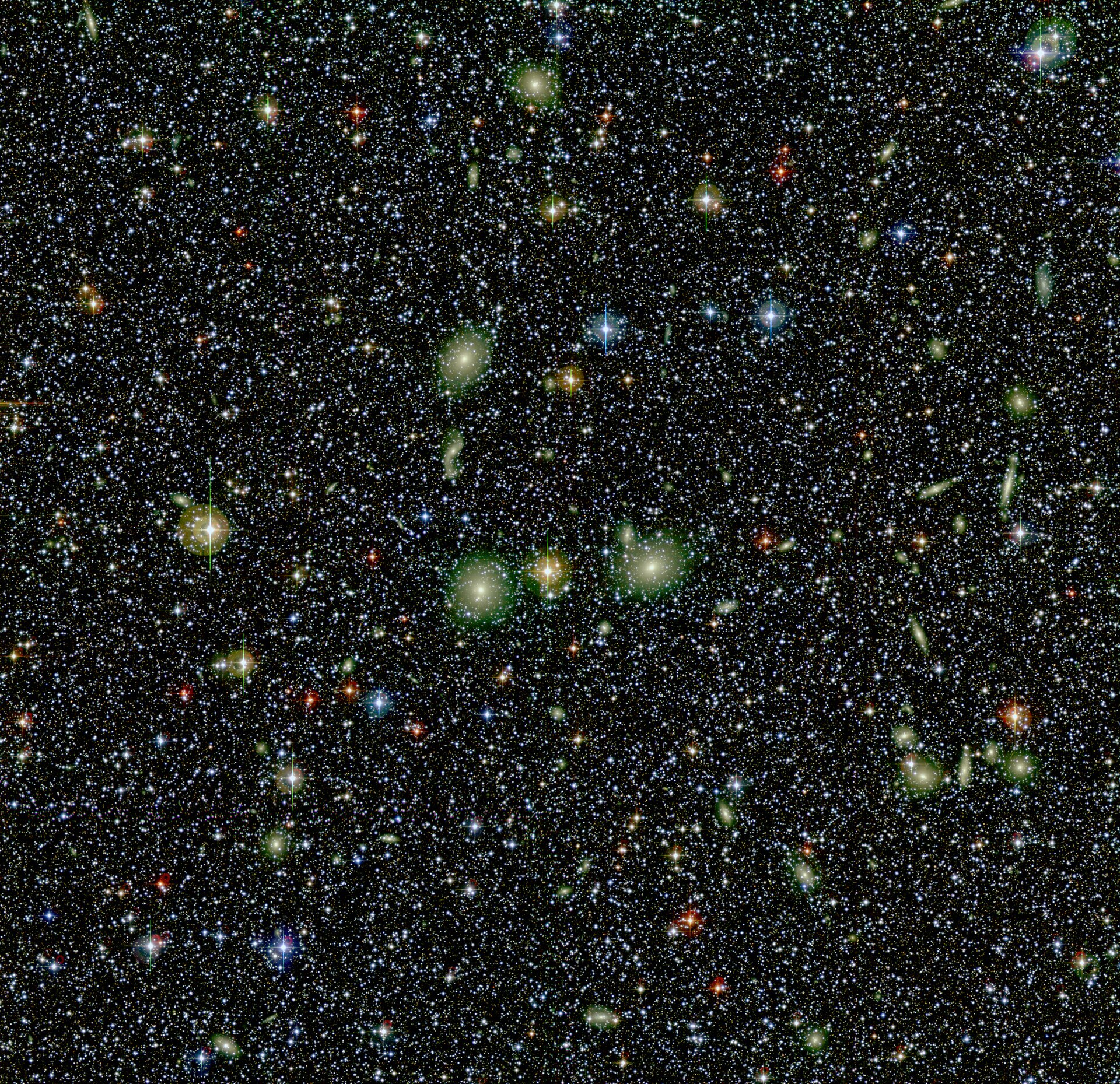
- ESO: One Hundred Thousand Galaxies at a Glancethe 1999 press release behind this article's photograph, and the wider survey it came from
- NPR Short Wave: the mysterious 'Great Attractor' pulling the Milky Way off coursea friendly ten-minute audio primer on the flow, and the larger Laniakea picture it sits inside
- arXiv: Revisiting the Great Attractor (Stiskalek et al., 2026)the newest full reconstruction of the Local Group's trajectory, math included
- arXiv: Large-scale peculiar velocities in the universe (Tsagas et al., 2025 review)a technical but readable survey of the whole bulk-flow debate, dark flow included