
№ 00838 NOVEMBER 2026PLACEŞANLIURFA PROVINCE, SOUTHEASTERN TURKEY
Göbekli Tepe
Six Thousand Years Older Than Stonehenge, Then Buried on Purpose
Unsolved since 1994Eleven thousand six hundred years ago, hunter-gatherers with no farming, writing, or metal tools raised rings of five-meter limestone pillars in southeastern Turkey, carved with foxes, scorpions, and vultures. Centuries later, the whole thing vanished under tons of rubble, and no one agrees why, or whether anyone meant it to.
What We Know
In October 1994, Klaus Schmidt climbed a scrubby hill outside Şanlıurfa, in southeastern Turkey, chasing a one-line mention in a decades-old survey. A team from Istanbul and Chicago had passed the same hill in 1963, seen broken limestone slabs, and written it off as an abandoned cemetery. Schmidt, a German archaeologist who’d excavated a similar site nearby, looked at the same slabs and knew immediately they weren’t gravestones. “It was clear right away this was a gigantic Stone Age site,” he said later. The next year his team had opened its first trench.
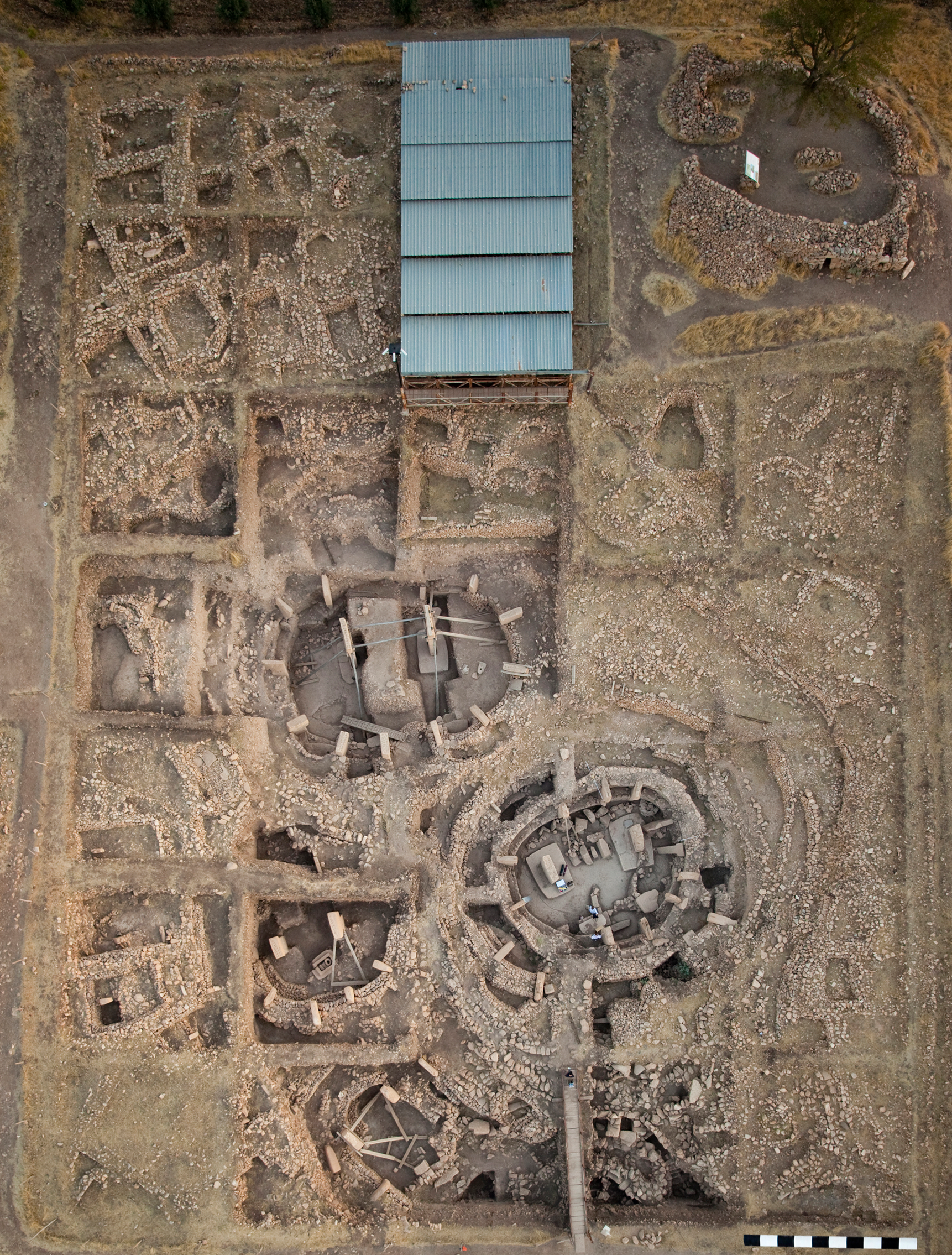
What they found were rings of T-shaped limestone pillars facing inward around a pair of central stones — the tallest and heaviest in the whole complex, standing 16 feet and weighing up to ten tons. Some pillars are blank; others carry carvings of foxes, boars, snakes, scorpions, and vultures, single animals with no obvious scene connecting them. Radiocarbon dating puts construction at roughly 9600 BCE: more than 6,000 years before Stonehenge, before the people who built it had pottery, metal tools, or writing of their own. Schmidt’s team found none of the usual signs of a village: no hearths, no houses, no storage pits. What it did find, over nearly two decades, was more than 100,000 butchered animal bones, mostly wild gazelle, boar, and sheep — the leftovers, Schmidt argued, of feasts held when the stones went up.
Sometime after each ring went out of use, it was filled with rubble, more bone, and broken tools, and a new ring rose nearby or on top. Those layers built the hill itself. Schmidt died in 2014, still excavating, still certain of his own answer: that scattered bands built Göbekli Tepe before they had agriculture, and building it is what pushed them toward farming and settled life, not the other way around. Temple first, city after, he liked to say. Less than 5 percent of the hill has ever been dug.
The Roadblock
The problem isn’t a shortage of evidence. It’s evidence with no one left to explain it. Göbekli Tepe’s builders left no writing (that invention was still six millennia away), so there’s no label for what any carved animal meant, no inscription naming a god or an ancestor, and no comparable site from the same centuries to check a reading against. Archaeologists still don’t agree whether the carvings are totems, warnings, star charts, or simply what the carvers saw around them.
The dig itself compounds the problem. Fewer than 5 percent of the site’s 22 acres have been excavated, and radar surveys suggest at least 15 more stone rings remain buried. What’s exposed keeps getting reinterpreted: later builders reused and reset older pillars into newer walls, so a pillar’s current position may not be where its carvers placed it, a real problem for any theory that depends on precise alignment. Even the burial is contested. Schmidt’s team read the rubble fill as deliberate decommissioning; a more recent architectural review found wall damage that looks more like earthquake collapse than intentional infill. Excavators working the site today are actively revising conclusions Schmidt’s own team once treated as settled, including, most consequentially, whether anyone lived here at all.
Best Guesses
Four readings of Göbekli Tepe have real evidence behind them, and none has forced the others off the field. They disagree at the most basic level a site can be argued over: whether the builders ever slept there.
A gathering ground that sparked farming
Klaus Schmidt’s own thesis, still the most repeated: dispersed bands converged periodically to build, carve, and feast, and the coordination that took (raising ten-ton stones with no draft animals or metal tools) is what pushed them toward the settled labor farming would later demand. Its evidence is the absence Schmidt spent two decades documenting: no hearths, no houses, no storage pits, unlike nearby settlements of the same age. Its wound: that absence is now being overturned. Recent digging, at Göbekli Tepe itself and across the region, keeps finding domestic material Schmidt’s team never found, because it never dug where that material was.
Curated skulls anchored an ancestor cult
In 2017, Julia Gresky’s team published three human skull fragments from the site’s fill, each bearing deep grooves cut with flint, one drilled clean through: deliberate modification, not casual damage. It’s a narrow base for reinterpreting an entire complex — three fragments out of roughly 700 recovered site-wide, and no intact burial has turned up to anchor it further. Still, the skulls don’t stand alone: vultures carved on several pillars are regionally linked to carrying the dead skyward, and archaeologist Danielle Stordeur has found the same symbolism 50 miles away in Syria, from the same era. Together, they point to an ancestor cult built around curated, displayed skulls — venerating the deceased, not worshipping gods.
The carvings record a comet strike
A minority reading, published by engineers Martin Sweatman and Dimitrios Tsikritsis in 2017: the animals on Pillar 43, the “vulture stone,” aren’t totems but constellations, encoding a date, roughly 10,950 BCE, matching a proposed comet impact at the start of the Younger Dryas cooling. Its wound, laid out in a direct rebuttal from Göbekli Tepe’s own excavation team, is severe: Pillar 43 isn’t in its original spot after centuries of rebuilding, the calculated date runs up to a thousand years older than the enclosure’s radiocarbon dates allow, and the analysis leans on only a handful of the site’s 60-plus pillars.
People lived on the hill they built
The newest, most disruptive reading: Göbekli Tepe wasn’t only a pilgrimage site — people lived there, alongside the ritual rings, for real stretches of time. The residential-looking structures behind this reading sit in sectors Schmidt’s team never reached, and the excavators who found them concede that walls alone can’t prove what a room was for. But digging since the 2021 launch of the wider Taş Tepeler project has turned up more than walls: hearths, middens, thousands of grinding tools, and a stone cistern, read by field director Lee Clare as sustained occupation, not a seasonal camp. One version treats this as no contradiction of the ritual reading — just evidence that communities anchored to the hill specifically to resist the farming life spreading around them, not join it.
The Verdict
At least 15 more rings lie unopened under this hill, and dirt will settle this before argument does. A cluster of hearths or food debris predating rather than postdating the earliest rings would answer the settlement question outright. A single intact burial found inside one of the monumental enclosures, instead of scattered fragments in backfill, would do the same for the skull-cult reading. And only a securely dated pillar, found in its original position and carved with matching imagery, could rescue the comet theory from the chronology problem that currently sinks it.
Until one of those turns up, the honest description of Göbekli Tepe is the one Klaus Schmidt never got to finish arguing: a monument whose builders left behind everything except an explanation.
Where do you stand?
That’s one. There’s another every morning at 6 a.m. local time.
Share where you stand
What Didn't Hold Up
Details that circulate with this case but failed verification against independent sources. Cut from the story above — listed so you know they weren't missed.
“A lost advanced Ice Age civilization, sometimes identified with Atlantis, built Göbekli Tepe or gave hunter-gatherers the knowledge to — a claim popularized by Netflix's Ancient Apocalypse.”
No excavated tool, structure, or skeletal find at Göbekli Tepe falls outside the region's known Pre-Pottery Neolithic toolkit. The claim traces to Graham Hancock's speculative writing and television series, not to any peer-reviewed finding, and mainstream archaeologists have rebutted it directly.
The Rabbit Hole
- Andrew Curry, "Gobekli Tepe: The World's First Temple?", Smithsonian Magazine (Nov 2008)the piece that introduced this hill to English-language readers, Klaus Schmidt walking the ruins at dawn included
- German Archaeological Institute, Tepe Telegrams (project blog)the excavating institute's own blog, still posting dig updates two decades on
- Gresky, Haelm & Clare, "Modified human crania from Göbekli Tepe...", Science Advances (2017)the skull-cult paper itself, open access, images included
- Andrew Curry, "Last Stand of the Hunter-Gatherers?", Archaeology Magazine (May/June 2021)the deepest published account of how domestic evidence has complicated Schmidt's original picture
- Sweatman & Tsikritsis, "Decoding Göbekli Tepe with archaeoastronomy", Mediterranean Archaeology and Archaeometry (2017)the comet-date theory, argued in the researchers' own words