
№ 005814 OCTOBER 2026DISAPPEARANCEKING WILLIAM ISLAND, ARCTIC CANADA
Franklin's Lost Expedition
Two Wrecks, One Note, and No Agreed Cause of Death
Unsolved since 1848In 1845, two Royal Navy ships sailed into the Canadian Arctic carrying 129 men, hunting the Northwest Passage. A note found six years later records both ships abandoned and the commander already dead. The wrecks turned up in 2014 and 2016. What killed the men has never been settled.
What We Know
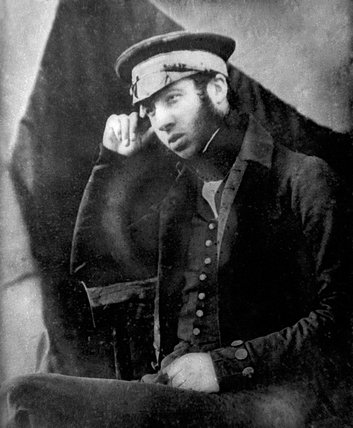
Harry Goodsir was twenty-five, an Edinburgh anatomist with a passion for tide-pool creatures nobody else wanted to touch, when he signed on as assistant surgeon and naturalist aboard HMS Erebus. On May 19, 1845, he and 128 other officers and men left England on two Royal Navy ships, Erebus and Terror, to finish charting the last unmapped stretch of the Northwest Passage. Steam engines, iron-plated hulls, and three years of newly-canned food made the expedition look unsinkable on paper.
It wintered first at Beechey Island, and before the ships moved on, three men were already dead and buried in graves cut into the permafrost: John Torrington, John Hartnell, and William Braine, the first losses of an expedition that hadn’t yet reached the ice that would trap it. By September 1846, both ships were beset off King William Island. They never sailed under their own power again.
Franklin died aboard Erebus on June 11, 1847, for reasons no surviving document explains. By April 1848, twenty-four men were dead (nine officers, fifteen sailors), and the 105 who remained made the decision that has haunted the record since: they abandoned both ships and set out on foot for a river mouth roughly 400 kilometers south, hauling lifeboats loaded with silver cutlery, books, and a writing desk. Captains Francis Crozier and James Fitzjames left one message behind, in a stone cairn, confirming the deaths, the retreat, the date.
Not one of the 105 is known to have survived. London searched blind for six years, until Hudson’s Bay Company surveyor John Rae came home in 1854 with Inuit testimony describing a starving column of white men, and relics that could only have come off the ships. Rae also relayed something Victorian Britain refused to hear: that toward the end, some of the men had eaten their dead. He was pilloried for it in the press. It would take another 143 years for anyone to check.
The Roadblock
The problem was never a lack of effort. Dozens of search parties combed the Arctic for Franklin within a decade of his disappearance, more have gone since, and the wrecks themselves turned up in 2014 and 2016 almost exactly where Inuit oral testimony had placed them for over 150 years. Finding the ships answered where. It didn’t answer why the retreat killed everyone.
The retreat is the difficulty. The 105 men who left the ships in 1848 scattered their dead across roughly 400 kilometers of King William Island’s coast and tundra on their way toward the Back River, and the Arctic doesn’t preserve a crime scene the way a tomb does — permafrost, scavengers, and 178 years have reduced most of that route to bone fragments, not bodies. Only a few dozen sets of remains have ever been recovered, out of 105 men, so every forensic study since has had to generalize from a small, unevenly distributed sample. And the two best-preserved data sets, the three Beechey Island graves and the DNA-testable King William Island bones, come from different points in the disaster, two years and roughly 650 kilometers apart, which is exactly why one clean cause keeps refusing to emerge.
Best Guesses
Lead poisoning from tinned rations
Owen Beattie’s 1980s exhumation of the three Beechey Island bodies found lead levels dramatically higher than expected in bone, hair, and tissue — solder sealing the era’s tin cans could run up to 90 percent lead, and three years of canned rations was a new exposure for any sailor. Beattie and John Geiger’s book Frozen in Time turned the finding into the standard popular explanation. A 2018 confocal X-ray fluorescence study complicates it badly: it found lead exposure in the men’s bones that predates the voyage and doesn’t track with how long anyone spent in the Arctic — ordinary Victorian-era exposure, not a poisoning that began in 1845.
Scurvy, starvation, and cold together
This is the least dramatic answer, and the one most bioarchaeologists working the case now favor: no poison, no single disease, just three Arctic winters compounding on each other. Rations calculated for a shorter voyage ran low; vitamin C dropped out of a canned diet that had none built in; men already weakened by cold and labor became easy targets for whatever came next. Skeletal evidence of scurvy has turned up in remains along the retreat route, and the arithmetic of three winters stranded, hauling loaded boats toward a river 400 kilometers away, barely needs a specific verdict to explain why nobody survived. Its weakness mirrors its strength: “everything, gradually” is honest, but it doesn’t explain the three men who died the first winter, before the real crisis had even started.
Botulism from the tinned food supply
The contractor who supplied the expedition’s cans, Stephan Goldner, worked under a rushed deadline, and inspectors later found some tins undersized and poorly sealed. The theory’s problem is that it has no body behind it: Clostridium botulinum needs an oxygen-free environment a leaking can may not reliably provide, and there’s no way to test 178-year-old remains for a toxin that leaves no trace in bone. Every other theory here rests on tissue evidence; this one rests on a contractor’s paperwork. What it explains that slow malnutrition can’t is timing: John Torrington, the first man to die, was dead within months, while everyone else was still eating well by any ration count.
Zinc deficiency and infectious disease
Before the ships were ever trapped, three men were already dead at Beechey Island, their autopsies showing lung damage consistent with pneumonia and tuberculosis in all three. The gap here is scope: it accounts for 3 of 129 deaths, and the evidence needed to test it in the other 102 men mostly doesn’t exist. But a 2016 study of one of them, John Hartnell, read his preserved fingernails growth-ring by growth-ring and found a severe zinc deficiency that set in before any significant lead had built up — collapsing immunity, not poisoning. If that’s right, the earliest deaths and the later ones weren’t the same disaster: something was already going wrong within months of departure, for reasons separate from whatever killed the retreat party two years later.
The Verdict
The Arctic mostly refuses to give up what would move this from argument to answer: more of the 105 retreat dead, identified and tested by modern methods, not just the three Beechey Island graves or the handful of King William Island bones science has already worked through. Isotope and lead studies keep sharpening the picture of a small, non-random sample — they can’t yet produce a picture of the whole. The 2024 identification of Captain James Fitzjames by DNA, from a jawbone that also carried cut marks, showed the method exists. A May 2026 study named four more men the same way: three from Erebus Bay, one from Terror, found 130 kilometers off, with no cut marks on any of them. Six men now have names; the ice still holds the other ninety-nine. Every study published since 2018 has made the old lead story less certain. None has replaced it with a single answer. The next bone found on King William Island might belong to someone’s grandfather. It might also, finally, be someone whose cause of death nobody can argue with.
Where do you stand?
That’s one. There’s another every morning at 6 a.m. local time.
Share where you stand
What Didn't Hold Up
Details that circulate with this case but failed verification against independent sources. Cut from the story above — listed so you know they weren't missed.
“Lead poisoning from the tinned rations drove Franklin's crew to violence or madness in their final days.”
Popularized by the lead-poisoning story and The Terror. The crew's record shows two years of ordinary exploring and camp-building, inconsistent with lead neurotoxicity, and a 2018 study found their lead exposure predated the voyage. Confirmed: background 19th-century lead levels, not a poisoning that caused madness.
“Both ships were crushed by pack ice and sank suddenly, ending the expedition in one catastrophic event.”
Parks Canada's 2014-2016 dives found both wrecks largely intact — Terror in what the lead archaeologist called pristine condition, 60 miles from where historians assumed the ice crushed it. Confirmed: the ships went down largely undamaged and stayed upright on the seabed, not destroyed in one dramatic crushing.
“Botulism from the expedition's canned food supply is the proven cause of the crew's deaths.”
Traces to Scott Cookman's book Ice Blink, criticized for errors and invented details. The evidence is one Clostridium spore in a sailor's intestine, not the toxin itself, and no outbreak hit other ships the same contractor supplied. Confirmed: one contested, evidence-thin theory among several, not a settled cause.
“Some Franklin expedition survivors lived on for years after 1848, sighted alive among the Inuit as late as 1851.”
Traces to David Woodman's 1990s reconstructions of Inuit testimony, arguing some of the 105 men re-crewed a ship and survived years longer. Woodman could not trace the original informants for these accounts and calls it speculative. Confirmed: no member of the retreat party is documented to have survived past 1848.
The Rabbit Hole
- Parks Canada: Finding HMS Erebusongoing dispatches from the wreck site itself, straight from the archaeologists diving it.
- The Victory Point Note, in fullthe last written words from the expedition, transcribed in full with the discovery context.
- CNN: Cannibalized remains from Franklin's lost Arctic expedition identifiedthe fullest account of the 2024 Fitzjames DNA identification and its cut-marked jawbone.
- canadianmysteries.ca: the Cannibalism? investigationa university-hosted walkthrough of Rae's report, the backlash, and the forensic case that eventually backed him up.