
№ 003925 SEPTEMBER 2026ARTIFACTMALVERN & WOLVERHAMPTON, ENGLAND
The Dorabella Cipher
The Cipher Too Short to Ever Be Proven Right
Unsolved since 1897In July 1897, composer Edward Elgar folded 87 hand-drawn symbols into a note to a 23-year-old friend and never explained one of them. A cash-prize competition and a 2023 cipher-cracking algorithm have both failed, and even a correct answer could never be checked against anything, because nothing else survives.
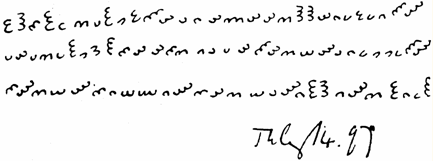
What We Know
Dora Penny was twenty-three when the letter arrived, tucked inside a note her friend’s wife had written to Penny’s own mother. It was July 1897. Edward and Alice Elgar had just spent five days as houseguests of the Penny family in Wolverhampton: kite-flying at Boscobel, Elgar sketching Caractacus at the piano, teasing Penny with invented “historical facts” on their walks. That spring he’d already carved himself a wax letter-seal just to have one. Elgar was forty, a provincial composer nobody outside Worcestershire had much noticed yet.
The enclosure wasn’t a letter. It was three lines of small, looping symbols, 87 of them, built from roughly two dozen distinct shapes, each a cluster of one to three semicircles turned to face one of eight directions. On the back, in Elgar’s hand: “Miss Penny.” Beneath the last line, a date: July 14, ’97.
Penny had no idea what to do with it. She put it in a drawer and left it there.
She kept it for forty years. Elgar went on to the fame almost no English composer of his generation matched, and dedicated one of his Enigma Variations to her, under a nickname, Dorabella, he hadn’t even coined yet on the day he sent her the cipher. He never explained the symbols, not in any letter that followed. If Penny ever asked him outright, no record of it survives.
In 1937, three years after Elgar’s death, she finally published it, reproduced whole as an appendix to her own memoir of their friendship, with a line that has been quoted ever since: she had never had the slightest idea what message it conveyed, every attempt she knew of had failed, and she would genuinely like to hear from any reader who succeeded where she hadn’t.
Nobody has, in the eighty-nine years since she asked.
The Roadblock
Eighty-seven characters is not much to work with. Cryptanalysis leans on volume: enough repetition for frequency analysis to sort the E’s from the Z’s, enough length for statistical patterns to rise above noise. In 2023, a study in the peer-reviewed journal Cryptologia ran modern decipherment algorithms directly against the Dorabella text, the same algorithms that solve English or Latin substitution ciphers of comparable length correctly better than 98% of the time. They found nothing. Not “failed to find the message.” Failed to produce a candidate that read as language at all, in either tongue.
Two problems compound each other on top of that. First, nobody has an independently confirmed key: no second document in the same symbol alphabet with a known plaintext to check a guess against. The Elgar Society’s 2007 competition, cash prize attached, drew seven serious entries and rejected all of them for an identical reason: each had matched symbols to letters through defensible logic, and each had then produced a different, equally arbitrary run of English. Second, the original letter itself is gone. Penny’s 1937 book is the only surviving record of exactly what Elgar drew: no ink to test, no stroke order, nothing but a printed facsimile to argue over.
Best Guesses
Every serious reader of this cipher ends up choosing among four bets: real ciphertext waiting on the right key, symbols that aren’t letters at all, a message never built to fully parse as language, or “solved” no longer being reachable since the original letter vanished. Nothing that survives rules out any of the four. A judging panel with a cash prize on the table ran into the same wall.
Substitution cipher, still unbroken
The 2023 algorithmic test is this theory’s biggest problem: methods that reliably crack comparable English or Latin ciphers found nothing resembling language in the Dorabella text at all. Every claimed solution since Sams’s widely-cited 1970 attempt, through the 2007 Elgar Society competition, works from the same premise: ordinary language under the loops, waiting on the right key. Not one has produced a plaintext another researcher can reproduce. What keeps the premise alive is Elgar himself: a year before he wrote to Penny, he’d already solved a magazine’s own “unsolvable” cipher and kept a card record of the method, proof he had the skill and the habit to build one like this.
A melody encoded as symbols
Elgar thought in music before prose; he was sketching Caractacus the very week he stayed with the Pennys. Researcher Javier Atance argues the cipher’s eight rotations and loop counts read less like letter substitution and more like a coded staff: a direction for a note on the scale, a loop count for whether it’s sharp, flat, or natural. It would explain a composer inventing his own private notation. What it hasn’t done, in any published version, is produce a melody a musician can recognize, and it doesn’t explain why a man who wrote music openly, constantly, in these same letters, would suddenly need to hide a tune instead of writing it down.
A private joke, not a message
Nothing in the surrounding letters suggests Elgar took Penny seriously as a cryptography partner: that same year he invented fake “historical facts” to tease her on their walks, and carved a wax seal purely for the joke of having one. The theory has to explain the effort, though: this same alphabet turns up reused elsewhere in Elgar’s papers, built with more care than a private joke usually earns. Its strongest support comes from a pattern nobody was looking for: researcher Keith Massey found matching loop-counts sit next to each other far less often, and mirror-image pairs far more often, than a genuine substitution cipher would produce by chance, closer to a hand moving playfully through symbols than to encoded prose.
A real solution, unprovable
The original letter has been gone since at least 1937; Penny’s book, not the manuscript, is the only surviving record of what Elgar drew. Even a correct decryption has nothing but a printed facsimile to check against; no document anyone living has held. Cipher historian Nick Pelling argues a genuine solution has to clear two bars: a defensible symbol-to-letter mapping, and a believable reason Elgar sent exactly this message to exactly this person. Dozens of attempts since 1970 have cleared the first bar. Almost none has cleared the second, and no second document exists to break a tie between two internally consistent but different English answers.
The Verdict
Elgar’s birthplace museum holds his other cipher material, the cards from the solved Pall Mall puzzle among them, and nothing catalogued there pairs with this one. A second document would be the fix: another letter in the same alphabet, paired to a meaning nobody has to guess at, working as a real key instead of one more decryption dressed up as certainty. Failing that, the lost manuscript resurfacing would resolve the smaller question: ink, stroke order, whether the printed facsimile even got it exact. Professionals with a cash incentive already tried the third option, a cleverer reading of those same 87 characters, and came up empty.
Dora Penny put the same invitation in print in 1937, open to any reader who could do what she couldn’t. Eighty-nine years on, it’s still open.
Where do you stand?
That’s one. There’s another every morning at 6 a.m. local time.
Share where you stand
What Didn't Hold Up
Details that circulate with this case but failed verification against independent sources. Cut from the story above — listed so you know they weren't missed.
“A recent claimed solution decodes the cipher into plaintext containing the word "DORABELLA" itself.”
Cipher historian Nick Pelling flagged this as anachronistic: Elgar didn't begin calling Dora Penny "Dorabella" until a dated letter of Sept. 1898, over a year after the July 1897 cipher, confirmed directly in Penny's own memoir. The nickname postdates the cipher.
The Rabbit Hole
- The Dorabella Cipher (Cipher Mysteries)the field's most complete running tally of every claimed solution and why each one was rejected
- Edward Elgar: Memories of a Variation (1937), full textDora Penny's own memoir, cipher appendix included; read her actual words about the letter she never solved
- The Artist of the Unbreakable Code (Nautilus)the fullest account of the 2007 Elgar Society competition and why its judges walked away empty-handed
- Dorabella unMASCed (Wase, Cryptologia, 2023/2025)the peer-reviewed paper behind the algorithmic test that couldn't crack it either