
№ 000926 AUGUST 2026IDENTITYPACIFIC NORTHWEST, USA
D.B. Cooper's Identity
The Tie D.B. Cooper Left Behind
Unsolved since 1971On Thanksgiving eve 1971, a man in a dark suit and a clip-on tie parachuted out of a hijacked jet with $200,000 and vanished into a Pacific Northwest storm. The FBI closed its biggest case in 2016. It's still testing his tie.
What We Know
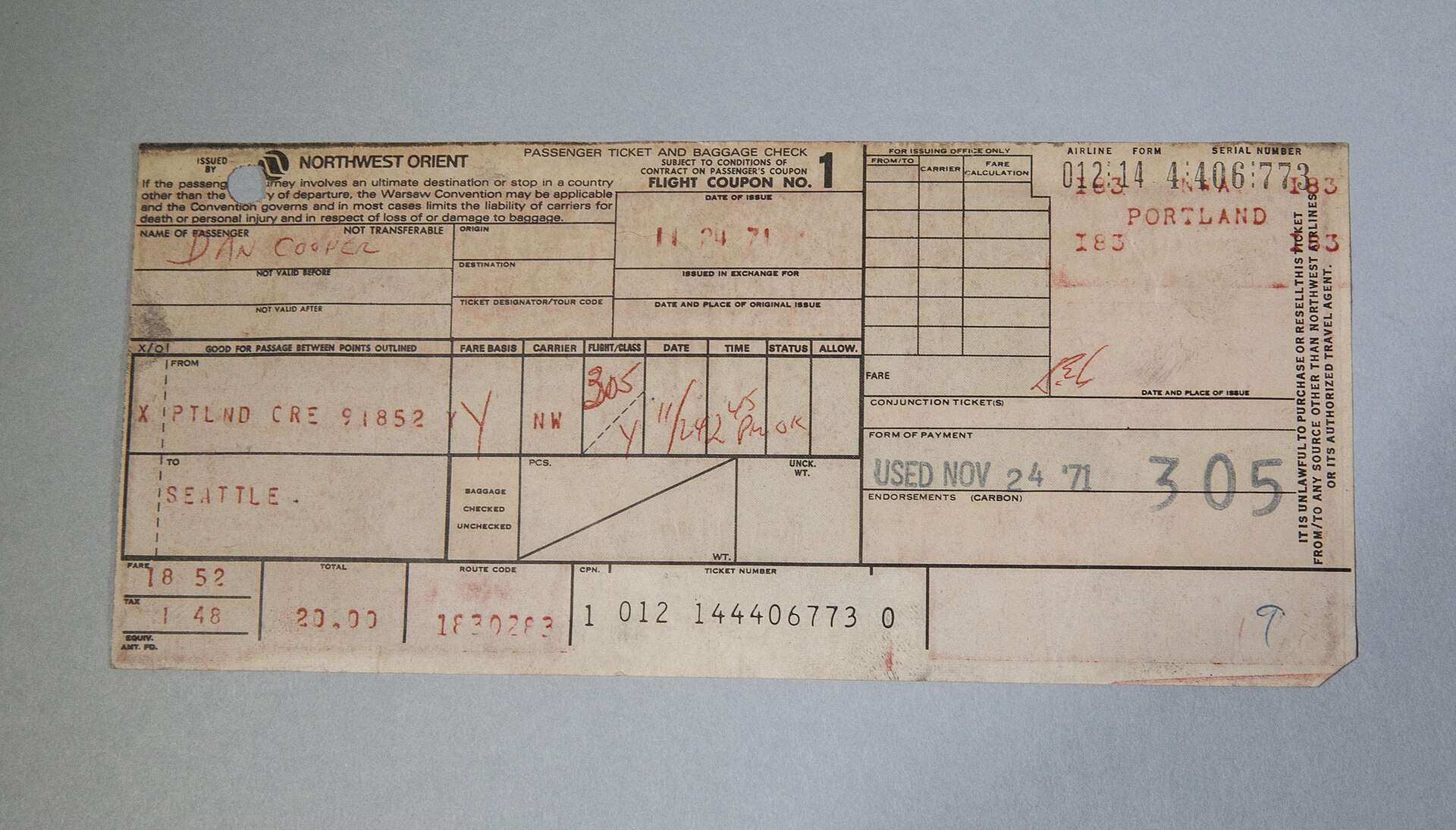
On November 24, 1971, the day before Thanksgiving, Tina Mucklow was icing glasses in the galley of Northwest Orient Flight 305 when the passenger in seat 18-C handed her colleague a note. Mucklow was twenty-two, the newest and lowest-ranked flight attendant on the crew. The note read, in part: Miss I have a bomb here and I would like you to sit by me.
The man wore a dark suit, a thin black clip-on tie, and horn-rimmed sunglasses. He’d paid cash in Portland for a one-way ticket under the name Dan Cooper. He opened the briefcase to show wires, a battery, and red cylinders. For the next several hours, while the plane circled Seattle and the other passengers were released in exchange for $200,000 in twenty-dollar bills and four parachutes, Mucklow was the one person he trusted to relay orders to the cockpit. She prayed. She stayed beside him. When the jet took off again for Mexico with only Cooper, Mucklow, and the pilots aboard, he had her show him how to lower the aft stairs, a maneuver airport officials hadn’t realized was possible until he asked for it.
Around eight that evening, at 10,000 feet over southwest Washington, in a rainstorm, wearing a suit and dress shoes, Cooper walked down those stairs with two of the four parachutes and the ransom bag, and jumped. Mucklow never saw him again. No one has.
The FBI recovered a leftover parachute, its shroud lines cut, and the tie Cooper left behind on his seat. In February 1980, an eight-year-old named Brian Ingram found three rotting packets of the ransom money, $5,800 of it, half-buried on a Columbia River sandbar; the serial numbers matched the bag handed over in Seattle. It remains the only trace of the money, or of Cooper, that anyone has ever recovered.
The FBI ran down more than a thousand suspects over the next forty-five years. In July 2016 it redirected the case’s resources elsewhere, saying the trail had gone as far as it could, while noting it would still act on any evidence tied specifically to the parachutes or the cash. In 2022, a family in North Carolina found a parachute in an outbuilding.
The Roadblock
Cooper’s case survives on scarcity, not abundance. He touched a tie, a briefcase, a drink glass — ordinary things nobody in 1971 thought to preserve for a genetic test that didn’t exist yet. What’s left of his DNA is decades-old and mixed with everyone else who has handled the tie since; the FBI has told the one family currently being tested that the sample yields roughly seven of the twenty-three genetic markers a confirmed match requires. That’s not a near-miss. It’s a coin that keeps landing on its edge.
The geography doesn’t help. Cooper jumped at night, in a storm, with no way to fix exactly where a moving jet was when he went out the door, and came down somewhere in Cascade foothills built to swallow a search party — steep drainages and dense timber, no ground truth to work backward to. Fifty-five years of river dredges and amateur metal-detecting have turned up exactly one confirmed trace of the ransom: $5,800, at Tena Bar. It’s cash, not a man.
Every named suspect is dead now. On paper that should simplify things — no reputations left to protect, nobody left to plead the Fifth. In practice it closes the one door investigators actually need: no one left who can be caught in a lie.
Best Guesses
Richard McCoy’s second jump
Five months after Cooper vanished, Richard Floyd McCoy II hijacked a United Airlines 727 over Provo, Utah, the same way: bomb threat, parachute demand, a jump from the aft stairs, this time for $500,000. He was a two-tour Green Beret and combat helicopter pilot who’d taken up skydiving with the Utah National Guard. Fingerprints caught him in 72 hours; he escaped prison in 1974 and died in a shootout three months later, still denying he was Cooper. His children found a modified parachute and jump logbook on the family’s North Carolina property in 2022. The FBI tested it for two years and returned it in December 2025 without a result. McCoy was twenty-seven, younger than most witness estimates of Cooper’s age.
The purser who knew the plane
Kenneth Christiansen worked for the same airline, a Northwest Orient purser who’d trained as an Army paratrooper. His brother Lyle spent years insisting Kenny was Cooper: unexplained cash, a house bought outright, a habit of secrecy. Retired lead FBI agent Ralph Himmelsbach called the tip worth chasing. Then he read Christiansen’s discharge papers. Five foot eight, 150 pounds, hazel eyes. “He’s too short, not heavy enough, and has got the wrong color eyes,” Himmelsbach told journalist Geoffrey Gray. Christiansen died of cancer in 1994, never questioned as a suspect while alive to answer for it.
The deathbed confession
Three days before he died in 1995, Duane Weber told his wife Jo, “I am Dan Cooper.” She’d never heard of the case. She found a library book on the hijacking and recognized her husband’s handwriting in its margins. Weber had a record of aliases and small cons, and had once described throwing money into a river near where the Tena Bar cash later surfaced. The FBI’s 1998 fingerprint check was inconclusive; a 2007 DNA comparison against Cooper’s tie excluded him, though the tie’s DNA is a mixture and its reliability has been challenged. It’s the same shape as every other deathbed tip the Bureau has chased down, and none of the others has held up either.
The coded letters
Six letters, apparently from Cooper, reached newspapers within four months of the hijacking; the FBI never determined whether the hijacker wrote any of them. In 2016, a documentary team led by Thomas Colbert said it had cracked a cipher inside two of the letters, naming Robert Rackstraw, a Vietnam veteran and convicted forger, as the confession’s author. The FBI had already cleared Rackstraw in the 1970s. After the claim aired on the History Channel, it declined to reopen the case — and wouldn’t confirm he’d ever been a suspect at all. Rackstraw denied everything until his 2019 death, leaving the case against him a decoded message inside letters nobody has proven Cooper wrote.
The Verdict
The test running right now is the plainest path to an answer this case has ever had: seven of twenty-three DNA markers, against a family that kept a parachute hidden in an outbuilding for decades rather than throw it away. A full match settles this outright. An exclusion settles it just as cleanly. Short of DNA, the case has only ever moved on paper: a discharge record, a jump logbook, a decoded letter, a widow’s marginalia. Not one of the four men above can be interviewed again, confronted with new evidence, or asked a follow-up question. Whatever this case gets next will have to survive on cloth fiber and whatever’s still readable in a fifty-five-year-old bloodstain.
The tie is still in an evidence file in Washington. It has outlasted every man who was ever accused of wearing it.
Where do you stand?
That’s one. There’s another every morning at 6 a.m. local time.
Share where you stand
The Rabbit Hole
- National Archives at Seattle: the U.S. Attorney's Case Filethe original 1971 case file, photographs and reconstruction experiments included
- Rolling Stone: the flight attendant who sat beside himTina Mucklow's own account, in her own words, fifty years on
- New York Magazine: Unmasking D.B. CooperGeoffrey Gray's 2007 investigation, the one with real access to the FBI's files
- Cowboy State Daily: the parachute comes backthe most current reporting on the McCoy family's DNA test, as of this writing
- HistoryLink.org: the day the money surfacedthe fullest account anywhere of the 1980 Tena Bar find