
№ 007329 OCTOBER 2026PLACEHOMESTEAD, FLORIDA
Coral Castle
The Nine-Ton Gate No One Saw Him Move
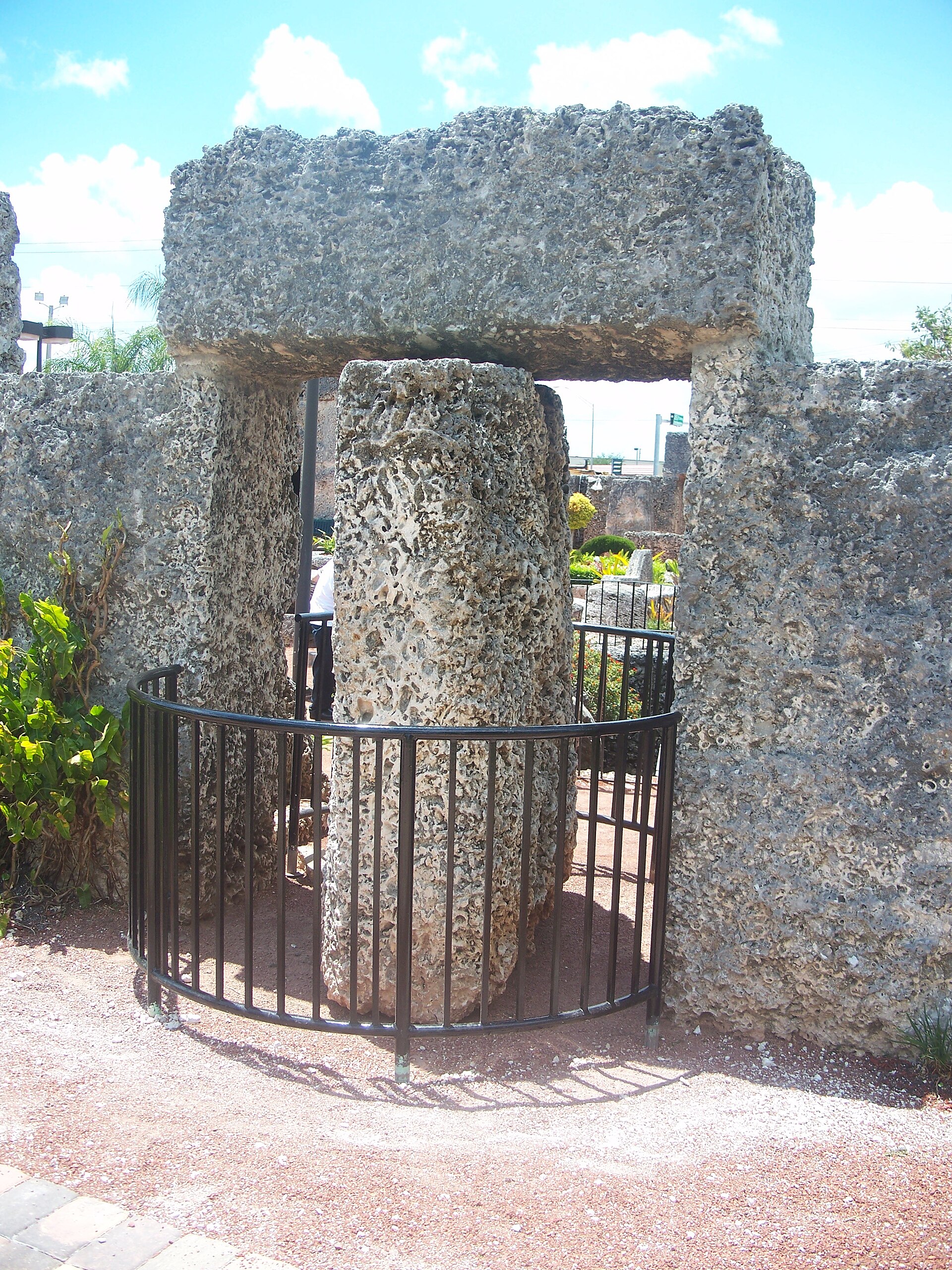
Unsolved since 1951In 1986, a nine-ton stone gate outside Miami jammed for the first time in fifty years. Inside was nothing supernatural — a truck bearing on a rusted shaft. No one has ever explained how a 100-pound Latvian immigrant, working alone at night, got it balanced there in the first place.
What We Know
Edward Leedskalnin arrived in Florida City in the early 1920s built like a jockey: five feet tall, about a hundred pounds, carrying what he said was a tuberculosis diagnosis and, by his own account, a broken engagement back in Latvia. He was twenty-six. His fiancée, ten years younger, had called off the wedding shortly before it was to happen. He never married, never explained further, and in 1923 spent twelve dollars on an acre of scrubland to begin building something enormous, by himself.
For the next twenty-eight years he quarried the coral limestone under his own feet, cut it into slabs weighing a few tons apiece, and set them into walls, furniture, and monuments: a nine-ton gate, a twenty-five-foot telescope aimed at Polaris, a working sundial, a fountain carved into the phases of the moon. He worked mostly at night. When neighbors asked how a hundred-pound man was moving stone that size, Leedskalnin gave the same answer for decades: he understood “the laws of weight and leverage,” and he had rediscovered “the secrets of the people who built the pyramids.” He never elaborated, and he never let anyone watch him lift a block.
In 1936, hearing that a housing subdivision was coming to his stretch of Florida City, he bought ten acres north of Homestead and spent nearly two years moving everything he’d already built, hiring a young local man’s flatbed truck but sending the driver away every time there was loading to do. At the new site, alone again, he built a larger perimeter wall, a bigger workshop, and the nine-ton gate that would outlast him. On December 4, 1951, he left a note on his door: Going to the hospital. He died three days later, sixty-four years old, leaving no will, no plans, and no notebook describing how any of it was done.
The Roadblock
The tools were never the mystery. A sign Leedskalnin posted himself, still displayed at the site, credits his results to “simple tools such as metal fall (block and tackle), rollers, jacks, wedges, slings, cables, sledges, chisels.” All of it is present, all consistent with what a determined stonemason could plausibly use. A 1955 campaign gathered more than 250 notarized affidavits from Homestead residents who said they’d known him personally and watched him work with ordinary hand tools, alone, over years.
What’s missing is the step in between. No photograph, film, or witness account anywhere in that record shows Leedskalnin actually lifting and setting one specific multi-ton block; only the tools beforehand and the finished stone after are documented. Modern demonstrations prove the physics is achievable: a retired Michigan construction worker has “walked” one-ton concrete blocks alone using nothing but a lever and a pivot stone, at roughly three hundred feet an hour. That shows a determined person can do this, not which method Leedskalnin used at this specific site. Nobody has ever matched a proposed technique against the tool-mark patterns, the worn contact points on his surviving lift structures, or the exact geometry of how the nine-ton gate’s mass distributes around its buried axle. The 1986 repair, which found only a truck bearing on a steel shaft, confirmed the result was ordinary engineering. It never explained how that shaft got positioned, at the block’s precise balance point, by one man with nobody watching.
Best Guesses
Levers, tripods, and time
Leedskalnin said, for the rest of his life, that leverage explained everything: understanding “the laws of weight and leverage,” patience, and the tools now on display at the site — block and tackle, tripods, jacks, rollers. What’s still missing is the reconstruction itself: no one has shown the actual sequence that moves an eight-foot slab from quarry pit to wall using only this kit. But oolitic limestone is heavily porous, far lighter per cubic foot than it looks, which narrows the space between “possible” and “superhuman” — and when the gate’s own mechanism finally came apart in 1986, the supposedly mysterious thing inside it was nothing but a truck bearing on a steel shaft.
A one-man trick, now lost
Somewhere between “generic leverage” and “impossible” sits a real, specific technique: Leedskalnin’s own, refined through years of solitary trial and error, distinct enough that no one has fully reconstructed it because he never let anyone close enough to see the decisive step. A claim this specific should be checkable, and it isn’t — nothing separates “a real lost method” from ordinary leverage without the demonstration that doesn’t exist. But modern demonstrations at least support the shape of it: the same Michigan builder who walked a twenty-ton barn alone does it with a method invisible until you’ve watched it work, and Leedskalnin’s secrecy was extreme even for a private man happy to sell tickets to see the results — the behavior of someone protecting an actual trick, not just a general principle.
Leedskalnin’s magnetic-current method
Leedskalnin’s own 1945 pamphlets, Magnetic Current and Mineral, Vegetable and Animal Life, lay out a personal physics: electric current as two counter-rotating “magnets,” reversible polarity, a device he called a Perpetual Motion Holder that could store a charge indefinitely. He told visitors he’d rediscovered the pyramid builders’ secret. Readers of those pamphlets today, mostly on sites republishing his own writing, connect that belief directly to the stonework, treating manipulated magnetism as the real lifting mechanism. Leedskalnin himself is not on record saying magnetism moved a single block; that particular leap is his readers’, not his. No engineer has ever measured a magnetic anomaly at the site, and his pamphlets, whatever their sincerity, describe nothing that lifts stone.
No lift was ever recorded
The most defensible position may be the least satisfying: nothing in the record actually documents him lifting one specific multi-ton block, not the tools on display, not Leedskalnin’s own vague description, not the 250-plus affidavits collected in 1955. People saw him working with hand tools over the years; nobody describes watching the decisive moment. That gap doesn’t mean anything paranormal happened inside it. It means the one piece of evidence that would settle which technique he used was never written down, photographed, or witnessed by anyone willing to say so. An absence isn’t a competing mechanism, but it is the honest ceiling above every mechanism proposed against it.
The Verdict
The nine-ton gate is still standing in Homestead, and nobody has ever tested a proposed lift technique against what’s actually there: the tool-mark patterns, the worn contact points on Leedskalnin’s surviving lift structures, the precise geometry of how the gate’s mass distributes around its buried axle. That kind of forensic match, physical evidence instead of argument by analogy, has settled disputed methods at other single-mystery sites; here, it has simply never been run. Short of new documentary evidence surfacing from a private collection — a photograph, a notebook page, a witness statement nobody has yet come forward with — that match is the fastest real progress available.
The gate still hangs on that shaft, fit within a quarter-inch of the wall on either side. Nobody alive knows exactly how it got there.
Where do you stand?
That’s one. There’s another every morning at 6 a.m. local time.
Share where you stand
What Didn't Hold Up
Details that circulate with this case but failed verification against independent sources. Cut from the story above — listed so you know they weren't missed.
“Leedskalnin worked in total secrecy and no one ever actually saw him working at Coral Castle.”
Overstated. More than 250 notarized affidavits collected from Homestead residents in 1955 describe watching him work with ordinary hand tools over the years. What's undocumented is narrower: no one describes watching him lift or set one specific multi-ton block.
“His fiancée left him waiting at the altar on their wedding day.”
The earliest documentary record (the 1984 National Register nomination) says only that the engagement was called off shortly before the ceremony was to take place, not that a ceremony was already underway when she left.
“Leedskalnin moved the stones using psychic power, by singing to them, or with help from extraterrestrials.”
No source attributes any of these to Leedskalnin himself or documents supporting evidence; they circulate as stock "wild theories" in retellings of the case. He consistently credited leverage and tools, matching the sign he posted and the affidavits describing his methods.
The Rabbit Hole
- National Register of Historic Places Nomination Form: Coral Castle (Rock Gate)the 1984 federal paperwork, complete with a hand-drawn site map and the tool placard transcribed in full
- Leedskalnin's collected writings, including Magnetic Current (1945)his physics pamphlets in his own words — the primary text behind the magnetism theory
- The Vintage News: a Michigan man's one-man StonehengeWally Wallington walking multi-ton concrete blocks alone with a lever and a pivot stone
- Peter Hancock, 'The Making of a Modern Myth' (Skeptic, 2013)an academic's account of how a hardworking eccentric turned into a folk legend