
№ 005511 OCTOBER 2026SIGNALORIGINATED ON 4CHAN; PUZZLE STEPS AND PHYSICAL CLUES PLACED WORLDWIDE
Cicada 3301
The Puzzle That Never Named Its Maker
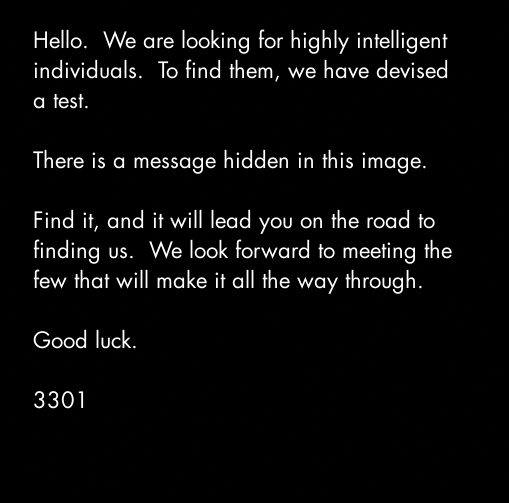
Unsolved since 2012On January 4, 2012, a plain image appeared on 4chan reading "We are looking for highly intelligent individuals" — with a longer message steganographically hidden inside it. Thousands spent two years chasing where that led. The trail ended in a private forum. Nobody has ever learned who was waiting there.
What We Know
Joel Eriksson found the first crack within hours. On January 4, 2012, an image appeared on 4chan’s paranormal board, /x/: white text on a black background, addressed to no one. “Hello. We are looking for highly intelligent individuals,” it read. “There is a message hidden in this image. Find it, and it will lead you on the road to finding us.” Eriksson, working alone while thousands of others teamed up in forums, ran the file through steganography-detection software and got a hit: a string of appended text signed “TIBERIVS CLAVDIVS CAESAR.” A shift-four Caesar cipher, keyed to Claudius being Rome’s fourth emperor, turned that into a link. The link led to another hidden image. That image led to a Reddit post written in a cipher keyed to Mayan numerals, which unlocked a passage from a medieval Welsh romance, which hid a book code, which produced a phone number. The voicemail on the other end read out three prime numbers. Their product opened onto the next stage.
That was the opening chase of what became, over the next two years, three annual puzzle rounds, each opening in January and escalating: deeper steganography, an invented cryptographic alphabet, and, several times, physical paper signs bearing QR codes, left in cities on four continents for someone to photograph and report back. Thousands organized in real time to work through it together. A small number reached the actual end. One of them, an American teenager named Marcus Wanner, solved that first round in 2012 and was invited into a private, password-locked forum, where people claiming to represent the puzzle set him and a handful of other winners to work on real software: an early tool meant to protect whistleblowers.
Whoever ran that forum never gave a name. The 2014 round ended with its central cipher unbroken. No new round has opened since. Nobody who ever reached the end has said, on the record, who was waiting there.
The Roadblock
Identifying an anonymous online actor usually gets easier with time: leaked emails, disgruntled insiders, forensic tools maturing. None of that has happened here. The puzzle’s organizers left almost nothing to trace. No payment processor, no domain registered to a real name, no server anyone has announced seizing. Every step ran on infrastructure that was already free and public: an imageboard, an image host, Reddit, a voicemail line, later Twitter. There’s no product to trace a customer list from and no ransom to trace a wallet from, the two threads that usually lead investigators to a name behind an anonymous operation. The handful of people who did make contact with someone claiming to run it met that person only inside a members-only forum, in a way that left even the winners unable to say who was actually on the other end. The operation policed its own authenticity, too: its communications were cryptographically signed, so anyone faking a new puzzle to draw out real information could be dismissed outright as a fraud. A project built by people who understood tradecraft, running on infrastructure with nothing to subpoena, leaves investigators with plenty of admiration and nothing to follow.
Best Guesses
Four explanations have stayed genuinely live since 2012, meaning each still has defenders who read the actual puzzle chain, not just people repeating a rumor. None has produced an org chart, a leaked memo, or a face attached to a name. What follows is the honest state of the evidence for each, not a ranking.
A spy agency’s hiring test
The puzzle rewards exactly what a signals-intelligence agency would want to test for: cryptography, steganography, obscure-language literacy, and the patience to sit with a problem for weeks. When a reporter asked directly, the CIA’s own head of recruitment denied it on the record: “It’s definitely not us.” No agency has claimed the puzzle in over a decade, which a real recruiting program would eventually want credit for. Yet it echoes a real, documented recruiting tactic: Britain’s GCHQ ran its own public code-breaking recruiting campaign around the same period, and University of Surrey security professor Alan Woodward suspected NSA or GCHQ involvement early on.
A privacy collective’s tryout
The puzzle’s own words, delivered to the solvers who finished round one, described the group behind it as something “much like a think tank,” dedicated to “liberty, privacy, security.” That tracks with what happened to at least one winner: Marcus Wanner says he was drawn into building software meant to protect whistleblowers, not folded into any agency’s org chart. The hole in this theory is that it rests almost entirely on the puzzle’s own self-description, precisely what a project chasing good publicity would say about itself, whether or not it were true.
One puzzle-maker’s private project
What strains this theory is scale. Physical clue signs appeared on multiple continents within days of each other, and whoever ran the private forum kept several winners occupied on a shared project for months afterward — more sustained coordination than most solo efforts manage without leaving a trace. Still, nothing about the puzzle chain required money changing hands: an imageboard, a free image host, a Reddit account, a voicemail line. Eriksson, who solved most of round one alone, saw firsthand how much of the challenge was coordination rather than raw cryptography — the kind of difficulty a small, skilled group could plausibly engineer without an institution behind it.
An abandoned marketing stunt
Alternate-reality-game marketing is a real, well-documented genre; studios and game publishers have built puzzle chains like this one before, purely to sell something. If Cicada 3301 was one, going quiet after 2014 would fit an abandoned or underfunded campaign more naturally than it fits a functioning intelligence operation. But no product, game, or brand was ever unveiled at the end of any of the three rounds, and nobody who reached the final stage has ever reported being pitched anything — which is the one beat a marketing campaign cannot skip.
The Verdict
There’s an odd asymmetry here: solving Cicada 3301’s ciphers turned out to be possible. Thousands of amateurs did it, for free, competing against nothing but the puzzle itself. Identifying Cicada 3301 has produced nothing in more than a decade. That gap is the real story. What would settle the code problem is more code-breaking: the Liber Primus, the last round’s central cipher, is still unbroken and might fall to the right method someday. What would settle who built it is a leak. A subpoenaed hosting account, a server log, someone who actually sat in that private forum willing to put a name to it on the record instead of behind a handle. Marcus Wanner did that: he gave his real name and his story to a national magazine. No new round has opened in a January since 2014. Nobody who ever claimed to speak for Cicada 3301 has followed him.
Where do you stand?
That’s one. There’s another every morning at 6 a.m. local time.
Share where you stand
The Rabbit Hole
- Cicada 3301 — the full solve, step by stepJoel Eriksson's own technical walkthrough of round one, command output included.
- Cicada: Solving the Web's Deepest MysteryRolling Stone's full account of what happened to a 2012 winner after he solved it.
- Uncovering Cicada WikiA solver community's sprawling, unofficial archive of every puzzle, image, and cipher — vast and worth getting lost in.
- DEF CON 31: Cracking Cicada 3301A decade-later talk from active solvers on what's still unbroken, and why they keep at it.