
№ 00772 NOVEMBER 2026SIGNALPARKES OBSERVATORY, NEW SOUTH WALES, AUSTRALIA
The BLC1 Signal
The Signal With No Transmitter for a Thousand Kilometers
Unsolved since 2019In April 2019, a radio telescope in Australia caught a narrow drifting tone from the direction of Proxima Centauri — present only when the dish pointed there, gone the moment it looked away. Two years of forensic work concluded it almost certainly wasn't aliens. Nobody ever found what it was.
What We Know
Shane Smith spent the summer of 2020 doing something extremely boring: scrolling through a year-old pile of radio telescope data, one automated detection at a time. He was an undergraduate at a small Michigan college with no observatory of its own, interning with Breakthrough Listen, the SETI project Yuri Milner bankrolls. The pile in front of him held roughly four million individual “hits” (candidate blips an algorithm had already flagged as maybe-interesting), recorded the previous April by the Parkes radio telescope in New South Wales while it sat pointed at Proxima Centauri, the nearest star to the sun.
He stopped scrolling at one, that October.
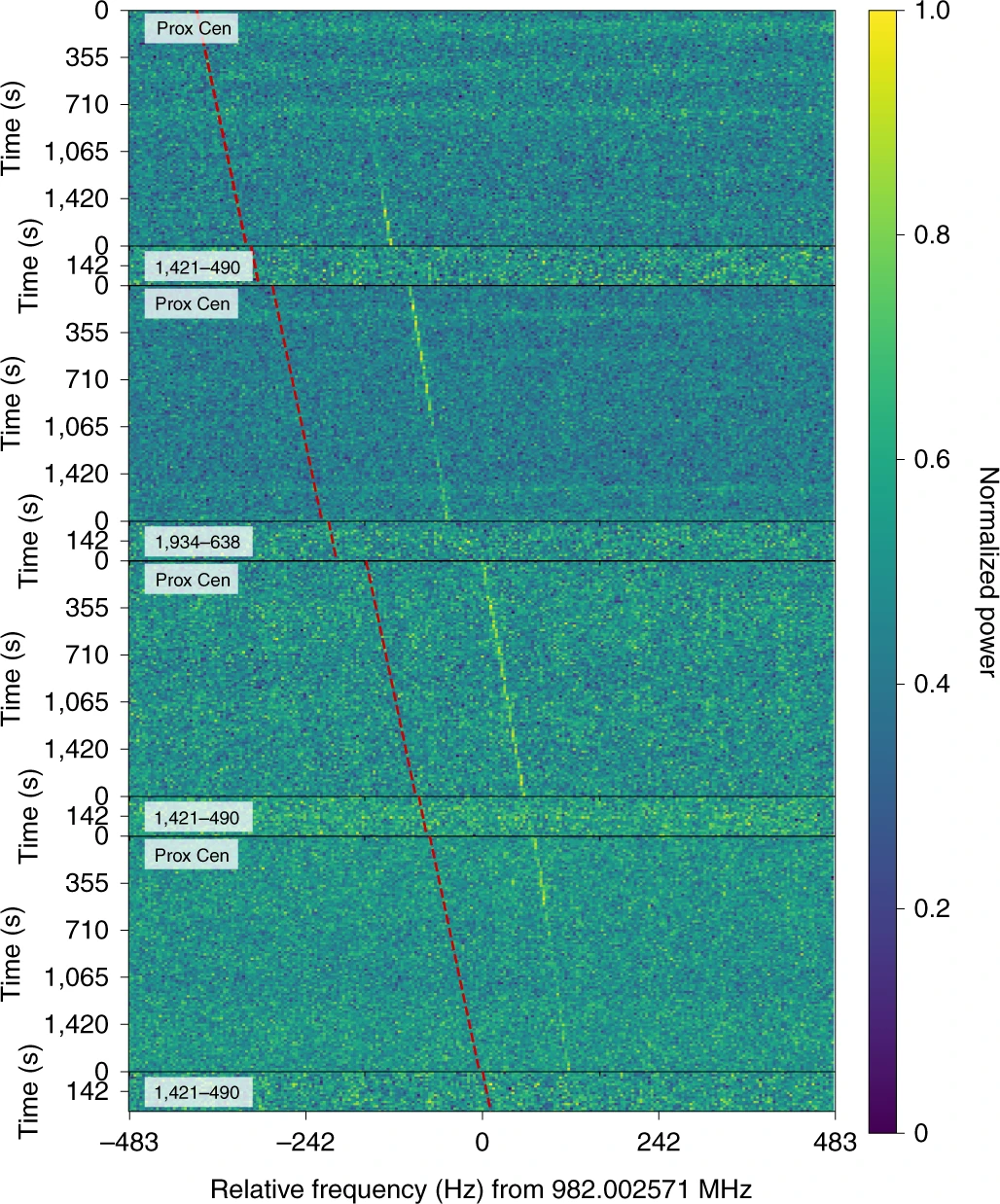
The signal sat at 982.002571 megahertz, narrower than anything a natural object in space is known to produce, and it drifted: its frequency crept over time in a pattern consistent with the Doppler shift of a transmitter’s motion on a rotating planet. Proxima Centauri had gained a planet of its own in 2016: Proxima b, roughly Earth’s mass, sitting inside the star’s habitable zone. The signal appeared only in the minutes the telescope spent pointed directly at that system. When the dish swung to a comparison patch of sky, on a rotation built specifically to catch this kind of illusion, the signal vanished. When it swung back, the signal returned.
It was the first candidate in Breakthrough Listen’s history to pass every filter the project runs before a human even looks at the data. Sofia Sheikh, the astronomer who inherited the case, later called it on par with the Wow! signal, the only other detection radio SETI has ever taken this seriously. Smith’s find got a name: BLC1, Breakthrough Listen Candidate 1. The project sat on it and kept testing.
The public found out anyway. In December 2020, more than a year and a half after the telescope recorded it, The Guardian broke the story before any paper existed to explain it.
The Roadblock
982 megahertz isn’t empty spectrum. Both American and Australian regulators reserve the band around it for aeronautical radionavigation, the low-power ground beacons that help aircraft measure their distance from a runway. Parkes’ own site should have been swimming in exactly that kind of local noise, which is what made the on-again, off-again test so persuasive in the first place: something that clean should have been trivial to explain as a nearby gadget.
It wasn’t. Investigators checked every transmitter registered to broadcast at BLC1’s exact frequency within a thousand kilometers of the dish. None existed.
Sofia Sheikh spent close to two years chasing it anyway, because a missing registration isn’t the same as a missing transmitter. Reviewing the wider dataset, her team found roughly sixty other signals sharing BLC1’s narrow, drifting shape, scattered elsewhere across the band. A whole population of lookalikes, several traceable to harmonics of the roughly 2-megahertz clock oscillators built into an enormous range of ordinary electronics. That population is what makes a non-human origin implausible. But BLC1 itself showed up nowhere in that population’s pattern: weaker than its strongest members, absent from the comparison scans where the confirmed lookalikes kept reappearing, matching none of their harmonic sequences. The mechanism looked right. The specific culprit never turned up.
Best Guesses
By late 2021, after two years of testing, the team published a verdict: BLC1 almost certainly wasn’t a message. The reasoning holds up. What’s worth arguing about, if you read the actual papers instead of the headlines, is how much that verdict really nailed down. Three honest readings of the same evidence, none of them holding out for aliens, disagree about how solved “solved” really is.
A stray harmonic like the other sixty
The simplest reading: BLC1 is exactly what dozens of other signals in the same dataset turned out to be — one local device’s electronics beating against another’s, producing a spurious tone that drifts and briefly resembles a beacon. Sheikh’s team found roughly sixty of these lookalikes, several tracing cleanly to harmonics of common clock oscillators, though BLC1 itself never lined up with their pattern the way a true member of the family should have. On this reading it’s still unremarkable — one more entry in a catalog of interference any sufficiently sensitive telescope eventually has to learn to recognize.
A single emitter nobody has found
The team’s own published language is narrower than the popular version: an “intermodulation product of local, time-varying interferers,” not a name-checked match to the sixty lookalikes. Two years of forensic work, a search of every registered transmitter for a thousand kilometers, and nobody has ever named the device, seen it, or caught it doing this twice. And still, on this reading, that’s exactly what happened: some specific emitter near Parkes, genuinely local and genuinely mundane, produced BLC1 once and was never caught at it again.
A verdict reached with no retrial
BLC1 never came back. Roughly thirty-nine hours of dedicated follow-up, across three separate campaigns between November 2020 and May 2021, found nothing at its frequency or anywhere within a megahertz of it. On this reading, the RFI conclusion is correct, but was reached the only way it could be: by elimination and statistical resemblance to other interference, not by ever re-detecting, isolating, or reproducing the thing itself. Danny Price, one of the paper’s own co-authors, said as much on the record — the team didn’t know exactly where BLC1 came from, only that it probably wasn’t Proxima Centauri.
The Verdict
Reobserving Proxima Centauri won’t settle this. Breakthrough Listen already tried, for the better part of forty hours, and BLC1 didn’t show up to its own retrial. What would actually close the case is duller and harder: a sweep of every transmitter, licensed or not, operating anywhere near Parkes at 982 megahertz, run until one of them is caught mid-drift producing something that looks like the 2019 recording. Nobody has done that yet. It’s the kind of thankless fieldwork that rarely gets funded once a paper has already declared a mystery closed enough.
Sofia Sheikh never claimed more than the data supported, and the data supported a great deal — just not a name. That two-year search, and its roughly sixty catalogued lookalikes, leaves one signal that still doesn’t officially belong to anyone. Proxima Centauri didn’t send it. The transmitter that did still has no name.
Where do you stand?
That’s one. There’s another every morning at 6 a.m. local time.
Share where you stand
What Didn't Hold Up
Details that circulate with this case but failed verification against independent sources. Cut from the story above — listed so you know they weren't missed.
“BLC1 was detected across five separate days of observation, not just once.”
The verified signal was detected in one ~2.5-hour window on 29 April 2019, per the detection paper. A follow-up paper separately notes fainter interference on four other days of that campaign, but calls it 'not provably identical' to blc1 itself. The five-day version treats that hedge as a confirmed detection.
The Rabbit Hole
- Breakthrough Listen's BLC1 hubboth full papers, the underlying data, and a flowchart of every test the signal had to pass before a human ever saw it
- The verification paper itself, free to readthe full technical case for intermodulation interference, lookalike signals and all
- A co-author's own plain-language accountDanny Price walks through the reasoning, and admits what it doesn't settle
- The SETI community's real-time reactionPaul Gilster's writeup, plus reader questions the papers still don't fully answer