
№ 005612 OCTOBER 2026IDENTITYHAGLEY WOOD, WORCESTERSHIRE, ENGLAND
Bella in the Wych Elm
Seven Words, Repainted for Eighty Years, Signed by No One
Unsolved since 1943In April 1943, four boys poaching in a Worcestershire wood found a woman's skull inside a hollow tree, then the rest of her skeleton stuffed in beside it — one hand missing. No missing-persons report matched her. Within a year, someone began chalking her name onto walls, and still does.
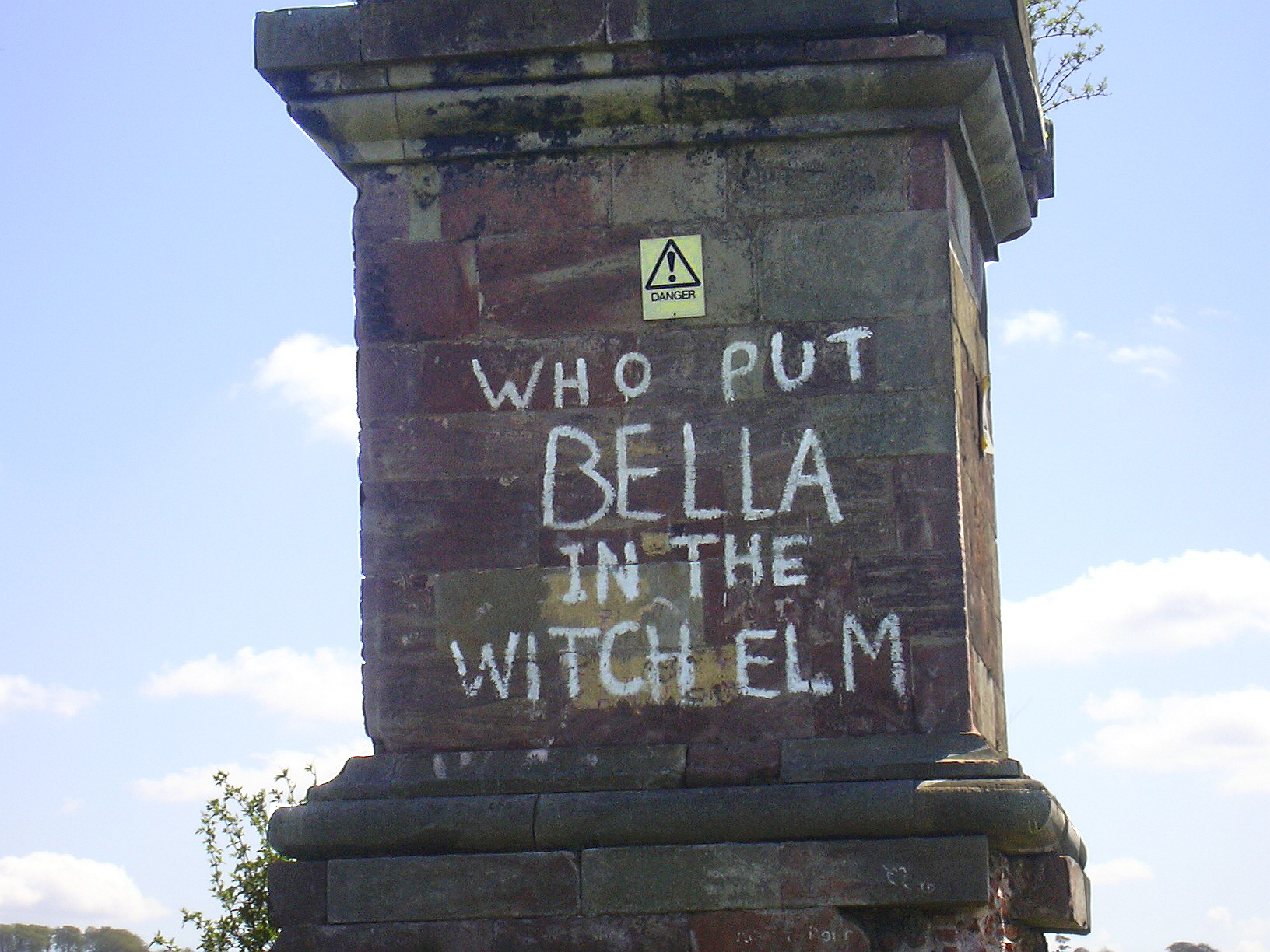
What We Know
Bob Farmer was fifteen, out poaching rabbits with three friends in Hagley Wood on the afternoon of April 18th, 1943, because meat was rationed and rabbits weren’t. He climbed a wych elm chasing what looked like a bird’s nest wedged in the hollow trunk, looked down into the dark, and found a human skull looking back, hair and teeth still on it. He put it back. All four boys swore to say nothing; admitting they’d been in Lord Cobham’s wood at all meant admitting they’d been poaching. Tom Willetts told his father anyway, and his father told the police.
What the police found, once they opened the trunk properly, was most of a woman, pushed down inside it: dressed in a mustard skirt and a striped cardigan, a gold ring still on one finger, one of her hands missing and later found scattered nearby. The Home Office pathologist, Professor James Webster, determined that she’d been dead at least eighteen months, since before October 1941, that she was around thirty-five, about five feet tall, and that a scrap of taffeta lodged in her throat suggested she’d suffocated. The width of the trunk’s opening told him something more specific: her body had to have gone in before rigor mortis set in, meaning she’d died at or very near that tree, within hours of being put inside it. “It was an excellent place for the concealment of a murder and I think it indicates local knowledge,” he told the inquest.
Police circulated her description and dental records to every force in the country. Nothing matched. No missing-persons report anywhere in wartime Britain fit her. The inquest returned the only verdict it could: murder by a person or persons unknown. She had no name at all until, sometime before that Christmas, someone chalked one onto a wall in Old Hill, a few miles from the wood: Who put Luebella down the wych elm.
Eighty-three years later, nobody has ever improved on it.
The Roadblock
Wartime Britain was, for exactly this kind of case, close to the worst possible moment to go missing. Blitz-displaced families, evacuees, deserters, and foreign workers moving through the Midlands’ factory towns meant the ordinary machinery for reporting an adult woman missing (a landlord noticing, a family filing a report) was running at its weakest in living memory. Webster’s own read on the case, that her killer had local knowledge of the wood, only sharpens the problem: someone local enough to know that tree, killing a woman anonymous enough that nobody came looking for her at all.
By the time forensic science caught up, with DNA identification and isotope analysis of teeth and bone that can now place a stranger’s origin within a region, it no longer mattered. Bella’s remains were kept for years inside Birmingham City Police’s own training collection, and at some point between the 1960s and the arrival of DNA testing, they were lost. West Midlands Police confirmed in 2018 they hold no record of where. A 2023 BBC appeal asked museums across the country to check their own stores for anything that might be her. Nothing surfaced. The case isn’t waiting on better technology anymore. It’s waiting on a body that may no longer exist to test.
Best Guesses
Four explanations survive contact with the record, each asking you to believe something the others don’t. One turns her into a wartime intelligence casualty. One makes her an ordinary crime victim. One turns the men who hid her into bystanders, not killers. One reads the missing hand as a message, not an accident. People who’ve spent decades on this case land in all four places.
A Nazi courier, silenced
Birmingham in 1941 sat ringed by the aircraft and munitions plants the Luftwaffe most wanted hit, and wartime rumor carried stories of a spy ring feeding target intelligence out of the city. Both named candidates for the courier have failed under scrutiny: Clara Bauerle was remembered by a fellow German agent, himself over five foot ten, as taller than he was — against Bella’s five feet. Clarabella Dronkers, named as a spy’s wife, wasn’t: his real wife was 48, died in Amsterdam, and never set foot in England. What survives the debunking is the letter itself, sent anonymously to a journalist in 1953, claiming she’d entered England illegally in 1941, and adding that “the only person who could give the answer is now beyond the jurisdiction of the earthly courts.”
Killed by a client on Hagley Road
In 1944, a Birmingham sex worker told police that a colleague on the same beat had vanished about three years earlier, inside Webster’s window for time of death. This theory needs no spy ring and no ritual, only an ordinary danger from work she may have done, and a woman nobody with standing to report her. Its weakness: nobody ever verified it. No surname survives, no separate sighting, nothing tying the report to Bella beyond a name that may itself trace to the same rumor.
A drunken cover-up, not a murder
A decade after the discovery, Una Mossop said her ex-husband Jack had confessed before he died: he and a Dutch drinking companion put an unconscious woman into the hollow trunk, meaning to frighten her sober, not kill her. Mossop had been committed to a mental hospital years earlier with recurring dreams of a woman’s face staring from inside a tree, predating Bella’s discovery — hard to explain as invention after the fact. It doesn’t explain the taffeta in her throat, which points to suffocation. Una waited ten years to say any of it, and told it more than one way.
A ritual killing for a Hand of Glory
Even Byford-Jones, who kept the case alive through the 1950s, dismissed folklorist Margaret Murray’s reading — a ritual killing for an old charm called a Hand of Glory, tied to local witch-elm folklore — as a distraction from the facts, and the hand bones investigators recovered were scattered near the tree, read at the time as scavenging, not ceremony. Murray argued it anyway. What neither rebuttal touches is the one detail nobody disputes: why a hand went missing at all, and why it was the only part of her ever separated from the rest.
The Verdict
Ending this doesn’t take a new theory. It takes one of two things that may no longer exist: a body to test, or a document nobody has found yet. The first is Bella herself: a single surviving bone or tooth would let a modern lab do in an afternoon what 1943 forensics couldn’t, a DNA profile, an isotope reading of where she grew up, maybe even a name pulled from a genealogy database the way cold cases increasingly get solved now. The 2023 museum appeal was exactly this bet, and it came up empty. The second is a document: a wartime missing-persons report filed somewhere and never cross-referenced against a body two counties away, sitting undigitized in a regional archive nobody has had reason to search.
Failing both, there’s a third option nobody has taken up. Whoever has kept that wall repainted since the 1970s knows something about why they, specifically, still care. No one has come forward.
The wall gets repainted anyway.
Where do you stand?
That’s one. There’s another every morning at 6 a.m. local time.
Share where you stand
What Didn't Hold Up
Details that circulate with this case but failed verification against independent sources. Cut from the story above — listed so you know they weren't missed.
“The wych elm's name comes from 'witch,' proof of an old occult association with the tree.”
Traces only to the graffiti's own drift, not to any dictionary. The OED and Etymonline both derive 'wych' from Old English wice/wican, 'to bend' — the tree's flexible branches. Confirmed: the resemblance to 'witch' is coincidental; the graffiti itself only drifted from 'wych' to 'witch' from the late 1990s on.
The Rabbit Hole
- Monthly Mystery: Who put 'Bella' in the wych elm? (Worcestershire Archive & Archaeology Service)the county archive service's own account of the case files, now held at The Hive
- Who put Bella in the wych elm? (Helen Barrell, Roads to the Past)the fullest single narrative account, including the graffiti's slow drift from 'wych' to 'witch'
- Debunked: Bella in the Wych Elm was the wife of spy Johannes Marinus Dronkersa WWII espionage historian dismantles one named spy candidate, archive file by archive file
- A Digital Reconstruction Reveals the Face of 'Bella in the Wych Elm'the 2018 forensic facial reconstruction, built from photographs after the actual skull went missing