
№ 003117 SEPTEMBER 2026ARTIFACTBEDFORD COUNTY, VIRGINIA
The Beale Ciphers
The Only Cipher Ever Broken Never Named the Spot
Unsolved since 1885In 1885, a Virginia pamphlet published two number sequences nobody has ever read and one describing a buried fortune without saying where. The Army's chief cryptanalyst and a modern algorithm have each tried the other two. A RAND researcher found something stranger in one. None has produced a readable word.
What We Know
Robert Morriss ran Lynchburg, Virginia’s Washington Hotel, and by his own account a guest named Thomas Jefferson Beale checked in for the winter of January 1820, left in the spring, and came back for a second winter the following year. In the spring of 1822, Beale left Morriss a locked iron box and two letters explaining what was inside: three sheets of numbers, useless without a key Beale promised would follow. Hold the box ten years, he instructed. If neither he nor an agent came for it by then, open it anyway.
The key never came. One more letter reached Morriss that May, then nothing. Beale and roughly thirty companions, the earlier letters explained, had ridden west on what began as a buffalo hunt around 1817, struck gold and silver north of Santa Fe, and spent two years secretly hauling it back to Virginia in small loads. They buried it twice, once in November 1819 and once in December 1821, in a vault near a crossroads called Buford’s, in Bedford County. The three sealed sheets recorded exactly what was buried, exactly where, and exactly who was owed a share. Beale was never heard from again.
Morriss didn’t open the box until 1845, twenty-three years after he’d promised to wait ten. He got nowhere with the numbers alone, and sometime before his own death handed the entire packet (box, letters, all three ciphers) to a friend named James B. Ward, in 1862. Ward spent the next twenty-odd years on them. He found that one sheet, run against the numbered words of the Declaration of Independence, spelled out real English. It gave an inventory totaling two thousand nine hundred and twenty-one pounds of gold, five thousand one hundred pounds of silver, and jewels worth $13,000 — a fortune worth, by some modern estimates, well over sixty million dollars today. That sheet also said the vault’s exact location was written in a second sheet, and the names of the men owed a share in a third.
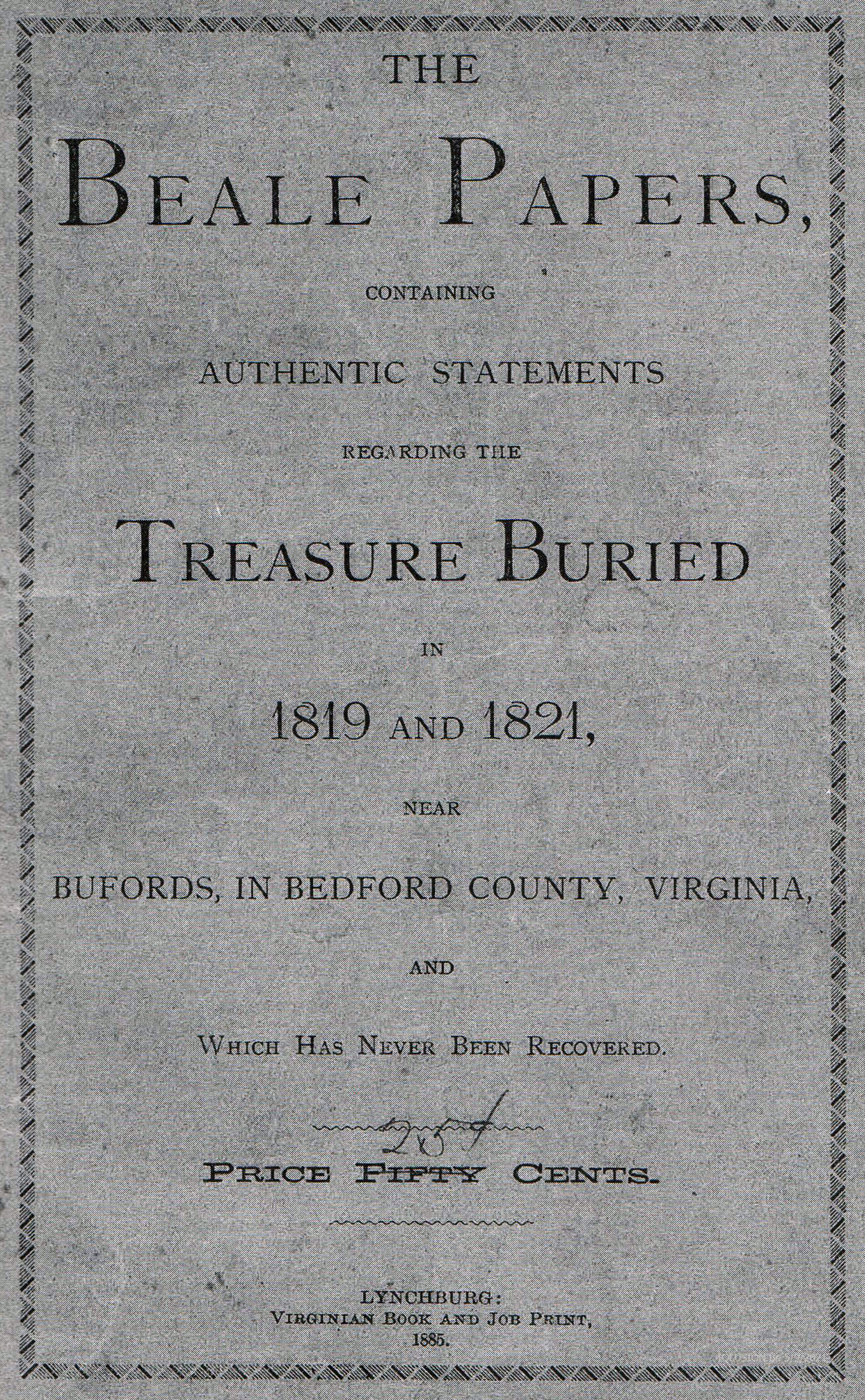
In 1885, Ward published everything he had: the letters, the story, all three number sequences, and his solution to exactly one of them, as a fifty-cent pamphlet. The other two ciphers have sat in print, unread, ever since. No vault has ever been found.
The Roadblock
Cipher No. 2 broke because Ward had, by luck or design, an edition of the Declaration of Independence that matched the cipher’s numbers, a narrower stroke of luck than it looks. Cryptographer Stephen Matyas later catalogued 327 period printings of the Declaration and found only 26 produce workable numbering at all; even Ward’s own reprint inside the pamphlet needed silent fixing (a word split, a few numbers nudged) to make his solution add up. Anyone attacking Cipher No. 1 or No. 3 is searching for the right edition of an unnamed document. There’s no way to know they’ve found it short of English falling out.
The deeper problem is that nothing survives to check an answer against. No manuscript, no autograph, nothing in Beale’s own hand: only Ward’s 1885 typesetting, already caught misprinting at least four words in the one cipher that is solved. William Friedman, the Army’s top cryptanalyst, spent years on the other two in the 1930s and confessed himself “beaten”; he later used the ciphers to teach codebreakers when to walk away from a problem. In 2014, a language-model algorithm built at RWTH Aachen cracked roughly 95 percent of Cipher No. 2’s symbols with no key at all, the first machine to do so. It found nothing usable in Ciphers 1 or 3, and couldn’t say why.
Best Guesses
A real vault, still unopened
The case for a real treasure rests on details Ward’s pamphlet doesn’t control. Historian Peter Viemeister traced several Virginia-born men named Thomas Beale through 1790s census and county records who fit the outline of the story. Fur trader Jacob Fowler, writing his own journal on an 1821–22 expedition through the same stretch of plains, recorded Pawnee and Crow informants describing a party of “about 35” white men passing through, close enough to Beale’s stated thirty to be more than a coincidence. Cryptographer Stephen Matyas spent decades building a case-by-case rebuttal of every hoax argument raised. A methodical, publicly documented search for the right key text is still running today, and hasn’t yet ruled the ciphers out. What it hasn’t produced, after two centuries of looking: a name that’s verifiably Beale’s, a burial record, or a single ounce of gold.
Ward’s fifty-cent fabrication
In 1980, cryptographer James Gillogly ran Cipher No. 1 through the same Declaration-keyed method that broke No. 2 and pulled out a twenty-letter run that’s almost perfectly alphabetical, a pattern with roughly a one-in-a-trillion chance of occurring by accident, and one that reads far more like a hoaxer padding gibberish than broken English. Separately, investigator Joe Nickell found Beale’s 1822 letter using “stampeding,” a word with no printed record before 1883. English professor Jean Pival compared Beale’s and Ward’s sentence structure against three unrelated 19th-century Virginia writers and found Beale and Ward shared the same grammatical quirks the controls didn’t. Solomon Kullback, a colleague of William Friedman’s, reached the same one-author conclusion independently. None of it explains why a hoaxer would build a puzzle that has paid out nothing for 141 years and counting.
No surviving original to check
Even researchers convinced the story is real run into the same obstacle: nothing survives except Ward’s own 1885 typesetting. Its reprint of the Declaration of Independence had to be quietly corrected to make Cipher No. 2’s solution work at all, and the published ciphertext itself carries verified transcription slips inherited from some now-lost original. If Cipher No. 1 or No. 3 were solved tomorrow, there would be no autograph and no second printing to confirm the answer against: only the same pamphlet that already needed fixing once. What’s actually being argued is whether “solved” is even a target this evidence could ever confirm anyone has hit, not what happened in 1820 at all.
The Verdict
The same blind test that cracked Cipher No. 2 in 2014 is the bar everything else has to clear: built and scored before its author ever sees a candidate plaintext, not fitted to one afterward. That test already failed on Ciphers 1 and 3. Run it against enough Declaration editions and enough alternate key documents, and either English falls out or it conclusively doesn’t. The hoax side needs something just as specific: one piece of period paper Ward couldn’t have written (a land deed, a probate filing, a newspaper notice) placing an actual Thomas Jefferson Beale in Bedford County with thirty men and two wagonloads of ore.
Genealogists have found plenty of Thomas Beales. A century and a half of searching hasn’t found this one, and it hasn’t found the vault either.
Where do you stand?
That’s one. There’s another every morning at 6 a.m. local time.
Share where you stand
The Rabbit Hole
- The Beale Papers, full 1885 textthe entire pamphlet, letters and all three ciphertexts included, transcribed straight from the original printing
- Beale Ciphers Research — Tim Marlandan active, public, ongoing key-text search — test your own candidate document against all three ciphers
- NSA declassified file on the Beale Papersthe government's own paper trail, including a 1949 letter from the Army's chief cryptanalyst admitting defeat
- Improved Decipherment of Homophonic Ciphers (Nuhn, Schamper, Ney, 2014)the actual computer-science paper behind the only automatic decipherment a Beale cipher has ever gotten