
№ 003218 SEPTEMBER 2026SIGNALNORTH PACIFIC OCEAN
The 52-Hertz Whale
Fifty-Two Hertz, and No Animal Attached
Unsolved since 1989In 1989 a US Navy array built to listen for Soviet submarines picked up a tone at fifty-two hertz. William Watkins of Woods Hole tracked its source for twelve years across the North Pacific, eleven thousand kilometers in one season alone. Nobody has ever seen the animal.
What We Know
William Watkins joined Woods Hole in 1958 as a research assistant in electronics and spent four decades building the tools that let anyone name a whale by its voice. When the Navy partially declassified its listening arrays in 1992, decades of North Pacific recordings came within reach of biologists, and Watkins went through them. He retired in 1996 and was immediately made the institution’s first Oceanographer Emeritus so he could keep working.
One voice in the data belonged to nothing.
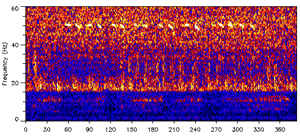
It was first noticed in 1989. The long-distance calls those arrays were built for — the twenty-hertz pulses of blue and fin whales — sit between fifteen and twenty-five hertz, and this one sat at fifty-two. The number alone was not the problem; fin whales make a second, sub-second call that runs just as high. The shape was. This call spread into sidebands about seventeen hertz apart, with silence where the fundamental should have been. Its tones lasted three to ten seconds and sagged by at most two hertz across their length, arriving in groups of two to twenty or more, seconds apart, then a gap of minutes, then another group. They typically started and stopped dead, with no fade at either end.
For three years the source barely moved, calling a few weeks a year from the same patch of water near 46°N, 126°W. In December 1992 it began to travel and Watkins’s team began to follow. Ordinarily you can hold an individual whale on acoustics for a few hours; they held this one for twelve consecutive seasons. It arrived each year between August and December, called on roughly half the days, covered between 708 and 11,062 kilometers, and all twelve times fell silent in January or the first days of February. Across fifteen years its dominant frequency crept downward, from near fifty-two toward fifty.
Nobody ever saw it. No photograph exists, and no tissue sample — only a column of positions, accurate to within ten kilometers, of an animal known entirely by the noise it made.
The paper reached the journal on March 2, 2004. Watkins died on September 24, of multiple myeloma, at seventy-eight. It went online eighteen days later, carrying the sentence that is still the last honest word on the subject: We do not know the species of this whale, whether it was a hybrid or an anomalous whale that we have been tracking.
The Roadblock
You cannot read a species off a call. Bioacoustics matches a new recording against known repertoires, a superb method right up until the recording matches nothing, at which point it has nowhere left to go. Nearly every claim about this animal has been made from the same twelve tracks and the same spectrograms, by people who have never laid eyes on it.
The evidence is also closed, in a specific, awkward sense. The arrays were Navy hardware, and the paper says plainly that their characteristics and processing techniques remain classified. The tracks were computed at a naval facility on Whidbey Island, on systems no outsider could inspect. Twelve years of positions exist as a published table; the data underneath cannot be reopened.
And the paper’s most-quoted finding is narrower than it sounds. A unique source does not mean one animal was shown to exist. It means that across fifteen years of monitoring the whole basin, only one series of these calls was recorded at a time, with no overlap, from which a single caller was the reasonable inference. Watkins wrote suggesting, and meant it.
Best Guesses
Blue-fin whale hybrid
Blue and fin whales interbreed. A 2026 review counts forty-six reported candidates, seventeen confirmed genetically: fifteen North Atlantic, one Mediterranean, one northeast Pacific. An animal built from both would carry a sound-producing apparatus belonging to neither, the tidiest explanation going and the first alternative Watkins named. Its weakness is that nobody knows what a hybrid sounds like: there is no baseline to hold this call against, so the theory predicts nothing anyone can check. The best-known one alive, a male tracked off northern Iceland since 2012, is usually seen inside a group of blue whales.
Malformed vocal anatomy
Malformation names no structure and no mechanism — nobody has proposed which part is deformed, and nobody can, without the animal. That makes it less a theory than a placeholder. It is also Woods Hole’s own first guess, and it fits: a blue or fin whale whose sound-producing structures were built wrong would sing in no species’ register while remaining, otherwise, an ordinary member of its own. The record neither rules it out nor supports it. The calls come in disciplined groups, begin and end cleanly, and held the same architecture for fifteen years.
One blue whale’s outlier song
What strains this reading is the absence of company: fifteen years of basin-wide listening, blue whales on the same equipment, nothing in between. But song does move. A 2009 study found the blue whale song off California had fallen thirty-one percent below its 1960s pitch, and nobody has settled why; Watkins wondered whether this call’s own two-hertz slide across fifteen years was an animal maturing. Christopher Clark, who ran Cornell’s bioacoustics program, has said it sings with a lot of the same features as a typical blue whale song. Nothing wrong with it. Just odd.
More than one caller
Non-overlap describes what the hydrophones heard, not a census of the Pacific. In 2010, sensors off the California coast picked up 52-hertz calls on widely separated instruments, close inshore rather than in the deep water SOSUS was laid for. John Hildebrand of Scripps, whose sensors they were, said it meant multiple animals could be singing. If he is right, the premise of the whole mystery changes shape. Nothing in the sixteen years since has confirmed it or turned it up again.
Sound alone can’t name a species
The question may not be answerable from this evidence, and may never have been. A recording carries no morphology and no genetics; all it can do is get matched against a library, and this one matches nothing in it. The only long-baseline dataset belongs to a classified Navy system. The follow-up Watkins promised in print — these calls set against the sounds of other whales — never appeared. Twenty-two years later, nothing has been published that adds to it.
The Verdict
What settles this is tissue. The seventeen confirmed hybrids were each identified from a sample, never from a recording, and sound cannot do that work. So the specification is almost entirely logistical: put a vessel in the right stretch of the North Pacific in the right month, get close enough for a biopsy dart, and a laboratory closes the question in days.
Watkins spent his final decade assembling a digital catalog of more than twenty thousand calls from over seventy species, and this one was never assigned to any of them. But the catalog is not what has kept this open. The animal calls from August into February, moves forty-seven kilometers on an average day, and in twelve tracked seasons never settled anywhere, crossing its own old ground only in passing, on a different route each year. The one instrument that could reliably find it was a classified array whose tracking program published its last report in 2004. Somebody has to be out there when it sings.
Where do you stand?
That’s one. There’s another every morning at 6 a.m. local time.
Share where you stand
What Didn't Hold Up
Details that circulate with this case but failed verification against independent sources. Cut from the story above — listed so you know they weren't missed.
“No other whale can hear it. The 52-hertz call sits at a pitch the rest of the ocean is deaf to, which is why nothing has ever answered.”
Christopher Clark, who ran Cornell's bioacoustics program, has said plainly that blue, fin and humpback whales can all hear this animal and are not deaf. Watkins's paper never tested whether other whales respond to the calls, so the unanswered silence is an assumption laid over the record, not a finding in it.
“The whale sings at fifty-two hertz — the number is its voice, the single note it holds, and the reason it has the name it has.”
Both of Watkins's reports record no energy at all at the call's fundamental frequency. Fifty-two hertz is where the dominant energy and its sidebands sit, not a note being sounded. The centre had also drifted to roughly fifty hertz by 2004, so the name is a snapshot of one moment.
The Rabbit Hole
- NOAA PMEL Acoustics: the 52 Hz soundNOAA hosts the recording itself, sped up ten times so a human ear can hear it
- Watkins et al., 'Twelve years of tracking 52-Hz whale calls from a unique source in the North Pacific'the whole case, including the table of all twelve seasonal tracks with start and end coordinates
- Oceanus: 'A Lone Voice Crying in the Watery Wilderness'Woods Hole's own account of the tracking program, published months after Watkins died
- Wiggins & Hildebrand: fin whale 40-Hz calling behaviortwo ordinary fin whales tracked by voice in the Gulf of Alaska, one of them calling at 51 hertz
- Marine and Freshwater Research Institute: blue and fin whale hybridswhat is actually known about hybrids, from the institute that has studied the most of them